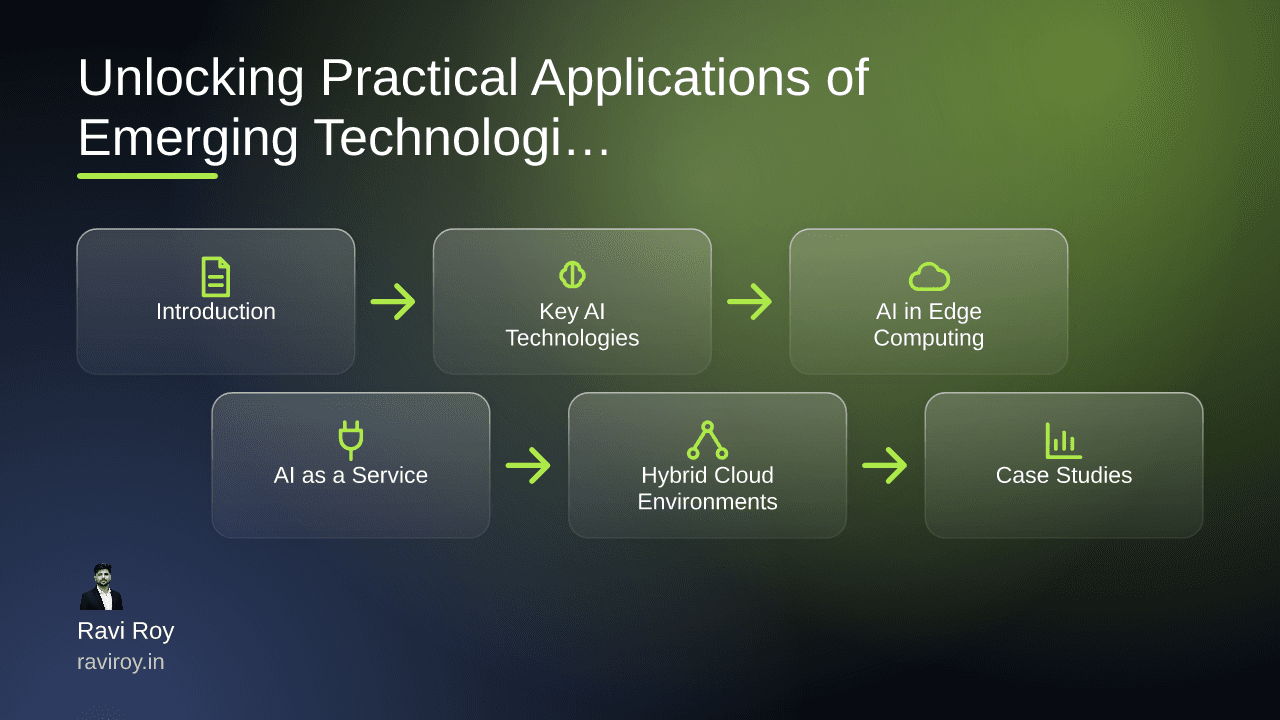
Unlocking Practical Applications of Emerging Technologies in Cloud Infrastructure
The future of cloud infrastructure is being reshaped by novel technologies that promise enhanced efficiency, security, and innovation. As businesses frantically pursue a competitive edge, understanding the practical applications of these emerging technologies, particularly in AI, is vital for success.
Introduction to Emerging Technologies in Cloud Infrastructure
Emerging technologies refer to those innovations that are in the early stages of development and hold transformative potential across industries. In cloud infrastructure, these tools not only streamline operations but also enable businesses to scale efficiently. One of the most groundbreaking trends is the integration of AI-driven applications into cloud environments, fundamentally altering how organizations manage workflows and data.
Current trends showcase increasing reliance on AI, with applications ranging from automation to intelligent data processing. These advancements are designed to maximize performance while minimizing costs.
Key Emerging AI Technologies Transforming Cloud Infrastructure
AI-driven Cloud Automation
AI-driven cloud automation tools revolutionize how organizations deploy and manage resources. They allow for automatic scaling, eliminating manual configurations that are prone to errors. Solutions like Terraform and AWS CloudFormation enable seamless infrastructure as code (IaC) deployment.
For instance, consider a company utilizing AWS Lambda, which automatically scales based on incoming requests, optimizing resource usage and reducing congestion during peak times. The result? Enhanced performance and substantial cost savings.
Real-time Threat Detection with AI
The integration of AI enhances real-time threat detection, enabling businesses to identify and respond to security vulnerabilities immediately. Machine learning algorithms analyze traffic patterns, distinguishing between normal and suspicious behaviors.
For example, companies employing AI-driven security solutions, like Darktrace, have reported significant improvements in their ability to detect intrusions before they occur. The system learns from network behavior, allowing for proactive rather than reactive defenses.
Cost Optimization Using AI in Cloud
Another critical application of AI in cloud infrastructure lies in cost optimization. By leveraging machine learning algorithms, organizations can analyze usage patterns and predict future demand, leading to better resource allocation.
Take, for instance, a retail business that integrates AI into its cloud strategy. By analyzing seasonal traffic data, they can optimize performance and reduce costs, avoiding overspending on unnecessary resources. Adjustments made in real time lead to significant savings, enhancing overall profitability.
AI in Edge Computing for Low-Latency Applications
Understanding Edge Computing
Edge computing, the practice of processing data close to its source instead of relying solely on centralized servers, plays a critical role in modern cloud environments. By reducing latency, it’s ideal for applications that demand immediate data processing, such as IoT devices and real-time analytics.
This proximity to data sources offers significant advantages, especially in industries like healthcare, where timely data can be life-saving.
AI Implementation at the Edge
Successful AI implementations at the edge include smart manufacturing setups where sensors and AI algorithms collaborate to monitor equipment performance in real time.
For example, a manufacturing firm utilizing AI at the edge can predict machine failures before they disrupt production, ensuring uptime and efficiency. Such implementations underscore the increasing necessity for rapid data processing in cloud infrastructure.
The Role of AI as a Service (AIaaS)
Adoption of AIaaS
AI as a Service (AIaaS) is rapidly growing, enabling businesses to access AI capabilities without heavy upfront investments. This service model democratizes AI technology, allowing organizations of all sizes to leverage advanced analytics and machine learning.
Platforms like Google Cloud AI and Amazon SageMaker offer scalable solutions, enabling companies to deploy AI tools while focusing on their core business functions.
Benefits of AIaaS in Cloud Strategy
Integrating AIaaS into cloud strategy brings numerous advantages, from cost efficiency to scalability. Organizations can quickly adopt new technologies, allowing them to innovate without the associated labor and overhead costs of maintaining on-premise infrastructure.
For instance, a startup using AIaaS can enhance customer experiences through personalized recommendations, without investing heavily in AI talent or infrastructure. This flexibility ensures that businesses can pivot quickly in response to market demands.
Hybrid and Multi-cloud Environments Enhanced by AI
Understanding Hybrid Cloud Architectures
Hybrid cloud infrastructures combine public and private clouds, offering flexibility, enhanced security, and cost savings. Organizations can ensure compliance and data control while benefiting from the scalability of public cloud services.
The hybrid model is especially valuable for enterprises dealing with sensitive data, striking a balance between compliance and efficiency.
AI’s Impact on Multi-cloud Optimization
AI enhances operations in multi-cloud setups through intelligent resource management and data handling. Various AI tools can assist in forecasting resource needs, load balancing, and managing costs.
For example, a global enterprise running applications across multiple clouds can optimize performance by deploying AI algorithms that analyze real-time data about usage trends, automatically adjusting resources to match demand.
Real-world Case Studies: AI-driven Solutions in Cloud Infrastructure
Cost Savings Across Industries
In various sectors, organizations have realized significant cost savings through AI implementation in cloud infrastructure. For instance, a financial services firm utilizing predictive analytics achieved a 30% reduction in operational costs by forecasting customer behavior and streamlining resource allocation.
Such real-world applications demonstrate the tangible benefits that AI can bring to cloud environments.
AI's Role in Cybersecurity
Cybersecurity is a paramount concern for organizations, and AI plays a crucial role in fortifying defenses. Implementing AI-powered security solutions can drastically reduce the time it takes to identify and mitigate threats.
A retail organization, for example, integrated AI tools into their cybersecurity protocols, resulting in a 40% reduction in security breaches over the span of a year. This highlights how AI improves not just detection but also response times, empowering businesses to protect sensitive customer data.
Future Outlook: Emerging Technologies in Cloud Infrastructure
Innovations on the Horizon
The future of AI technologies within cloud infrastructure appears promising, with ongoing innovations likely to further enhance efficiency and security. Advancements in natural language processing and computer vision will likely streamline processes, enabling more intelligent and intuitive cloud solutions.
Preparing for Upcoming Trends
To stay ahead of emerging trends, businesses must adopt a forward-thinking approach, investing in training, and being open to adopting new technologies. Continuous learning becomes vital, fostering a culture that embraces change and innovation within cloud strategies.
Conclusion
The integration of emerging technologies—particularly AI—within cloud infrastructure is transforming business operations. Organizations that invest in these technologies are not just keeping pace with industry trends; they’re setting themselves up for future success.
What are your experiences with implementing AI in cloud infrastructure, and what challenges did you face?
💬 Join the conversation — share your take in the comments and tell us what you’d add.