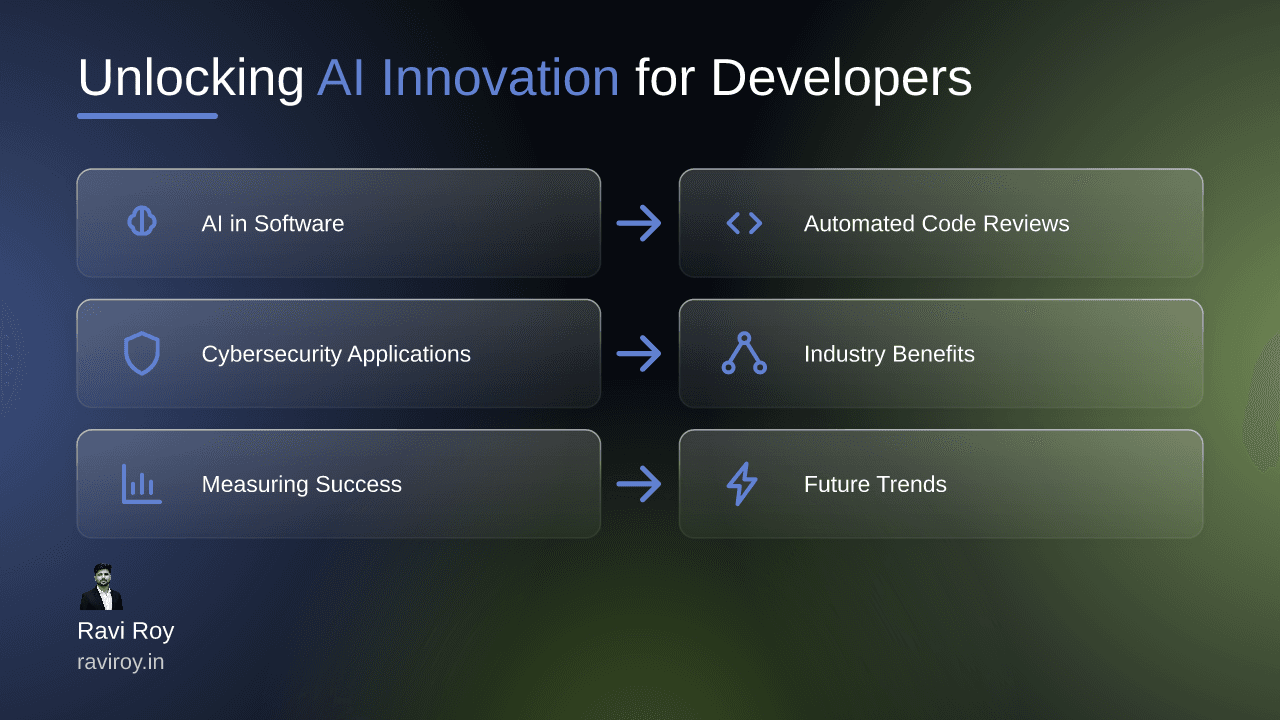
Unlocking AI Innovation: Practical Applications for Developers
The surge of artificial intelligence (AI) in software development isn't just a trend—it's a revolution reshaping how applications are built and experienced. As developers stand on the brink of this transformation, understanding AI innovation is crucial to leveraging its full potential.
Understanding AI Innovation in Software Development
Defining AI Innovation
AI innovation in software development refers to the use of machine learning, natural language processing, and other AI technologies to enhance functionality and improve application outcomes. By automating routine tasks and providing insights from vast data sets, AI empowers developers to focus on creativity and complex problem-solving.
Importance for Developers
The impact of AI on software development is profound. AI enhances both application efficiency and user experience by providing smarter functionalities, predictive analytics, and personalized interactions. For instance, integrating AI can drastically reduce development time by automating code reviews, leading to faster deployments and more robust codebases.
Practical Applications of AI Innovation
Automated Code Reviews
One of the most exciting applications of AI in software development is automated code reviews. Tools like DeepCode and SonarQube use AI to analyze code, identify bugs, and suggest improvements. By incorporating such tools, developers can:
Reduce Errors: AI helps pinpoint common vulnerabilities and code smells.
Improve Consistency: Code reviews are conducted uniformly, regardless of the reviewer’s availability or expertise.
Here's a simple integration example using DeepCode with a JavaScript project:
# Install DeepCode CLI
npm install -g deepcode-cli

# Run DeepCode on your project
deepcode analyze ./path/to/your/project
AI in Cybersecurity
AI is a game-changer in cybersecurity, where it is used to predict and neutralize threats more efficiently. Solutions like Darktrace and CrowdStrike leverage AI to analyze network behavior, detecting anomalies that could indicate a cyber attack. By automating threat detection, developers can enhance security measures without needing constant human oversight.
AI-Driven Personalization
Personalization enhances user satisfaction by tailoring experiences. Utilizing AI algorithms, developers can analyze user behavior to offer personalized content or product recommendations. For instance, Amazon's recommendation engine uses machine learning to analyze past purchases, providing suggestions that significantly boost sales.
The implementation often includes:
Data Collection: Gather user data from interactions.
Model Training: Use algorithms to analyze and learn from data.
Recommendation Generation: Output personalized suggestions in real-time.
Edge AI for Real-Time Processing
With the rise of the Internet of Things (IoT), edge AI has gained prominence. By processing data closer to the source rather than relying solely on cloud computing, developers can optimize response times for real-time applications. This is critical in environments like autonomous vehicles or manufacturing where milliseconds can make a difference.
A practical use case involves deploying AI models on edge devices to analyze data streams in real-time without latency.
Integrating AI with IoT
Combining AI with IoT opens new avenues for innovation. Smart devices now come equipped with AI algorithms that learn from user interactions, optimizing their performance over time. For example, smart thermostats can learn users' habits and adjust temperatures accordingly to save energy while improving comfort.
Challenges in Incorporating AI in Existing Systems
Technical Barriers
Despite the benefits, developers face technical challenges when integrating AI into existing systems. Legacy systems may not support contemporary AI technologies, requiring significant refactoring or resource investment. Developers often find themselves tackling compatibility issues and skill gaps within their teams.
Cost Management
Implementing AI solutions can be cost-prohibitive. From acquiring the right tools to hiring skilled personnel, managing these expenses is crucial for successful integration. Developers need to explore the following strategies:
Open Source Tools: Use free AI frameworks that fit within budget constraints.
Phased Implementation: Gradually introduce AI features rather than attempting a comprehensive overhaul.
Industries Benefiting from AI Innovation
Healthcare
AI is revolutionizing healthcare by enabling faster diagnostics and personalized medicine. Tools like IBM Watson Health analyze massive datasets to uncover insights for treatment plans, helping healthcare providers make informed decisions more rapidly. For example, AI assists radiologists in interpreting imaging results more accurately, allowing for quicker patient care.
Finance
In finance, AI is improving fraud detection and risk management. Algorithms analyze transaction patterns to flag unusual activity that could signify fraud. Platforms like ZestFinance leverage AI to assess credit risks more effectively, providing lenders with a more accurate picture of borrower profiles.
Retail
AI enhances the retail experience significantly. From chatbots providing immediate assistance to inventory management systems predicting stock needs, AI increases efficiency and customer satisfaction. Retail giants are already seeing a noticeable uptick in conversion rates thanks to tailored marketing strategies based on AI-driven analytics.
Measuring the Success of AI Integration
Key Performance Indicators (KPIs)
Developers can track several KPIs to measure the success of AI integration, including:
Response Time: Assess how AI improves system response rates.
Error Reduction: Monitor decreases in bugs or vulnerabilities post-integration.
User Engagement: Evaluate increases in user interactions stemming from personalized experiences.
User Feedback
User feedback is invaluable in assessing AI solutions. Conduct surveys to understand how well the AI features meet user expectations. Incorporating user insights into future iterations ensures that developments align with real-world needs and preferences.
The Future of AI Innovation in Development
Trends to Watch
As AI continues to evolve, several trends are emerging:
Increased Automation: More development processes will become automated, freeing up developer time for innovation.
Augmented Reality (AR) and AI Fusion: Expect AR applications enhanced by AI, adding real-time data overlays that inform decision-making.
Ethical Considerations
With great power comes great responsibility. Developers must consider the ethical implications of AI, such as data privacy and algorithmic bias. Ensuring that AI applications do not perpetuate existing inequalities is critical for fostering trust and acceptance in the technology.
AI innovation is unlocking new pathways for developers, but it's essential to approach these opportunities thoughtfully and strategically. What specific AI innovations have you successfully implemented in your projects, and what were the results?
💬 Join the conversation — share your take in the comments and tell us what you’d add.