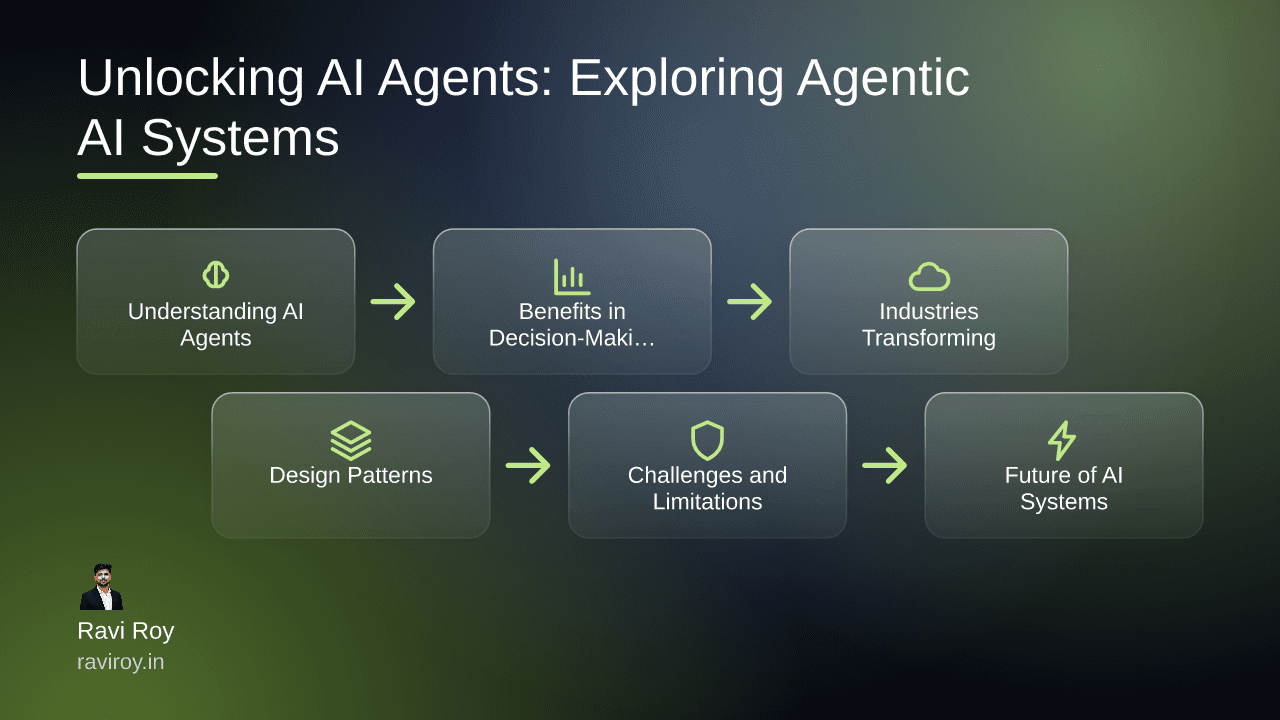
Unlocking AI Agents: Exploring Agentic AI Systems for Next-Gen Applications
The future is here, and it's driven by intelligent agents that can learn, adapt, and make complex decisions autonomously. Agentic AI systems are not just tools but transformative entities redefining the landscape of automation and decision-making.
Understanding AI Agents
What Are Agentic AI Systems?
Agentic AI refers to a class of artificial intelligence that takes on an autonomous role in executing tasks. Unlike traditional AI, which often requires human intervention or preset instructions, agentic AI systems can interpret data and respond with intelligence, making them suitable for dynamic environments. This self-governance characterizes them, allowing for complex decision-making processes with minimal oversight.
A key feature of agentic AI is its ability to learn from interactions, adapt to new information, and optimize its outputs. The applications of such systems range from mundane automation tasks to intricate processes that may directly influence business outcomes.
How Do Agentic AI Systems Function?
Agentic AI systems operate on a framework that integrates various components: data input, processing capabilities, decision-making logic, and output actions. They typically utilize machine learning algorithms to process vast amounts of data, identifying patterns that can inform future decisions.
For example, in a healthcare application, an agentic AI system might analyze patient data to predict health risks. The agent learns from prior cases, tailoring its responses based on individual patient profiles and the latest medical research. This capability of learning and evolving in real-time is what sets agentic AI apart from its traditional counterparts.
Benefits of Agentic AI in Decision-Making
Enhancing Decision-Making Processes
One of the standout advantages of agentic AI systems lies in their ability to streamline decision-making processes. These systems use data-driven insights to produce rapid analyses. As a result, businesses can respond to market changes and customer needs more quickly and with better precision.
Consider a manufacturing company that deploys an agentic AI system for inventory management. The AI continuously analyzes order patterns, seasonal demands, and supply chain data to optimize inventory levels, thereby reducing costs and improving service levels. Through these enhanced decision-making capabilities, agentic AI enables organizations to operate more efficiently and effectively.
Real-World Applications in Business
Numerous organizations have started leveraging agentic AI to gain competitive advantages. For instance, a major financial institution implemented an agentic AI system to detect fraudulent transactions. By analyzing transaction data in real time, the system identifies anomalies that could suggest fraud, improving not just the speed of detection but also the accuracy, subsequently saving millions.
Data analysis plays a crucial role in the success of these systems. Whether it’s through complex algorithms or straightforward statistical analysis, the agent learns and improves its decision-making capabilities over time, leading to optimal outcomes for the organization.
Industries Transforming with Agentic AI
Healthcare Advancements
Agentic AI is making impressive strides in healthcare, particularly in diagnostics. For example, an agentic AI system analyzing medical images can detect anomalies that are often missed by human eyes, providing a second opinion that boosts diagnostic accuracy. Another example might involve predicting patient outcomes based on historical data, thereby informing treatment strategies.
The implications are profound; earlier and more accurate diagnoses lead to better patient care and potentially lower healthcare costs. This transformation is just the beginning, as the field of healthcare continues to adapt to the capabilities of agentic systems.
Finance and Risk Management
In finance, agentic AI has shown immense promise in enhancing risk management practices. These systems can analyze market trends and consumer behavior, providing critical insights for investments and financial forecasting. They excel in modeling complex financial scenarios, helping institutions to navigate risks more effectively.
Furthermore, institutions employing agentic AI for fraud detection have noted significant improvements in identifying suspicious behavior, considerably minimizing financial losses. This dual efficacy—both in predictive analysis and fraud prevention—illustrates the critical role of agentic AI in the financial sector.
Manufacturing and Automation
In manufacturing, agentic AI systems are revolutionizing processes through predictive maintenance. With the integration of sensors and IoT devices, agentic AI systems can monitor machinery health and predict failures before they occur. This capability minimizes downtime and ensures that the manufacturing processes remain efficient.
For instance, a automotive manufacturer utilizing agentic AI to predict equipment failure saves substantial costs related to unplanned outages. By focusing on proactive maintenance, manufacturers can extend the lifecycle of their machinery and optimize their operations.
Design Patterns of Agentic AI Systems
Common Design Patterns
Agentic AI systems commonly utilize design patterns like goal-oriented behavior and learning loops. Goal-oriented behavior means that the AI identifies specific objectives and formulates strategies to achieve them. Learning loops involve continuous improvement; the AI refines its approach based on outcomes from previous actions.
For instance, an e-commerce site might utilize an agentic AI system that aims to maximize customer satisfaction by recommending products based on user preferences, continually adjusting recommendations as it learns from user interactions.
Scalability and Customization
Scalability is crucial for implementing agentic AI solutions effectively. A successful agentic AI system must handle increasing loads of data while maintaining performance. Organizations must also consider industry-specific needs when customizing these systems to ensure they align with unique operational strategies.
For example, a retail organization might customize their agentic AI system to take into account seasonal trends, while a healthcare provider might focus on integrating patient data securely, demonstrating the importance of tailoring design patterns to specific industries.
Challenges and Limitations in Implementing Agentic AI
Technical Challenges
Despite the potential of agentic AI, several technical hurdles stand in the way of widespread adoption. Data integration across systems can be complex, especially when legacy systems are involved, leading to interoperability issues that may hinder performance.
Additionally, the vast amounts of data that agentic AI systems require for effective analysis pose challenges. Organizations often struggle with data quality, leading to unreliable outputs. Addressing these challenges requires careful planning and robust data governance strategies.
Ethical Considerations
As organizations adopt agentic AI, ethical concerns loom large. Issues such as algorithmic bias and accountability become critical as decision-making shifts from humans to machines. Organizations must ensure their AI systems are free from bias, providing equal opportunities and fair outcomes for all individuals.
Strategies to mitigate these risks include regular audits of AI algorithms and fostering transparency around AI decision-making processes. Upholding ethical standards is essential to gaining public trust and ensuring the responsible implementation of agentic AI.
Future of Agentic AI Systems
Innovations on the Horizon
The future of agentic AI is bright, with numerous innovations on the horizon. Upcoming advancements in natural language processing and human-computer interaction will enhance the capabilities of these systems, allowing for even more seamless integration into daily operations.
Furthermore, the rise of quantum computing may accelerate the processing capabilities of agentic AI, enabling more complex and rapid decision-making than ever before. Such advancements could transform sectors like healthcare, finance, and manufacturing significantly.
Predictions for Industry Adoption
As agentic AI gains traction, predictions suggest widespread industry adoption across sectors will follow. Organizations that embrace agentic AI systems will likely operate with increased efficiency and effectiveness, gaining a competitive edge in their respective markets.
Preparing for these changes involves upskilling employees, investing in new technologies, and adapting organizational structures to facilitate integration. Companies that are proactive in their approach will be better positioned to thrive in the evolving landscape.
What challenges have you faced or anticipate in implementing agentic AI in your industry?
💬 Join the conversation — share your take in the comments and tell us what you’d add.