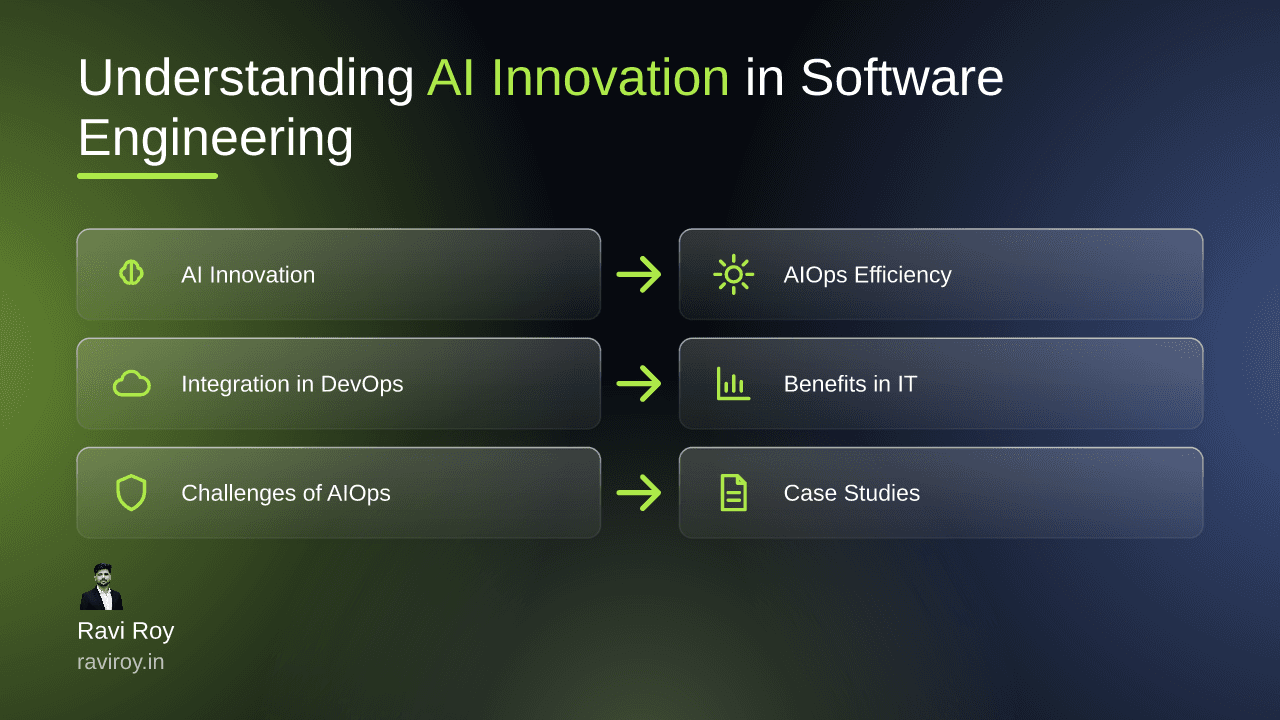
The Role of AI Innovation in Software Engineering
AI innovation is revolutionizing software engineering, transforming how teams manage and operate IT environments. At the heart of this transformation is AIOps—a blend of artificial intelligence and IT operations designed to improve efficiency and effectiveness across software development life cycles.
Defining AI Innovation in IT
To understand AI innovation in IT, consider its core components: machine learning, data analytics, and automation. AI innovation aligns the ever-changing demands of technology with the need for speed and accuracy. By harnessing vast amounts of operational data, organizations can develop predictive models that anticipate incidents before they escalate, leading to more effective resource allocation and enhanced decision-making.
AI innovation also includes the ability to learn from past incidents. For example, by analyzing patterns in downtime, organizations using AIOps can implement solutions that mitigate similar issues in the future. This move towards a predictive rather than reactive stance marks a significant shift in operational capabilities.
The Shift to Intelligent Automation
The transition from traditional IT management to intelligent automation marks a pivotal moment in software engineering. Traditionally, IT operations relied heavily on manual processes and reactive strategies, often leading to inefficiencies and increased downtime. Intelligent automation, powered by AIOps, changes this paradigm.
By implementing machine learning algorithms, IT teams can automate routine monitoring tasks, system alerts, and incident responses. This shift not only reduces the time spent on manual processes but also minimizes the risk of human error. The result is a more agile, responsive IT environment which can adapt quickly to changes, ensuring rapid software delivery and enhanced user experience.
How AIOps Enhances Efficiency in Software Engineering
AIOps dramatically enhances efficiency within software engineering by fostering a culture of proactive incident management and streamlining development processes.
Improving Proactive Incident Management
One of AIOps' most significant contributions to software engineering is its ability to facilitate proactive incident management. Instead of waiting for issues to arise, AIOps continuously analyzes data streams in real time, allowing teams to identify and address potential problems before they impact system performance.
For instance, consider a company that implements AIOps to monitor its application performance. By analyzing logs and metrics, AIOps can pinpoint unusual patterns—such as a decrease in response time or a spike in error rates. With this proactive approach, IT teams can perform maintenance or deploy fixes before end-users experience disruptions, fostering reliability and trust in the system.
Streamlining Development Processes
AIOps doesn't just bolster incident management; it also streamlines development workflows. By integrating AI-driven insights into the software delivery pipeline, teams can automate deployment processes, enabling faster updates and reduced time-to-market.
For example, a development team utilizing AIOps may employ CI/CD (Continuous Integration/Continuous Deployment) practices. AI models can analyze code changes and predict their impact on system performance, allowing for more informed decision-making during releases. This streamlined approach minimizes the risk of failures, enhances productivity, and accelerates innovation.
Integration of AIOps in DevOps and SRE
Effective integration of AIOps into DevOps and Site Reliability Engineering (SRE) practices is crucial for achieving the benefits of AI innovation in software engineering.
Collaboration Between Teams
Collaboration is vital for the successful integration of AIOps in DevOps frameworks. Both DevOps and AIOps teams must work closely to ensure that AI-driven data insights are utilized effectively throughout the software life cycle. This collaboration fosters open communication, enabling teams to share responsibility for system performance and reliability.
For instance, regular cross-functional meetings can be held to discuss the latest insights generated by AIOps, focusing on areas where enhanced performance can be achieved or potential issues can be proactively managed. By aligning the objectives of both teams, organizations cultivate a more cohesive and responsive IT environment.
Tools and Techniques for Integration
Several tools facilitate the seamless integration of AIOps into DevOps practices. Leading platforms like Splunk, Dynatrace, and Prometheus provide comprehensive analytics and monitoring capabilities essential for an AIOps-driven approach.
Splunk: Offers advanced data analysis features that allow teams to visualize application performance metrics, personalizing dashboards for deeper insights.
Dynatrace: Utilizes AI to provide automatic root cause analysis, helping teams quickly identify and address performance bottlenecks.
Prometheus: Serves as a robust monitoring solution that collects and queries metrics from services, offering alerts and visualization based on real-time data.
By adopting these tools, organizations can ensure that their software engineering processes remain agile and data-driven.
Benefits of AIOps in Modern IT Environments
Adopting AIOps offers numerous benefits within modern IT landscapes, primarily through cost optimization and enhanced observability.
Cost Optimization Strategies
One of the most compelling advantages of AIOps is its ability to drive significant cost savings. By automating routine IT tasks and optimizing resource allocation, organizations can reduce operational expenses while improving service quality.
For instance, an organization may analyze its cloud usage data through AIOps, identifying underutilized resources. Adjusting workloads to eliminate waste not only curtails spending but also enhances performance. In this manner, AIOps not only streamlines IT operations but also empowers financial decision-making across departments.
Enhancing Observability in Cloud Native Systems
AIOps also enhances observability in cloud-native systems, vital for maintaining performance and reliability in complex environments. By leveraging AI, teams can gain deeper insights into their microservices architectures, identifying potential issues and areas for improvement.
To achieve this, organizations can implement distributed tracing and logging capabilities, allowing for real-time monitoring of service health. AIOps can analyze these data points to highlight trends, helping teams understand their systems' behavior more comprehensively.
For example, if an increase in latency is detected in one microservice, AIOps can analyze dependencies with other services to provide actionable insights, facilitating root cause analysis.
Addressing Challenges of AIOps Implementation
While AIOps presents exciting opportunities for software engineering, organizations must also navigate certain challenges during implementation.
Overcoming Integration Barriers
Integrating AIOps with existing IT infrastructures can pose challenges, particularly when legacy systems are involved. Organizations often encounter compatibility issues that require careful planning and strategic decision-making.
To mitigate these challenges, embracing a phased integration approach can facilitate smoother transitions. Organizations should prioritize areas with the most potential for improvement and gradually expand AIOps capabilities, ensuring thorough validation at each step. By doing so, they can build confidence in the implementation process.
Cultural Shifts in Organizations
Adopting AIOps necessitates a cultural shift in many organizations. Employees must embrace new technologies and techniques, often requiring a departure from traditional practices. This cultural adjustment can be difficult, especially if teams are accustomed to legacy systems.
To address this resistance, organizations should prioritize training and education initiatives, ensuring team members understand the benefits and functionalities of AIOps. Encouraging open dialogue about challenges and successes will foster a more innovative mindset that welcomes AI-driven enhancements.
Case Studies Showcasing Successful AIOps Implementation
Examining successful real-world implementations of AIOps can provide valuable insights and drive understanding of best practices.
Real-World Examples
Company A: A global e-commerce platform adopted AIOps to streamline incident management. By integrating predictive analytics, they reduced their incident response time by 60%, significantly improving overall user satisfaction.
Company B: A financial institution leveraged AIOps to enhance observability across its diverse microservices architecture. The implementation of automated monitoring reduced downtime by 50% while optimizing resource utilization, driving substantial cost savings.
Lessons Learned from AIOps Deployments
From these case studies, key lessons emerge regarding the implementation of AIOps in organizations:
Start Small: Focus on the most pressing areas for improvement to gain initial buy-in and momentum.
Prioritize Training: Investing in training improves team confidence in utilizing AIOps tools effectively.
Emphasize Collaboration: Ensure that teams work together, fostering communication and shared ownership of outcomes.
By following these lessons, organizations can lay a solid foundation for successful AIOps integration.
Integrating AIOps into your software development practices presents challenges and opportunities that can redefine your approach to IT operations. What challenges have you faced while integrating AIOps into your development practices?
💬 Join the conversation — share your take in the comments and tell us what you’d add.