In the rapidly evolving landscape of modern application development, the choice of a database isn't just a technical detail—it's a foundational decision that shapes an application's architecture, scalability, and performance. For developers and architects navigating this complex terrain, understanding the fundamental differences between SQL vs NoSQL is paramount, especially when it comes to data modeling for diverse and demanding workloads. This showdown between relational and non-relational databases isn't about declaring a single winner, but rather equipping you with the knowledge to pick the right tool for the right job, ensuring your applications are robust, efficient, and future-proof.
Understanding the Core Differences: SQL vs. NoSQL Fundamentals
At its heart, the distinction between SQL and NoSQL lies in how they structure, store, and retrieve data, directly impacting their strengths and weaknesses.
Relational vs. Non-Relational Data Models
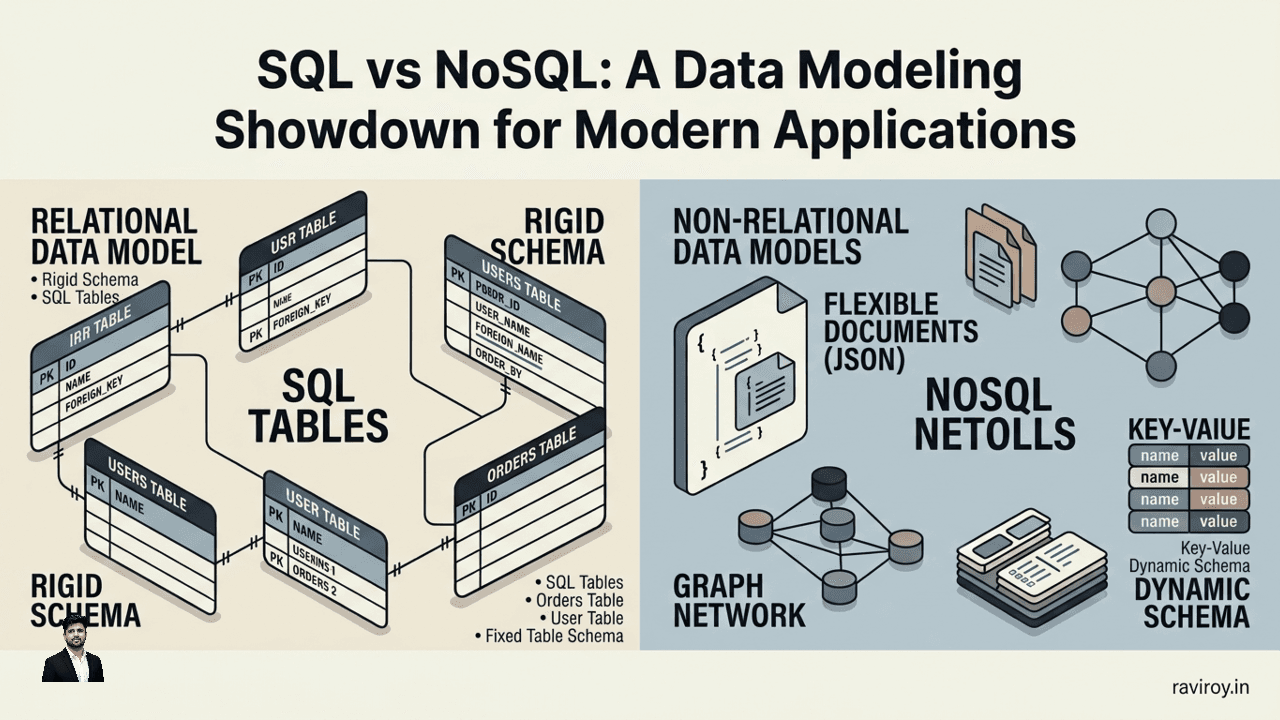
SQL databases, often referred to as relational databases, are built on a tabular model. Data is organized into tables, which consist of predefined columns and rows. Each row represents a record, and each column represents an attribute of that record. This structure mandates a rigid, predefined schema. For instance, a customer table might have CustomerID, Name, Email, and Address columns, and every record must conform to this structure. Relationships between different pieces of data are established through primary and foreign keys, allowing for complex data associations and ensuring consistency across related tables. This strict adherence to a schema provides strong data integrity guarantees.
NoSQL databases, on the other hand, offer a non-relational, more flexible approach to data storage. They encompass a variety of data models, each suited for different types of data and access patterns:
Document Databases: Store data in flexible, semi-structured documents (e.g., JSON, BSON, XML). Each document is a self-contained unit, and documents in the same collection can have different fields. This is ideal for hierarchical data and rapidly evolving schemas.
Key-Value Databases: The simplest NoSQL model, storing data as a collection of key-value pairs. Think of it like a highly scalable hash map. Fast for simple lookups, but lacks complex querying capabilities.
Wide-Column Stores: Organize data into tables, rows, and dynamic columns. Unlike relational tables, column names and format can vary from row to row within the same table, offering immense flexibility for sparse data.
Graph Databases: Optimized for storing and navigating relationships between entities. Data is represented as nodes (entities) and edges (relationships), making them perfect for interconnected data like social networks or recommendation engines.
This diversity means NoSQL databases are either "schema-less" or offer a "flexible schema," allowing for rapid iteration and handling of unstructured or semi-structured data without upfront rigid planning.
ACID vs. BASE Consistency Models
The other fundamental divergence lies in their approach to data consistency, especially critical in distributed systems.
SQL databases typically adhere to the ACID properties:
Atomicity: Transactions are all-or-nothing. Either all operations within a transaction complete successfully, or none of them do. There's no partial completion.
Consistency: A transaction brings the database from one valid state to another. Data integrity rules are enforced before and after the transaction.
Isolation: Concurrent transactions execute independently without interfering with each other. The intermediate state of one transaction is not visible to others.
Durability: Once a transaction is committed, its changes are permanent and survive system failures (e.g., power loss).
ACID properties are crucial for applications requiring high transactional integrity, such as financial systems or inventory management, where even a tiny inconsistency can have significant consequences.
NoSQL databases, especially those designed for distributed environments, often prioritize availability and partition tolerance over strict consistency, following the BASE properties:
Basically Available: The system guarantees availability of the data, even in the event of partial failures.
Soft State: The state of the system may change over time, even without input, due to eventual consistency.
Eventually Consistent: After all updates have ceased, all replicas of the data will eventually converge to the same consistent state. There might be a delay where different nodes have different versions of the data.
BASE properties are a trade-off, favoring scalability and availability, which is vital for applications like social media feeds or IoT data ingestion where losing a single data point is less critical than ensuring continuous operation and high throughput.
Data Modeling Paradigms: Architecting for Modern Workloads
The choice between SQL and NoSQL profoundly impacts how you design your data models, guiding you to architect for specific performance characteristics and workload types.
SQL Data Modeling: Normalization and Relational Integrity
SQL data modeling typically revolves around normalization. Normalization is a process of organizing the columns and tables of a relational database to minimize data redundancy and improve data integrity. The goal is to isolate data so that additions, deletions, and modifications of a field can be made in just one table and then propagated through the rest of the database via relationships.
A common level of normalization is Third Normal Form (3NF), which dictates that:
All non-key attributes are dependent on the primary key.
All non-key attributes are independent of each other.
Example of Normalization:
Imagine an e-commerce platform. Instead of putting all product details (name, description, price, category) directly into an Orders table, you'd normalize it:
Orderstable:OrderID,CustomerID,OrderDate,TotalAmountOrderItemstable:OrderItemID,OrderID(FK),ProductID(FK),Quantity,UnitPriceProductstable:ProductID,ProductName,Description,Price,CategoryID(FK)Categoriestable:CategoryID,CategoryName
To retrieve a complete order with all product details, you would use JOIN operations across these tables. For instance:
SELECT
    o.OrderID,
    c.CustomerName,
    p.ProductName,
    oi.Quantity,
    oi.UnitPrice
FROM
    Orders o
JOIN
    Customers c ON o.CustomerID = c.CustomerID
JOIN
    OrderItems oi ON o.OrderID = oi.OrderID
JOIN
    Products p ON oi.ProductID = p.ProductID
WHERE
    o.OrderID = 123;
While normalization ensures data integrity and reduces redundancy, frequent and complex JOIN operations across many large tables can lead to performance bottlenecks, especially in read-heavy applications. This is where careful indexing and query optimization become critical in SQL environments.
NoSQL Data Modeling: Flexibility and Access Patterns
NoSQL data modeling often embraces denormalization, a strategy that intentionally introduces redundancy to optimize for specific read patterns and improve performance, particularly in distributed environments. The guiding principle is often "query-first" or "access pattern-driven" design, meaning you model your data based on how you intend to query it, rather than focusing solely on minimizing redundancy.
In a document database, for example, related data might be embedded within a single document instead of being linked via foreign keys.
Example of Denormalization (Document Database): For the same e-commerce product catalog, if product reviews are always fetched along with the product details, you might embed them:
{
  "_id": "PROD001",
  "name": "Wireless Headphones Pro",
  "description": "Premium noise-cancelling headphones...",
  "price": 199.99,
  "category": "Electronics",
  "brand": "AudioTech",
  "features": ["ANC", "Bluetooth 5.2", "40-hour battery"],
  "reviews": [
    {
      "reviewerId": "USER123",
      "rating": 5,
      "comment": "Amazing sound quality!",
      "date": "2023-10-26"
    },
    {
      "reviewerId": "USER456",
      "rating": 4,
      "comment": "Comfortable, but a bit pricey.",
      "date": "2023-10-27"
    }
  ]
}
This model optimizes for retrieving a product and its reviews in a single query, eliminating the need for joins. However, it introduces redundancy (e.g., if a reviewer changes their username, you might have to update it in multiple product documents) and can make updates to embedded arrays more complex.
Different NoSQL models lend themselves to unique modeling strategies:
Document Databases (like MongoDB) are excellent for managing product catalogs, user profiles, or content management systems where data structures can evolve frequently. You design documents to align with application objects.
Graph Databases (like Neo4j) are inherently designed for relationships. Modeling social connections, recommendation engines, or fraud detection systems involves defining nodes (e.g.,
Person,Product) and edges (e.g.,FRIENDS_WITH,PURCHASED,RATED).Key-Value Stores (like Redis) are used for simple caching, session management, or leaderboard data where fast, direct access to data via a unique key is paramount.
The key takeaway for NoSQL data modeling is to understand your application's primary access patterns and design your data structure to optimize those specific queries, often at the expense of strict relational integrity or some data redundancy.
Scalability and Performance: Which Database Wins the Race?
When applications grow, their underlying databases must scale to handle increased data volumes and user traffic. SQL and NoSQL databases approach scalability in fundamentally different ways.
Vertical vs. Horizontal Scaling Strategies
SQL databases traditionally rely on vertical scaling, also known as "scaling up." This involves adding more resources (CPU, RAM, faster disk) to a single existing server. The idea is to make one server more powerful to handle more load. While effective up to a point, vertical scaling eventually hits physical and economic limits. There's only so much you can add to a single machine, and powerful enterprise-grade servers can become prohibitively expensive. Moreover, a single server remains a single point of failure.
NoSQL databases, by design, are typically built for horizontal scaling, or "scaling out." This involves distributing data and processing load across multiple commodity servers, often referred to as sharding or clustering. Instead of making one server bigger, you add more servers to the database cluster. This allows for near-linear scalability, handling massive data volumes and high request rates by simply adding more machines. If one server fails, others in the cluster can continue operating, offering high availability. NoSQL databases achieve this by distributing data across nodes, often leveraging techniques like data replication and eventual consistency.
Performance Considerations for Different Workloads
The performance characteristics of SQL and NoSQL databases also vary significantly based on the workload:
NoSQL databases generally excel in scenarios requiring very high write throughput and low-latency retrieval for simple operations (e.g., key-value lookups, fetching a single document by ID). Their distributed nature allows them to process many concurrent writes by spreading the load across multiple nodes. This makes them ideal for ingesting large streams of data (e.g., IoT sensor data, log files) or serving rapidly changing content (e.g., social media feeds).
SQL databases typically shine in environments that demand complex analytical queries, ad-hoc reporting, and operations involving multi-table joins and aggregations. Their relational model and mature query optimizers are highly efficient at processing these types of queries, making them the preferred choice for business intelligence, data warehousing, and applications where data integrity and complex relationships are paramount. While they can achieve good performance for transactional workloads, their ability to scale horizontally for truly massive, high-velocity data writes is often limited compared to distributed NoSQL systems.
It's not about one being definitively "faster" than the other, but rather about which architecture is better suited to optimize for the specific types of operations your application performs most frequently.
Real-World Use Cases: When to Choose Which
The decision between SQL and NoSQL isn't a blanket statement; it depends heavily on the specific requirements, constraints, and nature of your application's data.
Ideal Scenarios for SQL Databases
SQL databases remain the backbone of many critical enterprise systems due to their strong guarantees and proven reliability. They are the go-to choice for applications where:
Data integrity and consistency are non-negotiable: Financial systems, banking applications, payment processing, and inventory management absolutely require ACID compliance to ensure every transaction is accurate and reliable.
Complex transactions involving multiple related entities are common: Traditional Enterprise Resource Planning (ERP) systems, Customer Relationship Management (CRM) platforms, and supply chain management rely heavily on transactions that span across many tables with intricate relationships.
The data schema is stable and well-defined: Applications with a clear, unchanging data structure that is unlikely to evolve rapidly benefit from SQL's rigid schema, which helps enforce data quality.
Complex ad-hoc querying and reporting are essential: Business intelligence tools and analytical platforms thrive on SQL's powerful querying capabilities, enabling users to ask complex questions across their data.
Examples:
An online banking system managing accounts, transactions, and user balances.
An airline reservation system ensuring seat availability and booking integrity.
A retail point-of-sale (POS) system handling sales, returns, and inventory updates.
Ideal Scenarios for NoSQL Databases
NoSQL databases are increasingly popular for modern, agile applications that prioritize scalability, flexibility, and performance over strict transactional consistency. They are best suited for situations where:
Large volumes of unstructured or semi-structured data need to be stored and processed: Content management systems, social media platforms (user posts, feeds), IoT data streams, and real-time analytics platforms often deal with diverse and rapidly evolving data types.
The schema is dynamic or rapidly evolving: Agile development environments that require frequent changes to data structures without downtime find NoSQL's flexible schema highly advantageous.
Extreme scalability and high availability are paramount: Applications with unpredictable traffic spikes or global distribution requirements, like gaming platforms, user profile management for large user bases, or real-time recommendation engines.
Data access patterns are predictable and often involve retrieving entire "documents" or key-value pairs: When you know exactly how you'll query the data (e.g., always fetching a user profile by
userID), NoSQL can offer superior read/write performance.
Examples:
A social media platform storing user profiles, posts, and friend connections (document or graph DB).
An e-commerce site managing product catalogs, user reviews, and shopping cart data (document DB).
A gaming application storing player data, scores, and game state (key-value or document DB).
An IoT platform collecting vast amounts of sensor data (wide-column or time-series DB).
The Hybrid Approach: Combining Strengths for Polyglot Persistence
The modern application landscape rarely fits neatly into an "either/or" choice. Increasingly, organizations are adopting a hybrid approach, leveraging the strengths of both SQL and NoSQL databases within a single application architecture. This strategy is known as polyglot persistence.
Strategies for Integrating SQL and NoSQL
Polyglot persistence involves selecting the best data storage technology for each specific component or microservice of an application. Instead of forcing all data into one database type, you choose the right tool for the right job, leading to a more optimized and resilient overall system.
Key strategies include:
Microservices Architecture: This architectural style naturally facilitates polyglot persistence. Each microservice can manage its own data store, independent of other services. This means a service responsible for user authentication might use a SQL database for strict ACID compliance, while a separate service for user preferences might use a document database for flexibility and scalability.
Database-per-Service Pattern: A common microservices pattern where each service owns its data and manages its own database. This allows architects to choose the optimal database technology for each service's unique data characteristics and access patterns.
Caching with Key-Value Stores: Using a NoSQL key-value store (like Redis) as a caching layer in front of a slower, more complex SQL database to speed up frequently accessed data.
Search and Analytics Offloading: Offloading specific workloads, such as full-text search or real-time analytics, to specialized NoSQL databases (e.g., Elasticsearch for search, Cassandra for analytical data).
Practical Examples of Hybrid Architectures
Let's look at how this plays out in real-world scenarios:
E-commerce Platform:
SQL Database (e.g., PostgreSQL, MySQL): Handles core transactional data like
Orders,Customers,Inventory, andPayment Transactions. These require high data integrity, complex joins, and ACID compliance.Document Database (e.g., MongoDB): Stores
Product Catalogs(with flexible schemas for varying product attributes),User Reviews, and potentiallyShopping Cartdata, where flexibility and scalability for read-heavy operations are crucial.
SaaS Application:
SQL Database (e.g., SQL Server, Oracle): Manages critical
Billing Information,User Accounts,Subscription Plans, andAudit Logs. Data here is highly structured and requires strong consistency.NoSQL Database (e.g., Apache Cassandra, DynamoDB): Used for
Real-time Analytics,Event Streams(e.g., user activity logs, application metrics),User Preferences, orNotification Queues. These systems need to handle high ingest rates and offer rapid, eventually consistent reads.
By thoughtfully combining SQL and NoSQL, architects can design applications that achieve optimal performance, scalability, flexibility, and data integrity across different functional areas.
Making Your Decision: A Data Modeling Framework
Choosing between SQL and NoSQL, or deciding on a hybrid approach, requires a systematic evaluation of your project's specific needs. Here’s a practical decision framework to guide your data modeling choices:
Analyze Your Data's Structure and Relationships:
Is your data highly structured with clear, well-defined relationships? (e.g., financial records, inventory items, user profiles with fixed fields) -> Lean towards SQL.
Is your data unstructured, semi-structured, or does its schema evolve frequently? (e.g., user-generated content, IoT sensor data, product catalogs with varying attributes) -> Lean towards NoSQL (document, wide-column).
Is your data primarily about connections and relationships? (e.g., social networks, recommendation engines, fraud detection) -> Consider a Graph Database.
Is your data simple key-value pairs for caching or session management? -> Consider a Key-Value Store.
Evaluate Your Application's Consistency Requirements:
Do you require strict ACID compliance for every transaction? (e.g., banking, order processing where data must be immediately and absolutely consistent) -> SQL is usually the safest bet.
Can your application tolerate eventual consistency? (e.g., social media feeds, IoT dashboards where data can be slightly out of sync for a short period) -> NoSQL offers more flexibility for scalability.
Assess Future Scalability Needs and Expected Growth:
Will your application primarily scale vertically? (e.g., small to medium-sized applications with predictable growth) -> SQL can perform well with proper optimization.
Do you anticipate massive growth in data volume or user traffic, requiring horizontal scaling? (e.g., global web applications, real-time analytics, big data) -> NoSQL is designed for this type of scale.
Analyze Primary Access Patterns and Query Types:
Will your application frequently perform complex, ad-hoc queries involving multiple joins and aggregations? (e.g., reporting, business intelligence) -> SQL is optimized for these workloads.
Are your queries mostly simple lookups by ID, range queries, or retrieving entire "documents"? (e.g., fetching a user profile, product details by ID) -> NoSQL can offer superior performance for these specific patterns.
Do you need fast write throughput for data ingestion? -> Many NoSQL databases excel here.
Factor in Development Speed, Team Expertise, and Ecosystem/Tooling:
Does your team have strong SQL expertise and prefer a mature, standardized ecosystem? -> SQL might offer faster development initially.
Are you building a greenfield project with a need for rapid iteration and a flexible data model? -> NoSQL can accelerate development, especially for agile teams.
Consider the availability of drivers, ORMs, monitoring tools, and community support for your chosen database.
By thoughtfully working through these considerations, you can make an informed decision that aligns your data modeling strategy with your application's technical and business requirements.
In your experience, which specific application scenario or data challenge has most strongly influenced your decision between SQL and NoSQL, and why?
💬 Join the conversation — share your take in the comments and tell us what you’d add.