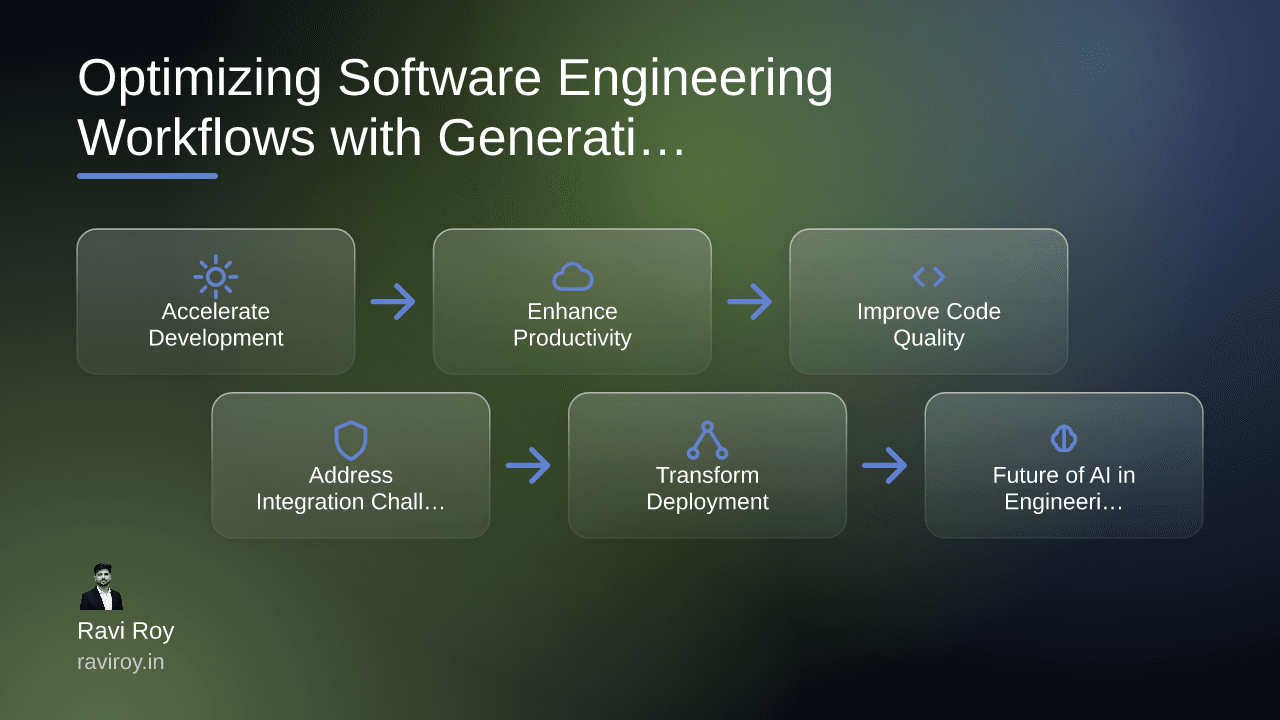
How Generative AI Tools Accelerate Software Development
Generative AI tools are revolutionizing software development, transforming tedious tasks into efficient processes. With capabilities that can produce code snippets in a flash, these tools are set to redefine what rapid software engineering looks like.
AI-Assisted Coding for Faster Output
Imagine a scenario where coding becomes as simple as typing a natural language request. AI-assisted coding tools can generate code snippets within seconds, letting developers focus on higher-level design and architecture rather than the minutiae of syntax. For instance, GitHub Copilot has shown that developers can save over 50% of their coding time, leading to accelerated project timelines and faster delivery of features.
Reducing Manual Errors with Intelligent Debugging
The introduction of intelligent debugging tools significantly minimizes manual errors, which can be a costly and time-consuming aspect of software development. These tools analyze code and suggest corrections or optimizations, enabling developers to identify and fix bugs more efficiently. For instance, a team utilizing intelligent debugging reported a 30% reduction in time spent on debugging, allowing them to allocate resources to new feature development instead (source).
Benefits of Using Generative AI in Software Engineering
The benefits of generative AI extend beyond just speed; they encompass enhanced productivity and quality assurance that no developer can afford to overlook.
Enhanced Developer Productivity
Automation is the name of the game when it comes to developer productivity. Generative AI tools automate repetitive tasks, such as code refactoring and documentation, which traditionally consume a lot of developer hours. According to recent studies, organizations that adopted AI tools reported a productivity boost of around 20-40%, allowing developers to engage in more creative problem-solving.
Quality Assurance Through Automated Testing
Automated testing has become more sophisticated with generative AI, dramatically improving code quality. AI algorithms now generate test cases based on code changes, ensuring comprehensive coverage and reducing the likelihood of bugs reaching production. A famous tech firm documented a 50% decrease in post-release bugs after incorporating generative AI into their testing framework.
How Generative AI Enhances Code Quality and Testing Processes
Enhancing code quality is no longer a manual endeavor. Generative AI is reshaping the landscape through automated processes.
Automated Code Reviews and Quality Checks
Generative AI can handle code reviews, ensuring that style guidelines and coding standards are consistently enforced without human bias. This automation enhances code quality and allows developers to focus on more significant architectural concerns rather than minor stylistic choices. When implemented, companies have reported code quality improvements by over 30%, making reviews faster and more effective.
Generative AI in Test Case Generation
Creating effective test cases can be a cumbersome task, often resulting in gaps in testing coverage. Generative AI addresses this by automatically generating test cases based on identified code paths, edge cases, and user scenarios. This not only increases testing efficiency but also elevates the reliability of software deployments.
Key Challenges When Integrating Generative AI
While the promise of generative AI is immense, realistic challenges arise during the integration process.
Overcoming Resistance to Change
Resistance to change is a significant barrier for many organizations looking to adopt generative AI tools. Developers may feel threatened by automation that takes over tasks they perform. Addressing this resistance through education and showcasing the benefits of AI, such as allowing more creative freedom, is crucial for successful integration.
Addressing Ethical Implications
Ethical considerations also pose challenges, particularly concerning bias in AI-generated code. If an AI system is trained on a dataset that lacks diversity, it could generate biased or flawed code, leading to unintended consequences. Addressing these concerns requires a proactive approach in training datasets and ongoing monitoring of AI outputs to ensure fairness and transparency.
Transforming Software Deployment and DevOps with Generative AI
Generative AI is not just a tool for coding; it’s transforming entire processes, including software deployment and DevOps practices.
Specification-Driven Development
Specification-driven development emphasizes defining requirements and expectations upfront using AI tools. This methodology streamlines the bridge between specifications and code, enabling faster feature implementation and reduced ambiguity during development cycles.
Streamlining Continuous Integration/Continuous Deployment (CI/CD)
Integrating generative AI into CI/CD pipelines enhances deployment efficiency significantly. AI algorithms can automate build processes, code merging, and deployment tasks that previously required manual inputs. Companies that have embraced these AI-driven pipelines have seen deployment times reduced by up to 50%, allowing for rapid iterations and feedback loops.
Case Studies on Successful Integration of Generative AI
Real-world applications of generative AI demonstrate its transformative potential.
Real-World Examples
A notable example is Microsoft, which integrated a range of generative AI tools into their Azure DevOps environment. By automating code reviews and testing, they achieved remarkable results, including faster turnaround times for code submissions.
Metrics of Success
Before implementing generative AI tools, many organizations reported deployment failures and high defect rates. After integration, Microsoft noted a 70% reduction in defects found in post-deployment phases, showcasing the efficiency gains backed by effective automation strategies.
Looking Ahead: The Future of Generative AI in Software Engineering
As generative AI continues to evolve, its impact on software engineering will only deepen.
Emerging Trends and Technologies
Emerging trends in generative AI, such as improved natural language processing and deeper integration with development environments, are set to reshape how code is developed, reviewed, and deployed.
Preparing for the Future Workforce
With the advent of generative AI, there’s a growing need for training and upskilling the workforce. It’s essential for developers to learn how to utilize these AI tools effectively while also understanding their ethical implications.
Generative AI represents the future of software engineering. Have you implemented generative AI tools in your development workflow? What challenges and successes have you encountered during this transition?
💬 Join the conversation — share your take in the comments and tell us what you’d add.