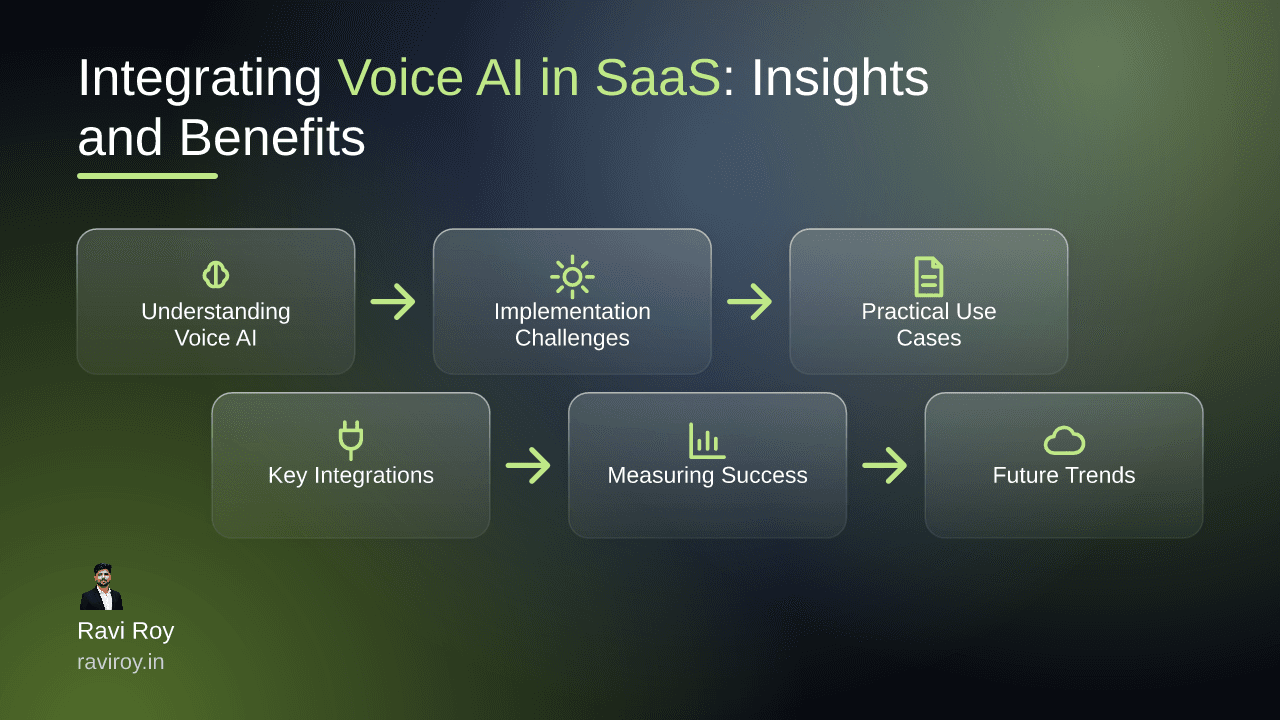
Understanding Voice AI in SaaS
Voice AI has emerged as a powerful tool for Software as a Service (SaaS) platforms, reshaping how businesses interact with their customers. By integrating voice technology, SaaS companies can enhance user experiences, boost engagement, and streamline processes. But what exactly is Voice AI, and how can it be leveraged in SaaS environments?
How Voice AI Works in SaaS Environments
Voice AI harnesses Natural Language Processing (NLP) and machine learning to facilitate human-like conversations between users and software applications. This technology enables users to communicate with SaaS solutions through voice commands, making interactions faster and more intuitive.
From a technical standpoint, integrating Voice AI into your SaaS product typically involves embedding APIs from leading voice recognition platforms like Google Cloud Speech-to-Text or Amazon Lex. These APIs allow for effective transcription and comprehension of spoken language, creating a seamless interface for users. Using standard RESTful APIs can streamline this integration and allow for real-time processing without significant latency.
Key Benefits of Voice AI Integration
The incorporation of Voice AI into SaaS provides numerous advantages:
Enhanced Customer Engagement: Voice AI facilitates faster interaction, reducing the friction often seen in traditional user interfaces. According to a recent study, the response time in customer service can decrease by up to 30% with voice capabilities (link text).
Improved Service Efficiency: Features like voice commands enable service representatives to quickly access customer data and provide answers, streamlining operations during peak times.
Increased Personalization: With the capability to analyze user interactions, Voice AI can offer personalized recommendations and responses based on previous interactions, enhancing the overall customer experience.
Challenges of Implementing Voice AI in SaaS
While the benefits of Voice AI are compelling, the implementation process is fraught with challenges that must be navigated carefully.
Common Implementation Hurdles
One major obstacle is the context in which voice interactions take place. Accents, dialects, and varied speech patterns can impact the accuracy of voice recognition systems, leading to potential user frustration. Training your model on domain-specific language can help mitigate this issue.
Additionally, ensuring that your Voice AI can handle multi-turn conversations—where multiple questions and responses occur—adds another layer of complexity.
Addressing Latency and Data Security
Latency can significantly impair user experience if Voice AI responses are delayed. It's critical to optimize backend processes for swift response times; consider utilizing cloud functions that process requests immediately and return outputs seamlessly.
Moreover, data security remains a pressing concern. Compliance with regulations such as GDPR is essential. Implementing end-to-end encryption and regular audits can strengthen your security posture while addressing potential compliance issues.
Practical Use Cases for Voice AI in SaaS
Voice AI can be a game changer in a variety of SaaS applications, particularly in enhancing customer support and streamlining sales processes.
Enhancing Customer Support
For customer service teams, using Voice AI can drastically improve response times. By deploying AI-driven chatbots that utilize voice recognition, support agents can handle queries more effectively and resolve issues faster, leading to improved customer satisfaction.
For example, Zendesk has harnessed Voice AI to reduce average resolution time by over 25% through automated responses to common queries (link text).
Streamlining Sales Processes
In sales, Voice AI can be employed for tasks like lead qualification and appointment booking. By analyzing voice data from sales calls, AI can provide insights that help sales teams prioritize their leads.
Consider the example of a SaaS company that integrated Voice AI to facilitate bookings via voice commands. This not only streamlined their booking process but also enhanced user experience, as clients could easily schedule appointments without needing to navigate through clunky email chains.
Key Integrations for Voice AI in SaaS
To maximize the benefits of Voice AI, effective integration with existing tools is crucial.
Necessary Tools for Voice AI Integration
Essential tools for implementing Voice AI in your SaaS product include:
Voice Recognition APIs: Top choices like Amazon Lex or Google Speech API.
NLP Libraries: Frameworks such as spaCy or NLTK for advanced language processing.
Development Kits: SDKs from major cloud providers to facilitate seamless integration.
Integrating with CRM and Customer Data Platforms
Integrating Voice AI with your Customer Relationship Management (CRM) system is vital for delivering hyper-personalized experiences. CRMs can utilize voice interactions to gain insights into customer preferences, making support and sales interactions more relevant.
For instance, Salesforce's Einstein Voice allows sales reps to update their CRM via voice commands, freeing them up to focus on customer engagement rather than data entry.
Measuring Success and ROI of Voice AI in SaaS
With significant investments in Voice AI, understanding its impact is essential.
Identifying Key Performance Indicators (KPIs)
To track Voice AI performance, identify key metrics such as:
Response Time: The average time taken to respond to voice commands.
User Engagement Rates: The frequency of voice interactions versus traditional methods.
Customer Satisfaction Scores: Ratings collected post-voice interactions.
Establishing ROI Metrics
Calculating return on investment (ROI) for Voice AI involves assessing the cost savings associated with improved efficiency and customer retention. One effective method for calculating this is:
Compare customer service costs before and after implementing Voice AI.
Measure the increase in sales or conversion rates attributed to voice capabilities.
Case studies reveal that companies can see ROI within six months of Voice AI integration through significant operational cost reductions (link text).
Future Trends in Voice AI for SaaS
As technology progresses, the landscape of Voice AI continues to evolve.
Emerging Technologies
Innovations like AI-driven sentiment analysis and context-aware systems are becoming essential in creating truly interactive experiences. Companies are investing in multimodal integrations, allowing users to switch seamlessly between voice and visual interfaces based on preference.
Integration with Multilingual Capabilities
As globalization increases, the demand for multilingual Voice AI support will only grow. For SaaS companies, this means being equipped to handle multiple languages and dialects to cater to diverse user bases. The future will see Voice AI capable of learning and switching languages fluidly, creating a more inclusive user experience.
Voice AI has undeniably begun to shape the future of SaaS interactions. As you consider implementing Voice AI in your own product, what challenges have you faced, and how did you overcome them? Your experiences can help drive the conversation forward!
💬 Join the conversation — share your take in the comments and tell us what you’d add.