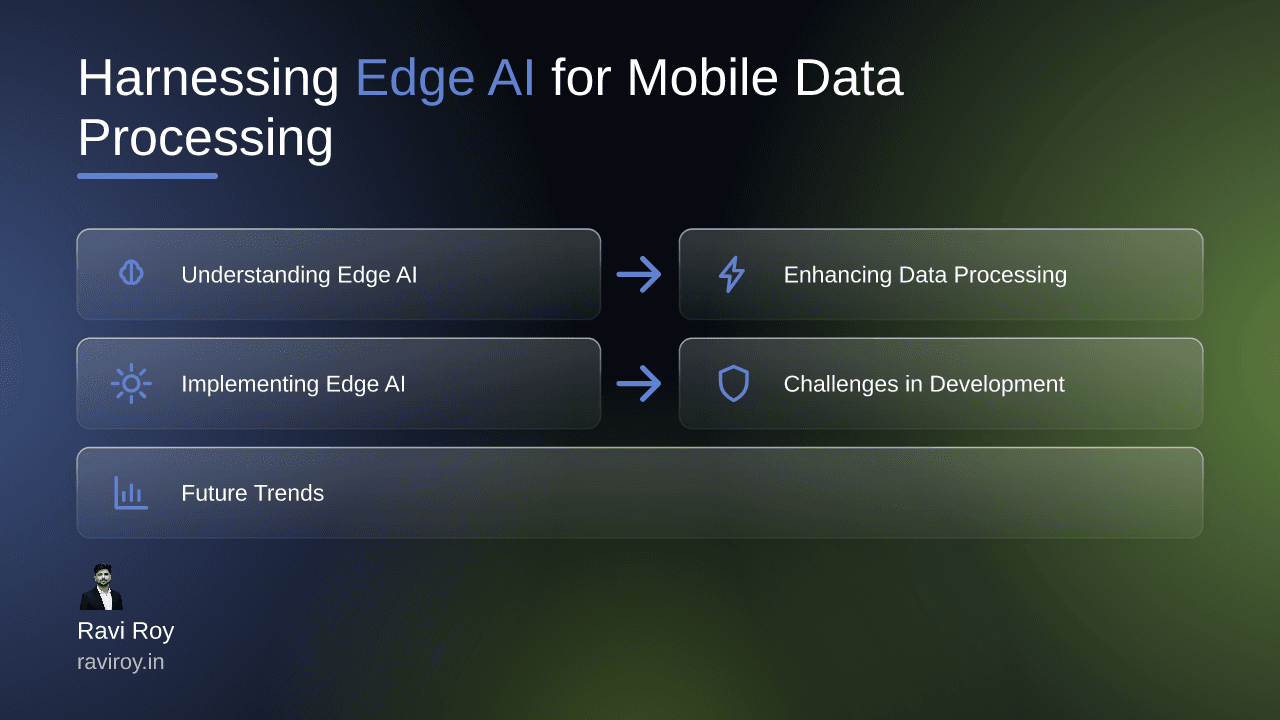
Understanding Edge AI and Its Role in Mobile Applications
The revolution in mobile app development is no longer just about faster networks or sleeker interfaces; it's about making applications smarter with Edge AI. Imagine an app processing data in real time, right on your device, without constantly pinging the cloud. This transformation isn’t just a trend but a necessity for enhancing user experience and ensuring data privacy.
What is Edge AI?
Edge AI refers to the process of running AI algorithms locally on a device instead of relying solely on cloud computing resources. Unlike traditional AI, which processes data in bulk from centralized servers, Edge AI decentralizes this computation. This results in quicker decision-making on mobile devices like smartphones and tablets.
Why Edge AI Matters for Mobile Apps
The benefits of Edge AI are compelling. Reduced latency is perhaps the most significant advantage. With localized data processing, apps can deliver instant responses—vital for functionalities like voice recognition or augmented reality. Moreover, enhanced privacy is crucial in an age where data breaches are rampant. With Edge AI, sensitive user data is processed on-device rather than being sent to external servers, reducing the risk of exposure.
Several mobile apps successfully leverage Edge AI. For instance, Google Lens uses Edge AI to analyze images and provide results in real-time, while image editing applications utilize localized processing for instant modifications.
How Edge AI Enhances Real-Time Data Processing
Speed and Efficiency
When it comes to real-time applications, speed can dictate user satisfaction. Edge AI drastically reduces response times, enabling applications to process data within milliseconds. A classic example can be found in navigation apps that rely on real-time location tracking. By processing data locally, these applications can quickly reroute users based on traffic conditions without delay.
Improved User Experience
Speed alone can’t guarantee a great user experience; interaction quality matters too. By utilizing Edge AI, applications can enhance app responsiveness. For instance, voice assistants that rely on local processing can respond to queries without lag, making interactions feel seamless and more natural for users.
Data Security and Privacy
One of the biggest concerns in today's digital landscape is user privacy. Traditional cloud-based AI often jeopardizes this by transmitting sensitive data over the network. Edge AI mitigates these risks by keeping personal data on the device. As a result, users enjoy an enhanced sense of security, knowing that their information isn't traversing the internet unnecessarily.
Implementing Edge AI in Mobile Applications
Choosing the Right Edge AI Framework
Selecting an Edge AI framework is crucial and can significantly affect your app’s performance. Popular choices include TensorFlow Lite for its robust modeling capabilities and OpenVINO for its efficiency across various hardware platforms. When selecting a framework, consider factors like ease of integration, supported platforms, and community support.
Integration Strategies for Mobile Developers
Integrating Edge AI into existing mobile apps requires strategic planning. Developers should start by identifying the specific features that will benefit from Edge AI, then implement gradual changes. For example, you might begin with local image recognition before expanding to more complex functionalities like natural language processing.
Real-life implementations showcase successful Edge AI applications. Take the example of Snapchat using Edge AI for real-time filters and effects. This integration allows users to modify images without lagging, improving overall engagement.
Challenges of Edge AI in Mobile App Development
Technical Limitations
While the benefits of Edge AI are significant, it comes with its set of challenges. Hardware limitations can impact performance, particularly in lower-end devices lacking the requisite processing power. Developing Edge AI applications must take into account the variety of devices users employ to ensure consistent functionality.
Scalability Concerns
Scaling Edge AI applications across diverse devices poses another challenge. Each device may have different processing capabilities, and ensuring compatibility can be complex. Moreover, developers need to strategize around potential architecture misalignments within the existing mobile ecosystem.
Future Trends of Edge AI in Mobile Applications
AI-Driven Personalized Experiences
The future of Edge AI is bright, especially in terms of personalized user experiences. Smarter data analysis will allow applications to learn from user behavior and provide tailored recommendations. Apps could anticipate user needs based on previous interactions, creating a uniquely immersive experience.
The Role of 5G in Enhancing Edge AI Capabilities
With the advent of 5G, the potential of Edge AI expands even further. The increased bandwidth and lower latency of 5G networks will enhance the performance of Edge AI applications, making real-time data processing even more efficient. Imagine the possibilities with autonomous vehicles or smart environments utilizing this technology.
Conclusion: The Path Forward with Edge AI in Mobile Apps
In summary, the incorporation of Edge AI into mobile applications presents countless opportunities to transform how we process data and engage users. By facilitating real-time analytics and ensuring robust privacy measures, Edge AI stands to revolutionize the mobile application landscape. As we look ahead, it’s essential for developers to explore and experiment with Edge AI technologies to stay ahead of the competition.
What have been your experiences using Edge AI in mobile applications? Share specific examples or challenges you've faced!
💬 Join the conversation — share your take in the comments and tell us what you’d add.