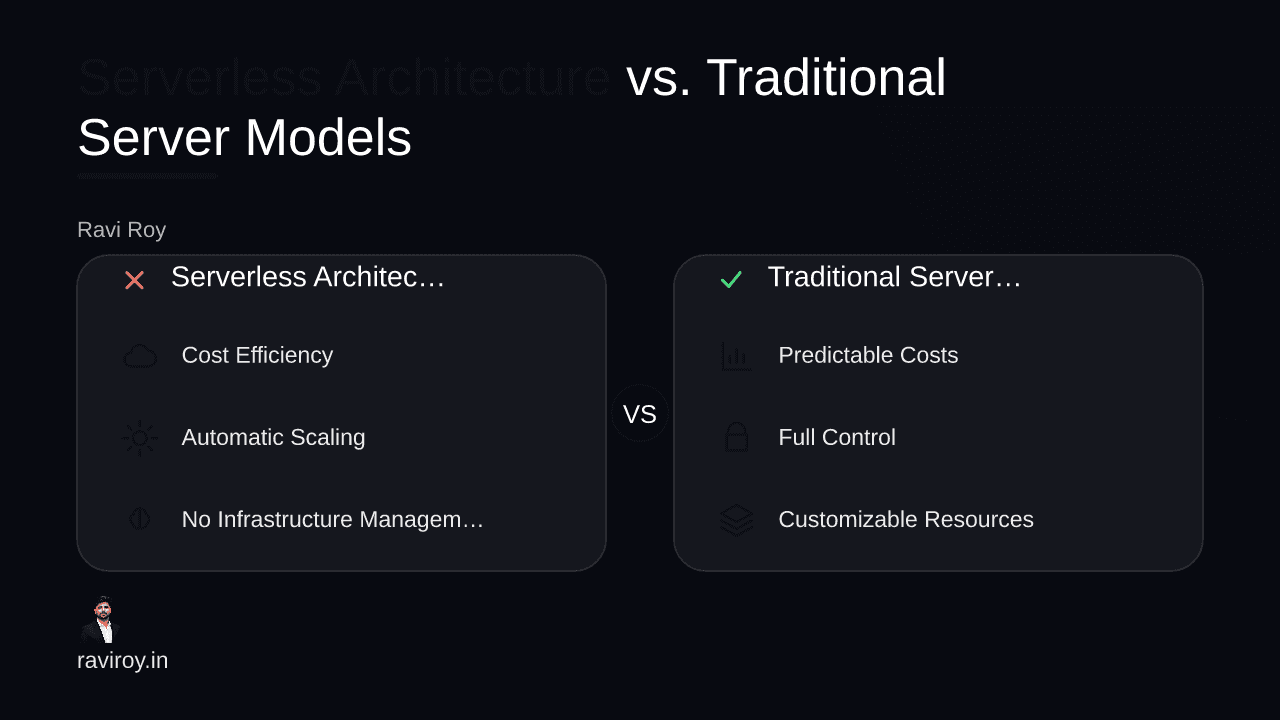
Introduction to Serverless Architecture and Traditional Servers
As businesses adapt to a rapidly changing technological landscape, choosing the right hosting model has never been more critical. The choice between serverless architecture and traditional server models can significantly impact your operational efficiency, scalability, and cost-effectiveness. Understanding these two paradigms is essential for making informed decisions in today’s digital world.
Serverless architecture allows developers to build and run applications without managing infrastructure, scaling resources automatically based on demand. Traditional server models, on the other hand, involve dedicated servers managed by the business or a provider, where capacity needs to be planned and provisioned in advance. This fundamental difference in how resources are managed makes the journey of adoption fascinating and complex, with serverless gaining traction as organizations seek agility and cost savings.
Recent studies project significant growth in serverless adoption, with many businesses shifting their focus toward this modern approach. By understanding the pros and cons of each model, you can determine which is best aligned with your business goals.
Cost Comparison: Serverless vs. Traditional Models
Understanding Pricing Models
When it comes to cost comparison, the pricing structures of serverless and traditional server models play a crucial role. Serverless solutions typically operate on a pay-per-execution basis. This means businesses only pay for the compute time they actually use. For example, major cloud providers like AWS and Azure charge based on function execution time, memory used, and invocation counts. This is a revolutionary model for variable workloads.
In contrast, traditional hosting usually comes with flat fees, which include monthly or annual contracts for server space and bandwidth. This can be beneficial for more predictable workloads, but can also lead to cost inefficiencies if you are over-provisioned resources for idle times.
Is Serverless Always Cheaper?
While serverless architecture can lead to significant savings, it isn’t universally cheaper. For instance, if you run a static website or a low-traffic application, the traditional hosting model might offer a more cost-effective solution. Here’s a brief comparison of pricing across major cloud providers for two scenarios:
Serverless Model (AWS Lambda): Costs approximately $0.20 per million requests and varies based on execution time.
Traditional Model (AWS EC2): Starts around $8.50 a month for a basic instance, regardless of utilization.
If your application doesn’t experience high traffic or consistent demand, the traditional model could save you money in the long run.
Performance and Scalability: Handling Traffic Spikes
Traffic Management in Serverless Architecture
One of the significant advantages of serverless architecture is its ability to handle fluctuating traffic seamlessly. When traffic spikes occur, serverless environments can scale automatically, spinning up additional resources as needed. This capability is crucial for businesses experiencing unexpected surges in activity, such as during a product launch or holiday sales.
Consider a major e-commerce platform that directly scaled its serverless architecture to handle a 500% increase in users during Black Friday sales without any downtime. The resources allocated dynamically ensured that every user had a smooth experience without bottlenecks.
Challenges with Traditional Servers
In contrast, traditional servers often struggle with sudden increases in traffic. They require prior provisioning of resources, and an unanticipated spike can lead to slowdowns or even crashes. Businesses may need to invest in a load balancer or horizontally scale their architecture, which can take time and require significant upfront costs.
Real-world scenarios have shown that companies with traditional setups faced major slowdowns during critical sales events, leading to lost revenue and customer frustration—issues that could have been avoided with a serverless model.
Latency Considerations: Cold Starts vs. Traditional Performance
What is Cold Start Latency?
A notable concern for serverless architecture is cold start latency. This occurs when a serverless function is invoked after a period of inactivity, resulting in a delay while the environment is set up. Cold starts can significantly impact applications that require rapid response times, such as web applications or APIs.
Comparative Performance Metrics
In contrast, traditional servers provide a consistent performance level since they remain active, regardless of usage. This reliability can be vital for applications with stringent latency requirements. For instance, a streaming service may find cold starts detrimental, while static content hosted on traditional servers runs smoothly all the time.
To illustrate this, a fintech app using serverless functions reported higher latency during peak hours due to cold starts, affecting user experience. Transitioning to a hybrid model allowed them to mitigate these effects while still leveraging the advantages of serverless architecture for less critical services.
Control and Flexibility: Developer Insights
Infrastructure Control in Traditional Servers
Developers often seek granular control over their environments, and traditional models deliver this via dedicated hardware. Organizations can configure security settings, install specific software, and fully customize their architectures to meet their needs. For instance, a healthcare provider may require custom compliance tools and resources that necessitate this level of control.
Limitations in Serverless Environments
On the flip side, serverless architectures impose constraints that can be limiting for developers. Functions may only run under strict resource limits, and the stack can be locked into a specific vendor’s ecosystem, complicating debugging and performance monitoring.
A startup developing a machine-learning model experienced frustrating limitations with their serverless environment, which restricted their ability to handle custom libraries needed for data processing effectively. After switching to a traditional setup, they regained control, enabling more tailored developments for their specific needs.
Potential Drawbacks of Serverless Architecture
Despite the numerous advantages, serverless architecture has its pitfalls. One concern is vendor lock-in, where businesses become reliant on a single cloud provider’s tools and services. This can hinder flexibility and lead to challenges if trying to switch providers down the road.
Moreover, debugging and monitoring tools are often less sophisticated in serverless environments, making it difficult to track down issues and optimize performance. Relying on various tools for visibility can complicate development and maintenance.
Lastly, businesses should prepare for the potential long-term costs associated with serverless models. While the initial pay-per-execution pricing appears attractive, costs can add up with increased usage, necessitating thorough cost-benefit analysis that considers future growth projections.
Conclusion: Choosing the Right Architecture for Your Needs
Choosing between serverless architecture and traditional server models involves several trade-offs. Each model offers unique advantages and drawbacks that can align differently based on your business requirements and growth trajectories.
As you consider migrating to a serverless model, reflect on your application needs, expected traffic patterns, and resource control requirements. Conducting a thorough assessment of these factors will enable you to make an informed decision that suits your operational strategy.
What has been your experience with serverless architecture versus traditional server models? Share your insights or challenges you've faced!
💬 Join the conversation — share your take in the comments and tell us what you’d add.