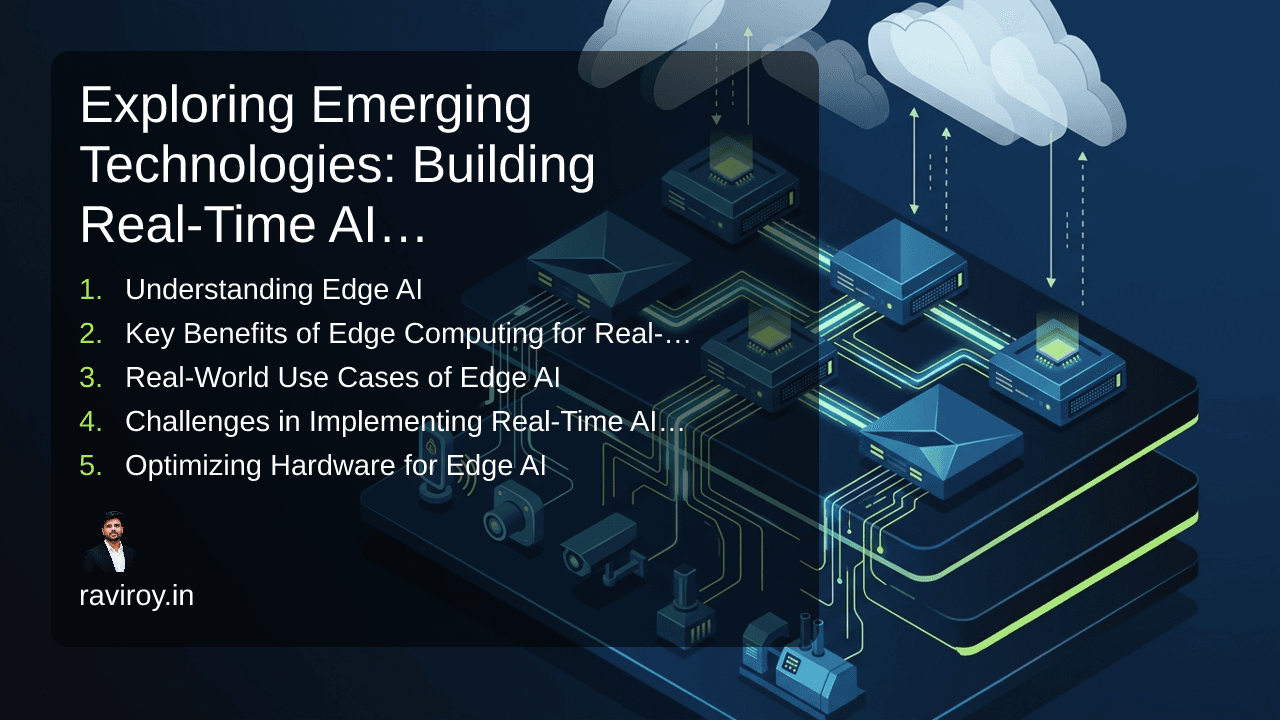
Exploring Emerging Technologies: Building Real-Time AI Applications with Edge Computing
The world of technology is evolving at a breakneck speed, redefining how applications process data. Among the most transformative innovations is Edge AI, which enhances real-time applications by bringing computational power closer to the data source. But what exactly is Edge AI, and how does it empower a new era of intelligent applications?
Understanding Edge AI
What is Edge AI?
Edge AI combines artificial intelligence (AI) algorithms with edge computing infrastructure to process data at or near the location it is generated. This approach enables devices to make rapid decisions without relying heavily on centralized data centers. Whether it’s a smart camera identifying a person in real-time or an autonomous vehicle interpreting its surroundings, Edge AI plays a pivotal role.
How Edge AI Works
Edge AI operates on a unique architecture that consists of several layers:
Data Source: Devices like sensors, cameras, and IoT gadgets collect data in real time.
Edge Devices: These are localized computing units capable of processing data. They can have integrated AI chips that perform machine learning tasks directly on the device.
Network Communication: Edge devices communicate data with the cloud as needed, but often perform necessary computations in real time, minimizing data transfers.
Processing data at the edge is critical, as it decreases latency, saves bandwidth, and allows real-time insights (source).
Key Benefits of Edge Computing for Real-Time AI Applications
Reduced Latency
One of the standout benefits of Edge AI is its ability to minimize latency. Traditional cloud-centric solutions can add significant delays due to data traveling back and forth over potentially congested networks. By processing data at the edge, decisions can be made within milliseconds. For example, in healthcare, a connected ECG monitor can alert medical professionals instantly to critical changes in a patient's condition.
Enhanced Data Privacy
With stringent regulations around data privacy, Edge AI enhances security by keeping sensitive data on-device for processing, rather than transmitting it over networks. This localized processing reduces exposure to potential breaches and complies more easily with legal frameworks like GDPR (source).
Cost Efficiency
Beyond performance gains, Edge AI can significantly lower operational costs. By reducing bandwidth consumption—since only essential data needs to travel to the cloud—organizations can save on data transmission fees. Moreover, processing data locally often reduces the necessity for substantial cloud infrastructure investments, making AI applications more cost-effective.
Real-World Use Cases of Edge AI
Autonomous Vehicles
Imagine a self-driving car equipped with thousands of sensors and cameras. Edge AI processes the data from these devices in real-time, enabling quick decisions—like applying the brakes or navigating a traffic jam. With minimal latency, vehicles can interact with their environments efficiently, making roads safer.
Smart Cities
Smart cities leverage Edge AI for various applications. For instance, traffic management systems analyze data from cameras and sensors to optimize traffic flow and reduce congestion. Environmental monitors can collect and process air quality data locally, allowing cities to respond to issues rapidly, ensuring the health and safety of their residents.
Industrial IoT
In manufacturing, Edge AI is critical for predictive maintenance. Sensors attached to machinery continuously gather data, and localized AI algorithms analyze this information to anticipate failures before they happen. This not only minimizes downtime but also extends the lifespan of equipment due to timely interventions.
Challenges in Implementing Real-Time AI at the Edge
Scalability Issues
As businesses adopt Edge AI, scaling these solutions can pose challenges. Integrating numerous edge devices into a cohesive system requires careful planning and robust architecture. Companies must ensure that infrastructure can handle increasing device loads while maintaining performance.
Data Synchronization
Another significant challenge is maintaining data synchronization between edge devices and cloud systems. Disparities in data processing can lead to inconsistent outputs. Therefore, a robust framework must be established for seamless data flow that ensures edge devices remain updated with the latest information.
Hardware Limitations
Edge computing devices often have constrained hardware compared to centralized servers. This can limit the complexity of the AI models that can be deployed. Therefore, understanding the hardware's capabilities and designing applications within these limits are essential for ensuring performance.
Optimizing Hardware for Edge AI
Specialized Chips and Hardware
To address hardware limitations, manufacturers are developing specialized chips tailored for Edge AI. These chips, such as Tensor Processing Units (TPUs) and Graphics Processing Units (GPUs), can perform complex computations efficiently within power-constrained environments.
Model Optimization Techniques
Optimizing AI models for edge deployment involves techniques like quantization, which reduces the precision of the calculations to save memory and computational resources. Another technique is pruning, which removes unnecessary weights from neural networks, making models lightweight and faster to deploy on edge devices.
The Impact of 5G on Edge AI Applications
Faster Connections
The rollout of 5G networks enhances Edge AI capabilities significantly. With ultra-low latency and high data transfer speeds, edge devices can communicate and collaborate more effectively, leading to faster decision-making processes in applications ranging from augmented reality gaming to smart grid management.
Increased Device Density
5G also allows for a greater density of connected devices. This increase opens up possibilities for expansive Edge AI ecosystems where numerous devices interact seamlessly. For instance, in smart factories, hundreds of IoT devices can communicate, collaborate, and operate in real-time, optimizing production workflows and enhancing efficiency.
As the landscape of technology continues to evolve, the combination of Edge Computing and AI is paving the way for innovative real-time applications. What real-time AI applications have you seen successfully leverage edge computing, and what challenges did they face?
💬 Join the conversation — share your take in the comments and tell us what you’d add.