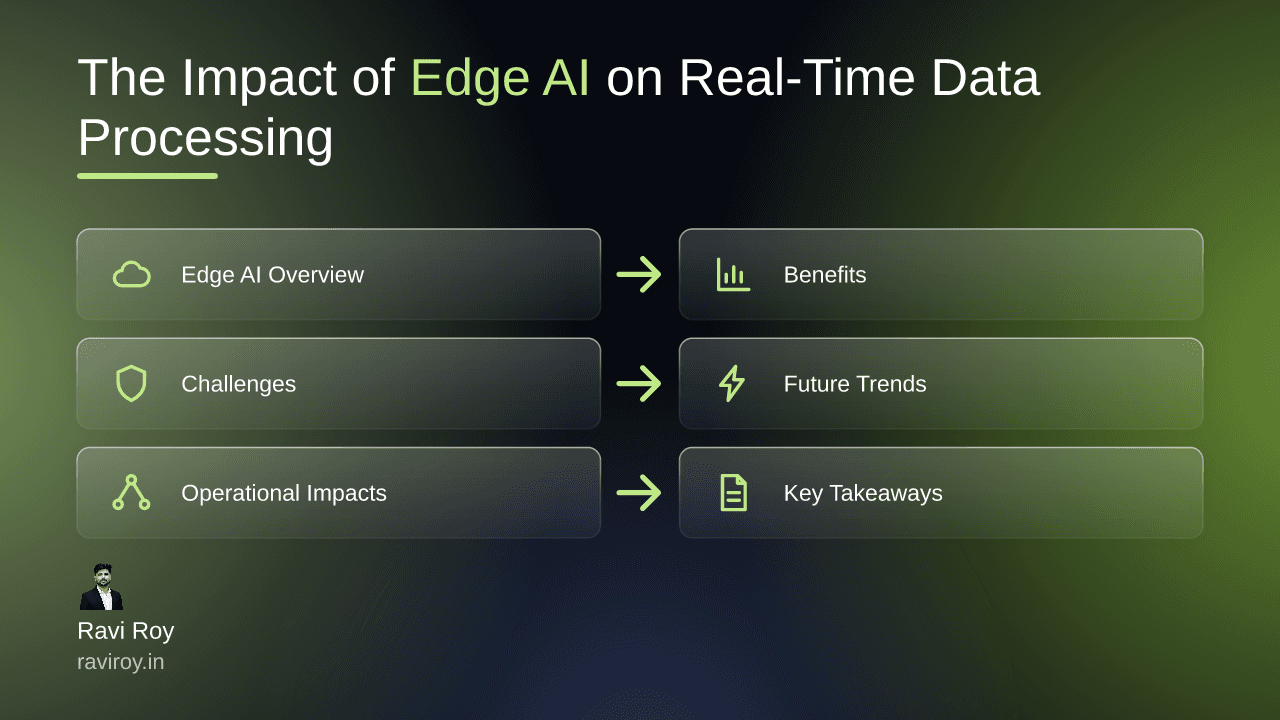
Understanding Edge AI and Its Role in Real-Time Data Processing
As the demand for instantaneous insights grows, real-time data processing has become crucial for businesses aiming to stay competitive. Enter Edge AI—a game-changer transforming how data is processed at the speed of life.
What is Edge AI?
Edge AI refers to the integration of artificial intelligence (AI) capabilities directly into edge devices, allowing for processing data in real time instead of relying solely on centralized cloud servers. This technology enhances efficiencies by enabling devices like cameras, sensors, and other Internet of Things (IoT) implementations to interpret data locally.
The Importance of Real-Time Data Processing
Real-time data processing is vital for various applications, from autonomous vehicles and industrial automation to healthcare monitoring. Instant access to data means quicker responses to changing conditions, allowing businesses to make more informed decisions. Emerging technologies, such as machine learning models and advanced data analytics, are enhancing Edge AI capabilities, making it possible to deploy complex algorithms on edge devices that were once limited to powerful data centers.
Benefits of Edge AI in Real-Time Data Processing
Reduced Latency
One of the most noteworthy benefits of Edge AI is its ability to drastically reduce latency. Traditional cloud processing necessitates sending data back and forth over the network, which can introduce delays. With Edge AI, data is processed locally, allowing for quicker decision-making and actions. For instance, in autonomous vehicles, each millisecond counts. Edge AI allows vehicle systems to rapidly assess sensor data for immediate obstacle recognition and collision avoidance.
Improved Data Privacy
Edge AI plays a significant role in enhancing data privacy, especially in industries that handle sensitive information, such as healthcare and finance. By processing data locally, only the most essential information needs to be transmitted to the cloud, significantly reducing the risk of unauthorized access and data breaches. Additionally, compliance with regulations like GDPR becomes less cumbersome when sensitive data doesn't need to traverse vast networks before analysis occurs.
Optimized Bandwidth Usage
Edge AI optimizes bandwidth by limiting the amount of data sent to the cloud. This is particularly beneficial in environments with limited connectivity, where tightly-coupled interactions with cloud services can lead to throttled performance. By processing data on-device, only pertinent insights are transmitted, minimizing unnecessary bandwidth consumption and reducing operational costs.
Challenges in Adopting Edge AI
Technical Limitations
Despite its advantages, the technical limitations of Edge AI cannot be overlooked. Not all edge devices possess the computational power necessary to run complex AI models. Companies must often invest in specialized hardware that can handle the demands of Edge AI, which can be a substantial upfront cost.
Integration with Existing Systems
Another challenge is the integration of Edge AI solutions with legacy systems. Many organizations rely on established technologies that may not be easily compatible with newer Edge AI applications. Bridging this gap requires extensive planning and resource allocation, often delaying project implementation and affecting overall budgets.
Security Concerns
Deploying Edge AI solutions also raises security risks. While processing data on-device can enhance privacy, it can also create vulnerabilities if devices are not adequately secured. Attackers can target unprotected edge devices, potentially leading to breaches that compromise the entire system. Organizations must invest in robust security protocols to mitigate these risks effectively.
The Future of Edge AI in Software Applications
Trends Influencing Edge AI Adoption
Several trends are shaping the future of Edge AI, notably the rise of hybrid architectures that combine edge and cloud computing. Such designs allow enterprises to leverage the speed of edge processing while still benefiting from the immense data storage and processing capabilities of the cloud. This balance provides the agility necessary for real-time insights while facilitating deeper analysis of historical data.
Case Studies of Successful Implementations
Numerous organizations showcase the successful implementation of Edge AI. For instance, a global retail chain adopted Edge AI to analyze customer behavior through in-store cameras. By processing visual data immediately at the edge, the retailer was able to personalize marketing strategies, significantly increasing customer engagement and sales.
Potential Future Applications of Edge AI Technology
The potential for Edge AI technology extends across various sectors. In agriculture, for example, farmers are employing drones equipped with Edge AI to identify crop health through imaging and sensor data, allowing for immediate decision-making in resource allocation.
Operational Impacts of Edge AI on IoT Devices
Real-Time Data Analysis
Edge AI revolutionizes real-time data analysis for IoT devices by allowing them to evaluate data instantly without the inherent delays of cloud processing. For applications like smart manufacturing, machines can report issues or adjust operations on-the-fly, leading to enhanced efficiency and reduced downtime.
Enhanced Device Communication
With Edge AI integration, communication between devices improves significantly. Smart home applications, for instance, benefit from devices that can communicate locally to coordinate actions without relying on the cloud. This not only boosts response times but also improves control over the entire system.
How Edge AI Impacts Decision-Making Processes in IoT Environments
Edge AI enhances decision-making processes within IoT environments by providing immediate feedback and predictive analytics. For example, a predictive maintenance system powered by Edge AI can forecast equipment failures by analyzing real-time data from sensors, allowing businesses to act before costly downtime occurs.
Key Takeaways and Looking Ahead
Summary of Benefits and Challenges
Edge AI offers significant benefits like reduced latency, improved data privacy, and optimized bandwidth usage, making it an increasingly valuable technology in real-time data processing. However, organizations must also tackle challenges such as technical limitations, integration with legacy systems, and security concerns to fully harness its capabilities.
Implications for Future Developments
Looking ahead, the continued evolution of Edge AI promises to influence a wide range of industries as more organizations opt for real-time solutions. The pursuit of seamless integration with legacy systems and enhanced security measures will shape a safer, more efficient future for Edge AI applications.
What specific experiences have you had with Edge AI in data processing, and how do you see it evolving in your industry?
💬 Join the conversation — share your take in the comments and tell us what you’d add.