Understanding Edge AI in Emerging Technologies
What is Edge AI?
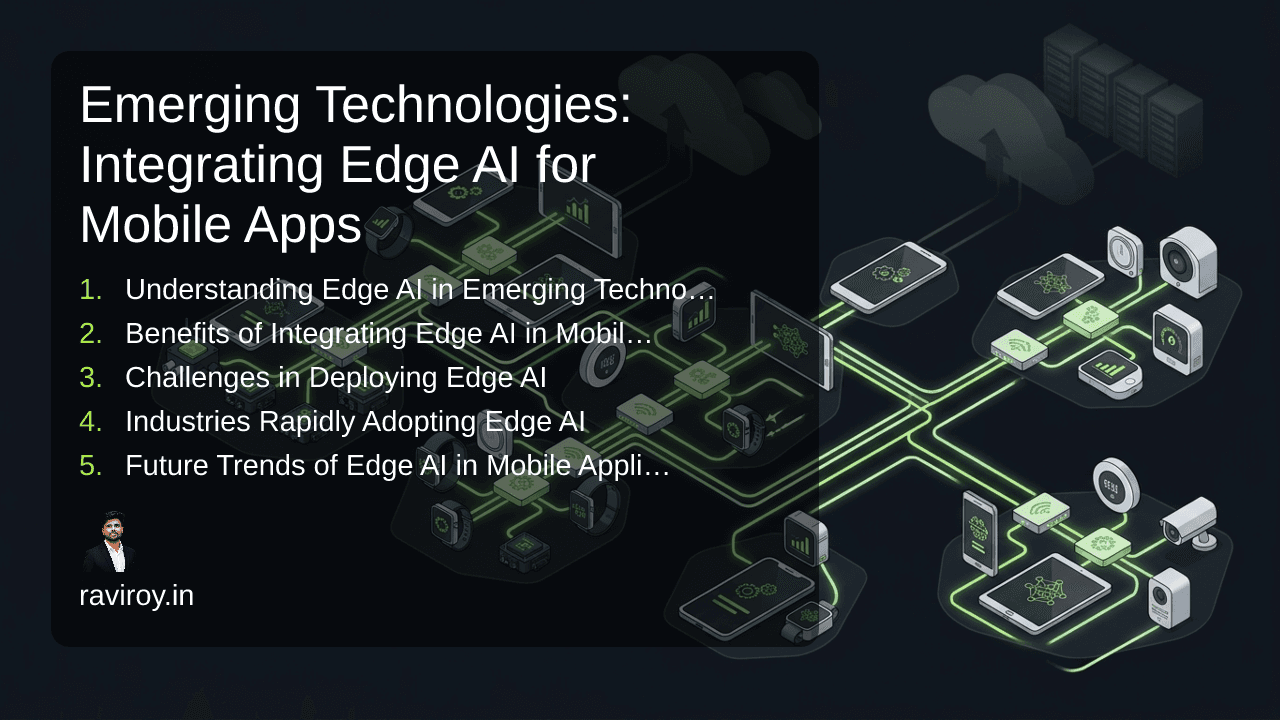
Edge AI represents a paradigm shift in the way artificial intelligence processes data, enabling smart analysis and decision-making at or near the source of data. Unlike traditional AI models that depend heavily on cloud computing, Edge AI takes advantage of edge devices like smartphones and IoT gadgets to perform computations and analyses locally. This shift significantly reduces latency and improves the efficiency of mobile applications, allowing for faster response times and enhanced user experiences.
At its core, Edge AI leverages machine learning algorithms that are deployed directly on mobile devices, enabling real-time processing without the need to communicate with distant servers for every request. This not only minimizes bandwidth usage but also enhances the overall performance of mobile applications.
Key Features of Edge AI
On-Device Processing: One of the hallmark features of Edge AI is its ability to process data directly on devices, offering real-time results. For instance, a mobile app equipped with image recognition capabilities can identify objects almost instantaneously without relying on cloud computations. This level of responsiveness is crucial for applications like augmented reality and gaming where user experience hinges on immediate feedback.
Reduced Latency: Edge AI’s localized processing leads to significantly lower latency. As data doesn’t need to travel to a central server for processing, users experience instantaneous interactions. This technological advancement is especially beneficial in mobile applications where split-second decisions are essential, such as in mobile gaming or autonomous navigation.
Benefits of Integrating Edge AI in Mobile Applications
Real-Time Capabilities
Integrating Edge AI into mobile applications dramatically enhances real-time capabilities, a critical component in ensuring user engagement. For example, chat applications can enable features like immediate language translation, providing users with a seamless communication experience without noticeable delays. Statistics reveal that applications utilizing Edge AI can see user engagement increase by up to 30%, showcasing the demand for instant results in a fast-paced digital environment.
Data Privacy Improvements
Privacy concerns are more pressing than ever, especially in an age where data breaches make headlines regularly. By processing data on-device, Edge AI provides a level of privacy assurance that traditional cloud-based systems cannot. Personal information is analyzed locally, meaning sensitive data is rarely transmitted over the internet, substantially reducing the risk of exposure. Research indicates that 78% of consumers are more likely to use applications that prioritize their data security—a compelling reason for developers to consider Edge AI in their solutions.
Challenges in Deploying Edge AI
Technical Limitations
Despite its potential, the deployment of Edge AI is fraught with challenges. One primary constraint is the limited computational power of many edge devices, leading to difficulties when handling complex AI models. Mobile apps must be carefully designed to balance processing capabilities while still delivering advanced features. Developers might consider lightweight models that maintain efficiency without sacrificing performance.
Energy Efficiency Concerns
Running sophisticated AI computations on mobile devices can significantly impact battery life. Edge AI models demand optimization to ensure minimal energy consumption, especially in mobile applications where users expect longevity. Solutions like hardware accelerators, such as GPUs or specialized chips, can enhance energy efficiency while running advanced algorithms. Continuous monitoring and adaptive algorithms can help maintain optimal performance without draining resources.
Industries Rapidly Adopting Edge AI
Mobile Banking
The mobile banking sector is a prime example of Edge AI application, enhancing user experiences with features like facial recognition for secure transactions and real-time fraud detection. Case studies demonstrate that banks utilizing Edge AI have reported a 40% reduction in transaction time due to immediate on-device processing, fostering higher customer satisfaction and engagement.
E-commerce Applications
In the competitive world of e-commerce, businesses are rapidly adopting Edge AI to tailor the shopping experience. From personalized recommendations to AR-enabled virtual fitting rooms, Edge AI empowers applications to respond to user behavior instantly. Statistics from recent studies show that e-commerce platforms implementing Edge AI have experienced a 25% uptick in conversion rates due to enhanced user interactions.
Future Trends of Edge AI in Mobile Applications
Expanding Mobile AI Market
The mobile AI market is projected to grow exponentially in the coming years, fueled by advancements in edge computing and mobile technology. Major players are introducing more sophisticated algorithms that run efficiently on consumer devices, increasing the appeal of apps that utilize Edge AI. In fact, projections estimate that by 2025, 70% of new mobile applications will incorporate some form of Edge AI.
The Role of MLOps
As organizations increasingly rely on Edge AI, the need for effective MLOps practices becomes vital. By embracing MLOps, companies can streamline model deployment and management processes, ensuring the AI capabilities within mobile apps evolve alongside user expectations. Continuous updates and model retraining are essential for maintaining performance and relevance in a fast-paced market.
User Experience Enhancement through Edge AI
Personalization and Virtual Assistants
Edge AI allows mobile applications to deliver unprecedented levels of personalization through real-time analytics. For example, virtual assistants integrated with Edge AI can process user commands and preferences immediately, providing intuitive responses that enhance user satisfaction. Companies that have deployed Edge AI in their virtual assistants report an increase in user engagement by approximately 20%.
Moreover, personalization through Edge AI adapts to user behaviors and preferences over time, creating a more tailored experience that resonates with users. For instance, a music streaming app can instantly curate playlists based on listening habits, significantly boosting user satisfaction metrics.
Conclusion
The potential of Edge AI in mobile applications is immense, transforming user experiences through real-time capabilities and enhanced data privacy. However, challenges remain, necessitating innovative solutions and practices. As industries increasingly adopt Edge AI, we can anticipate exciting developments in mobile applications.
What unique features or improvements have you seen from Edge AI in mobile apps that stood out to you?
💬 Join the conversation — share your take in the comments and tell us what you’d add.