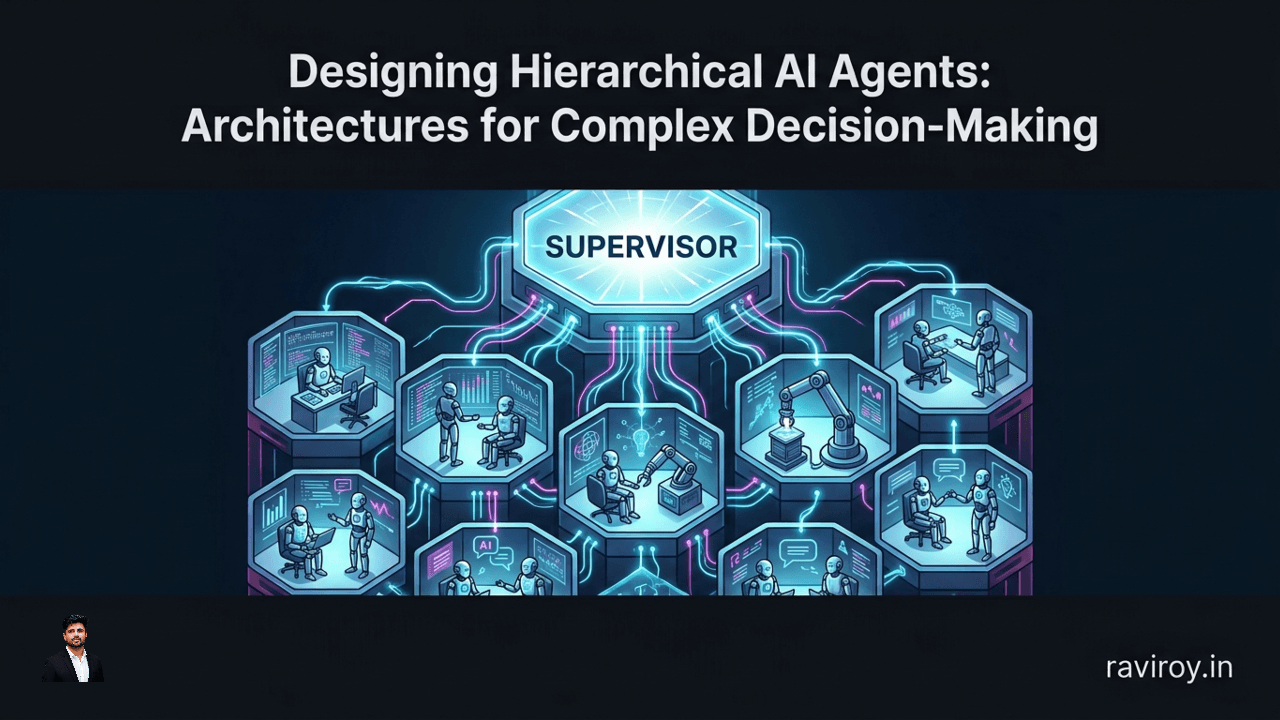
Tackling truly complex problems often feels like trying to orchestrate a symphony with a single conductor managing every individual instrument. In the realm of artificial intelligence, this challenge is magnified when designing agents capable of handling multi-faceted tasks. This is where designing hierarchical AI agents becomes not just advantageous, but essential, allowing us to break down monumental challenges into manageable, interconnected parts, just like a well-organized company structure.
Understanding Hierarchical AI Agents for Complex Tasks
Imagine a general leading an army; they don't personally command every soldier, but rather delegate to officers, who in turn delegate to sergeants, and so on. This multi-layered approach is the essence of hierarchical AI agents, offering a robust framework for handling intricate operations that would overwhelm a single, monolithic AI.
What Exactly are Hierarchical AI Agents?
At its core, a hierarchical AI agent system is an architectural paradigm where intelligence and control are distributed across multiple agents organized in a layered structure. A higher-level agent (often termed the "supervisor" or "orchestrator") delegates broad objectives to lower-level agents ("workers"), which then execute specific tasks, potentially breaking them down further for even lower-level agents. The supervisor oversees the overall strategy, monitors progress, and integrates results, while worker agents focus on specialized execution, often utilizing specific tools or knowledge domains.
The primary purpose of these systems is to effectively tackle complex, multi-domain problems by systematically decomposing them into smaller, more manageable sub-problems. This approach mirrors human organizational structures, allowing for focused expertise at each level and efficient coordination across the entire system. The supervisor-worker model is the dominant framing, where the supervisor acts as the strategic brain, and workers are the specialized hands.
The Mechanics: Supervisor, Workers, and Task Decomposition
The power of hierarchical AI agents lies in their structured delegation and specialized execution. Understanding how these layers interact is key to building effective systems.
Decomposing Complexity with Multi-Level Delegation
The supervisor agent plays a pivotal role in the hierarchy. It's responsible for the overarching strategy, high-level planning, and the initial decomposition of a complex goal into a series of logical subtasks. For instance, if the goal is "research, write, and publish an article on quantum computing," the supervisor might first break this down into:
Research phase (information gathering).
Drafting phase (content generation).
Editing phase (review and refinement).
Publication phase (formatting and submission).
Each of these phases is then delegated to a specific worker agent or group of agents. Worker agents, on the other hand, are specialists. They receive their delegated subtask, execute it using their specific skills, tools, and knowledge base, and then report their results back up the chain. An "editing agent" might use grammar checkers, style guides, and even cross-reference factual claims, then return a refined draft to the supervisor. This multi-level task decomposition allows for scaling complex workflows efficiently, as each agent can focus on its area of expertise without being burdened by the entire problem's complexity.
Communication and Coordination Patterns
Effective communication and coordination are the lifeblood of any hierarchical agent system. Without clear mechanisms, the system can quickly devolve into chaos or suffer from significant delays. Common communication mechanisms between layers include:
Shared State/Knowledge Bases: Agents might write their progress or findings to a central database or knowledge graph, which other agents can read from. This allows for asynchronous updates and broad context sharing.
Message Queues: For more explicit task delegation and result reporting, message queues (e.g., Kafka, RabbitMQ) provide a robust, asynchronous communication channel. A supervisor sends a "start task" message, and a worker sends a "task complete" message with results.
API Calls: Agents can expose specific functionalities via APIs, allowing other agents (usually from a higher level) to directly invoke their services and receive synchronous responses. This is common for tool-use agents.
Event-Driven Architectures: Agents can publish events when significant milestones are reached or states change, and other agents can subscribe to these events to trigger their own actions.
Layered control is distinct: the top tier focuses on strategy (what needs to be achieved), the middle tiers on planning (how to achieve it, and breaking it down), and the lower tiers on execution (doing the actual work). This clear separation of concerns ensures that each layer operates within its defined scope, optimizing efficiency and reducing miscommunication.
When to Deploy a Hierarchical Multi-Agent System
Choosing the right architectural pattern for AI agents is crucial. While simpler, flat architectures have their place, hierarchical systems shine in specific scenarios.
Advantages Over Flat Architectures
Consider a flat architecture where all agents are peers, potentially communicating in a mesh or hub-spoke pattern. While easy to set up for simple, independent tasks, this can lead to significant overhead and complexity as the problem scales. Every agent might need to understand the full context or coordinate directly with many others.
Hierarchical architectures offer distinct advantages:
Better Resource Management: Specialized agents only load the tools and knowledge pertinent to their specific tasks, reducing overall computational overhead compared to a monolithic agent attempting everything.
Clearer Accountability: Each agent has a defined role and responsibility within its layer, making it easier to track progress, identify bottlenecks, and debug failures.
Improved Fault Isolation: If a worker agent fails on a subtask, the impact can often be contained to that subtask, and the supervisor can potentially re-delegate or invoke a fallback mechanism, rather than crashing the entire system.
Reduced Cognitive Load on Individual Agents: No single agent needs to comprehend the entire problem space. The supervisor manages the big picture, while workers focus on their niche expertise, leading to more efficient processing and potentially higher quality output.
Enhanced Scalability: New specialized worker agents can be added or swapped out without redesigning the entire system, as long as they adhere to the interface expected by their supervisor.
Ideal Scenarios for Complex Decision-Making
Hierarchical systems are particularly well-suited for multi-domain workflows that demand sophisticated planning, execution, and oversight. Think about processes that naturally involve distinct stages and different skill sets.
Examples include:
Automated Content Creation: A supervisor agent tasked with "create a blog post about X" might delegate to a "research agent," a "drafting agent," an "SEO optimization agent," and a "proofreading agent."
Complex Code Generation with Testing: A supervisor receives a high-level feature request. It delegates to a "design agent" (API, data models), then to a "coding agent" (implementing features), then to a "testing agent" (unit, integration tests), and finally to a "refactoring/optimization agent."
Scientific Discovery Workflows: An agent system could manage hypothesis generation, experimental design, data collection via tool use (e.g., calling APIs for lab equipment), data analysis, and report generation, each handled by specialized sub-agents.
Advanced Customer Support: A high-level agent identifies customer intent, then delegates to a "knowledge base lookup agent," a "troubleshooting agent" (which might interact with specific system APIs), or even an "escalation agent" if human intervention is required.
These scenarios justify the choice of a hierarchical system because they require not just action, but structured thought, decision-making at multiple levels, and the coordinated application of diverse capabilities.
Blueprint Your Agent Hierarchy: Delegation, Layers, and Limits
Designing an effective hierarchical AI agent system is more than just stacking agents. It requires thoughtful planning around delegation, structure, and safety.
Defining Clear Delegation Boundaries
Ambiguity is the enemy of efficient multi-agent systems. For each agent, whether supervisor or worker, its responsibilities must be crystal clear.
Guidelines for defining clear boundaries:
Input/Output Contracts: Explicitly define what input a worker agent expects and what output it promises. This acts as an interface.
Domain Expertise: Each worker agent should have a distinct, well-defined domain of expertise and a set of tools it can use. Avoid overlapping responsibilities unless redundancy is a deliberate design choice for resilience.
Decision Scope: Supervisors make strategic decisions about what needs to be done next and who should do it. Workers make tactical decisions about how to execute their delegated task within their scope.
Escalation Paths: Define when and how a worker agent should escalate an issue (e.g., encountering an unresolvable error, needing information outside its domain) back to its supervisor.
For example, a "research agent" is responsible for gathering information and summarizing it. It should not be responsible for writing the final article. Its output is a structured summary, which then becomes input for a "writing agent."
Determining the Right Number of Layers
There's no magic number of layers for a hierarchical system; it depends entirely on the problem's nature.
Factors influencing the optimal number of layers:
Problem Complexity: Highly complex, multi-stage problems naturally lend themselves to more layers. A simple "fetch data" task might need one agent, while a "develop and deploy a new software module" might need three or four.
Scope of Tasks: How granular do tasks need to get before they become atomic and directly executable by a single worker? This determines the depth.
Communication Overhead: Each layer adds communication and coordination overhead. Too many layers can introduce significant latency and make debugging difficult. Aim for the minimum number of layers necessary to effectively decompose the problem.
Human Cognitive Load: Designing and managing the hierarchy should remain comprehensible to human developers. An overly deep hierarchy can become a labyrinth.
Generally, most enterprise applications find a sweet spot with 2-4 layers (e.g., Grand Orchestrator -> Domain Supervisor -> Task Worker -> Tool Agent).
Implementing Bounded Recursion and Safety
One of the critical design challenges in hierarchical agent systems is preventing runaway processes—infinite loops, scope creep, or resource exhaustion.
Bounded Recursion: If a supervisor can delegate to a worker, and that worker can itself become a supervisor, this recursive delegation needs explicit bounds.
Max Depth Parameter: Define a maximum depth for the task delegation tree. If an agent tries to delegate past this depth, it should be flagged as an error or handled by a default worker.
Timeouts: Each delegated task should have an execution timeout. If a worker fails to complete within this time, the supervisor should intervene (retry, re-delegate, escalate).
Strict Delegation Limits: Agents should only be able to delegate tasks that are within the capabilities of their designated worker pool. A research agent shouldn't be able to ask a code generation agent to write a poem.
Permission Boundaries: Define what resources (APIs, databases, external tools) each agent can access. This prevents unauthorized access and limits potential damage in case of agent malfunction.
Escalation Paths: Beyond just reporting errors, define clear pathways for when a task requires human intervention or cannot be resolved by the current hierarchy. This might involve flagging a human operator or triggering a fallback manual process.
Graceful Degradation: Design the system to continue functioning, albeit with reduced capabilities, if certain agents or layers fail. For example, if an AI proofreading agent fails, the system might publish the article with a warning that it wasn't proofread by AI, rather than halting publication entirely.
Operationalizing Your Hierarchical Agent System
Once designed, deploying and maintaining a hierarchical agent system requires robust operational considerations to ensure reliability and performance.
Robust Routing and State Management
Efficiently moving tasks, subtasks, and results across layers is fundamental.
Routing Mechanisms: Implement a centralized task orchestrator or a message broker to intelligently route tasks to appropriate worker agents based on their capabilities and current load. This could involve a simple queue per worker type or a more sophisticated system matching task requirements to agent profiles.
State Management Strategies:
Centralized State Store: A database (e.g., PostgreSQL, MongoDB) or key-value store (e.g., Redis) can maintain the overall state of the workflow. Each agent updates its portion of the state upon completion or significant progress.
Distributed Ledger/Event Sourcing: For high integrity and auditability, an event-sourced approach where all actions are recorded as an immutable sequence of events can be beneficial.
Context Passing: Ensure that when a supervisor delegates a task, sufficient context (relevant information, constraints, previous steps) is passed down to the worker to avoid redundant work or misinterpretation. This might involve a structured
TaskContextobject.
{
  "task_id": "article-creation-001",
  "parent_task_id": "overall-content-strategy-005",
  "delegator_id": "supervisor-agent-001",
  "assignee_agent_type": "research-agent",
  "objective": "Gather 5 key scientific breakthroughs in quantum computing since 2020.",
  "context": {
    "topic": "quantum computing",
    "target_audience": "technical professionals",
    "word_count_guideline": "500-700 words for research summary"
  },
  "status": "pending",
  "priority": "high",
  "max_retries": 3
}
Handling Failures and Retries
Failures are inevitable in complex distributed systems. A well-designed hierarchical system anticipates and handles them gracefully.
Retry Logic: Implement intelligent retry mechanisms for transient failures (e.g., network issues, temporary API unavailability). This should include exponential backoff and a maximum number of retries before declaring a permanent failure.
Error Propagation: When a worker agent encounters a non-recoverable error, it must accurately report this back to its supervisor. The error report should include detailed context (error type, stack trace, relevant inputs) to aid debugging and decision-making by the supervisor.
Fallback Mechanisms: Supervisors should be designed with fallback strategies. If a primary worker agent type consistently fails or is unavailable, can the task be delegated to an alternative agent? Or can a simpler, albeit less optimal, solution be adopted?
Idempotency: Design agent actions to be idempotent where possible. This means that executing the same action multiple times (e.g., due to retries) has the same effect as executing it once, preventing unintended side effects.
Observability and Monitoring for Agent Stacks
You can't manage what you don't measure. Robust observability is crucial for understanding, debugging, and optimizing hierarchical agent systems.
Structured Logging: Every agent should emit structured logs (e.g., JSON format) detailing its actions, decisions, inputs, outputs, and any errors. These logs should include unique task IDs and agent IDs to trace execution paths across the hierarchy.
Metrics Collection: Collect key performance indicators (KPIs) for each agent and the system as a whole:
Task completion rates (per agent type, per task type)
Latency (time taken for tasks, inter-agent communication)
Resource utilization (CPU, memory, API calls)
Error rates (per agent, per external tool)
Queue depths (for message queues)
Distributed Tracing: Implement distributed tracing (e.g., using OpenTelemetry) to visualize the flow of a single request or task across multiple agents and services. This is invaluable for pinpointing performance bottlenecks and debugging complex inter-agent interactions.
Alerting: Set up alerts based on critical metrics and error rates. For example, if a specific worker agent's error rate exceeds a threshold, or if task completion latency significantly increases, alerts should notify human operators.
Dashboards: Create intuitive dashboards that provide real-time insights into the system's health, agent performance, and workflow progress.
Navigating the Challenges: Latency, Cost, and Coordination Overhead
While powerful, hierarchical AI agent systems are not without their complexities and potential drawbacks. Understanding these challenges is the first step toward mitigating them.
Quantifying Performance and Resource Trade-offs
The distributed nature of hierarchical agents inherently introduces trade-offs compared to a single, monolithic system.
Increased Latency: Inter-agent communication, serialization/deserialization of data, and the overhead of orchestration layers add latency. Each delegation step takes time, meaning a task that could be done by a single, faster agent might be slower when split across several.
Higher Compute Costs for Orchestration: Running multiple agents, message queues, state management databases, and monitoring tools all consume computational resources. The orchestration layer itself adds to the compute footprint, potentially increasing cloud service costs.
Coordination Overhead: Beyond just compute, the effort involved in designing, implementing, and maintaining the communication protocols, task routing, and error handling logic across multiple agents is significant. This engineering overhead should be factored into development timelines and budget.
Mitigating Coordination Complexities and Risks
The very flexibility that makes hierarchical agents powerful can also introduce new categories of problems.
Emergent Undesirable Behaviors: The interaction between multiple independently acting agents can lead to unexpected, non-linear system behaviors that are difficult to predict or reproduce. For example, two agents optimizing for local goals might inadvertently create a suboptimal global outcome.
Debugging Difficulties: Tracing an issue through multiple layers of agents, each with its own logs and state, can be significantly more challenging than debugging a single application. Distributed tracing tools become indispensable here.
Misinterpretation of Delegated Tasks: Despite clear contracts, an agent might misinterpret the intent of a delegated task due to subtle ambiguities in natural language instructions, or a lack of complete contextual understanding. This can lead to incorrect results or unnecessary work.
Practical Strategies to Mitigate These Risks:
Clear Communication Protocols and Schemas: Standardize the format and content of messages passed between agents. Use structured data formats (e.g., JSON, Protocol Buffers) with clear schemas to minimize misinterpretation.
Structured Feedback Loops: Implement mechanisms for worker agents to provide structured feedback to supervisors, not just results. This feedback could include confidence scores, alternative interpretations, or detected ambiguities, allowing the supervisor to refine future delegations.
Human-in-the-Loop (HITL) Intervention: For critical workflows, build explicit checkpoints where human review or approval is required. This can catch errors, refine agent behavior, and build trust in the system. For instance, a human might review a complex code change generated by an AI before it's committed.
A/B Testing Agent Designs: When refining agent behaviors or communication patterns, use A/B testing to compare different designs in a controlled environment, measuring their impact on key metrics before full deployment.
Simulation Environments: Develop robust simulation environments to test agent interactions and identify emergent behaviors before deploying to production. This allows for safe experimentation with different hierarchical configurations.
Version Control for Agent Capabilities: Treat agent capabilities, prompts, and configurations as code, managing them with version control systems to track changes and roll back if necessary.
Enterprise Workflows Powered by Hierarchical AI Agents
The true potential of hierarchical AI agents lies in their ability to automate and optimize complex, knowledge-intensive workflows within the enterprise.
Examples in Multi-Domain Problem Solving
Let's look at concrete, actionable examples where these architectures shine:
Automated Research Assistant:
Supervisor: Receives a complex research query (e.g., "Analyze market trends for sustainable energy in Q3 2024, focusing on competitor activities and regulatory changes.").
Worker 1 (Market Data Agent): Queries financial databases, news APIs for market trends.
Worker 2 (Competitor Analysis Agent): Scrapes competitor websites, press releases, and industry reports.
Worker 3 (Regulatory Agent): Consults legal databases, government publications for policy changes.
Worker 4 (Synthesis Agent): Combines findings from workers 1-3, identifies key insights, and generates a structured report, which the supervisor then reviews and presents.
Complex Code Generation with Testing:
Supervisor: Receives a high-level user story (e.g., "Implement a new user authentication module with OAuth2 support and rate limiting.").
Worker 1 (Design Agent): Proposes API endpoints, database schemas, and architectural patterns.
Worker 2 (Code Generation Agent): Writes the core code based on the design, potentially calling a "Tool Agent" for specific library functions.
Worker 3 (Testing Agent): Generates unit tests, integration tests, and runs them against the new code. Reports failures back to the supervisor.
Worker 4 (Refactoring/Optimization Agent): If tests pass, reviews code for best practices, performance, and security, making further refinements before returning to the supervisor for final approval.
Multi-Stage Content Creation:
Supervisor: Goal: "Create a series of social media posts promoting a new product launch."
Worker 1 (Audience Agent): Analyzes target audience demographics, preferences, and platform specifics.
Worker 2 (Creative Brief Agent): Generates core messaging, calls to action, and visual concepts.
Worker 3 (Copywriting Agent): Drafts engaging captions and headlines for various platforms based on the brief.
Worker 4 (Image Generation Agent): Creates suitable imagery or suggests stock photos.
Worker 5 (Scheduling Agent): Schedules posts on appropriate platforms, handles approval workflows.
These examples clearly demonstrate how hierarchical agents effectively combine research, coding, writing, and various tool uses in integrated, automated workflows. Each agent focuses on its specialized capability, contributing to a much larger, more sophisticated outcome.
The Future of Agent Collaboration
The landscape of AI agents is evolving rapidly. As models become more capable and our understanding of complex systems deepens, we can expect even more sophisticated collaborative systems. Future developments might include dynamic hierarchy adjustments based on task complexity, advanced self-healing capabilities, and more intuitive human-agent collaboration interfaces. The goal remains the same: to empower organizations to tackle problems of unprecedented scale and complexity, ultimately augmenting human creativity and productivity.
Given the trade-offs and benefits, what specific enterprise workflow have you encountered where a hierarchical AI agent system would clearly outperform a flat or sequential approach, and why?
💬 Join the conversation — share your take in the comments and tell us what you’d add.