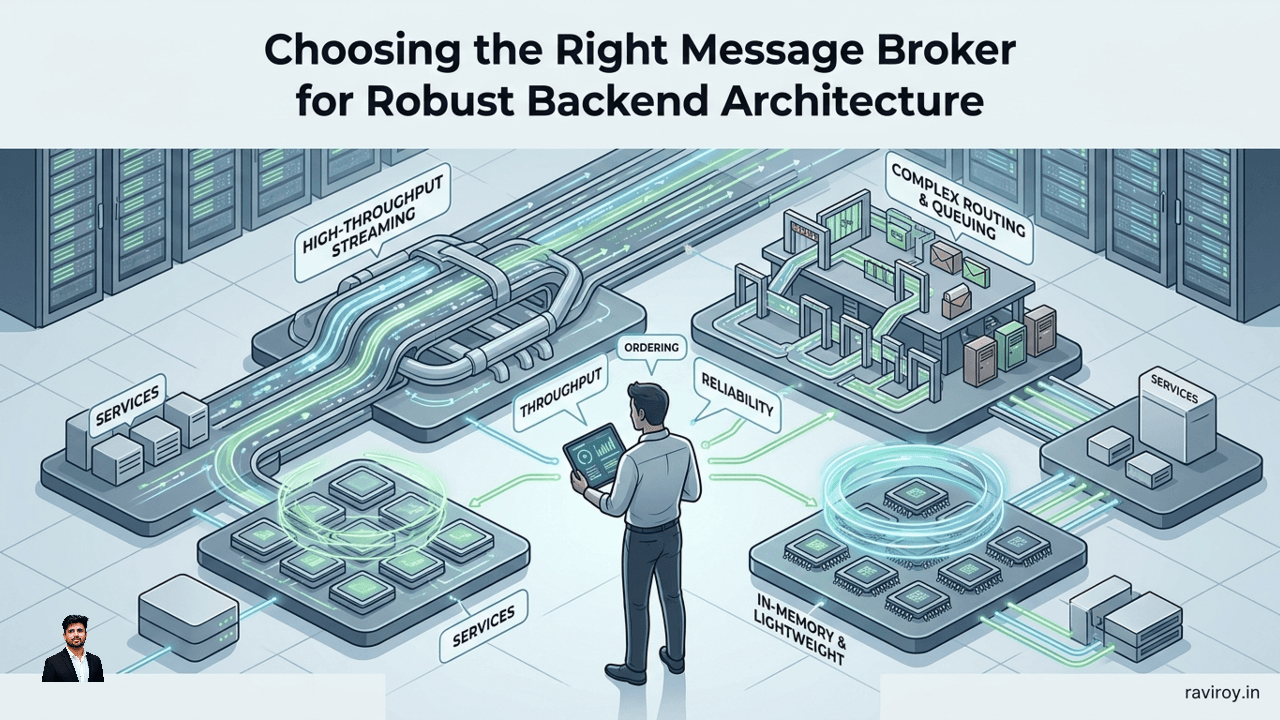
Building robust, scalable, and resilient backend frameworks & architecture demands careful consideration of every component. One of the most impactful choices for modern distributed systems is the message broker, a technology that underpins asynchronous communication and service decoupling. Deciding which message broker to integrate can profoundly shape your system's performance, reliability, and operational overhead.
Navigating Backend Frameworks & Architecture: Why Message Brokers are Essential
In today's distributed applications, services often need to communicate without being directly coupled. This is where message brokers shine. They act as intermediaries, allowing different services to send and receive messages without knowing each other's direct location or availability. This mechanism enables asynchronous communication, where a sender can dispatch a message and continue its work without waiting for the recipient to process it immediately.
The benefits of incorporating a message broker into your backend frameworks & architecture are multifold:
Improved Scalability: Services can scale independently. If a service generates a high volume of messages, adding more consumers to the message queue can handle the load without impacting the sender.
Enhanced Resilience: If a consumer service goes down, messages aren't lost; they remain in the broker until the service recovers and can process them. This prevents cascading failures and improves overall system stability.
Increased Maintainability: By decoupling services, changes to one service are less likely to impact others. This simplifies development, testing, and deployment, making the system easier to maintain and evolve.
Load Balancing: Message brokers can distribute tasks among multiple worker instances, ensuring even workload distribution and preventing any single service from becoming a bottleneck.
Event-Driven Architectures: They form the backbone of event-driven systems, allowing services to react to events published by other services, leading to highly responsive and flexible applications.
However, the landscape of message brokers is diverse, with each solution optimized for different scenarios. There's no single "best" message broker; the optimal choice critically depends on your specific workload, non-functional requirements, and operational capabilities. Making the right decision is crucial for establishing a solid foundation for your backend architecture.
Which Message Broker is Best? Start with Your Workload's Core Needs
Before diving into specific technologies, it's essential to understand the fundamental characteristics of your data flow and communication patterns. Your workload's core needs will dictate which message broker features are most important.
High-Throughput Event Streaming & Data Pipelines
If your application involves ingesting massive volumes of data, processing events in real-time, and building data pipelines, you'll need a broker designed for high-throughput event streaming.
Requirements:
Massive Data Ingestion: Ability to handle millions of events per second.
Ordered Processing: Guaranteeing that events within a specific stream or partition are processed in the order they were published.
Durability & Replayability: Messages should be persistently stored for a configurable period, allowing consumers to re-read past events (e.g., for analytics, debugging, or state reconstruction).
Scalability for Both Producers and Consumers: Ability to scale horizontally to accommodate increasing data volume and processing demands.
Use Cases:
Real-time Analytics: Processing clickstreams, user behavior, and sensor data for immediate insights.
Log Aggregation: Centralizing logs from numerous services for monitoring and analysis.
Change Data Capture (CDC): Streaming database changes to other systems for replication, caching, or data warehousing.
Event Sourcing: Storing a chronological sequence of events as the primary source of truth for an application's state.
Complex Routing & General-Purpose Task Queues
For scenarios requiring flexible message routing, various consumer patterns, and reliable delivery for background jobs, a broker offering robust queueing and routing capabilities is more appropriate.
Requirements:
Flexible Message Routing: Messages need to be routed to specific queues based on attributes or patterns, potentially involving complex rules.
Multiple Consumer Patterns: Support for both competing consumers (where multiple workers process messages from a single queue) and fanout patterns (where a message is delivered to multiple distinct queues).
Request-Reply Semantics: Ability for services to send a request message and receive a corresponding reply.
Message Acknowledgment: Consumers must explicitly acknowledge message processing, ensuring messages aren't lost if a consumer fails.
Dead Letter Queues (DLQs): Mechanisms to handle messages that cannot be processed successfully, preventing them from blocking the main queue.
Use Cases:
Background Job Processing: Offloading resource-intensive tasks (e.g., image resizing, report generation, email sending) from the main request thread.
Notifications: Sending push notifications, emails, or SMS messages reliably.
Inter-Service Commands: Orchestrating workflows between microservices where explicit command acknowledgment is required.
Work Queue Management: Distributing tasks among a pool of workers.
Low-Latency Service-to-Service Communication
When the absolute lowest latency is paramount for real-time interactions between services, especially in high-volume, ephemeral messaging scenarios, you'll need a broker optimized for speed over persistence.
Requirements:
Minimal Overhead: The broker itself should add negligible latency to message transmission.
Speed Over Persistence: Messages are often transient; losing some messages might be acceptable if it means achieving ultra-low latency.
High Fan-out: Efficiently delivering messages to a large number of subscribers simultaneously.
Dynamic Discovery: Services can easily discover and connect to the messaging system without complex configuration.
Use Cases:
IoT Sensor Data: Rapidly collecting and disseminating sensor readings from a multitude of devices.
Real-time Gaming Updates: Broadcasting game state changes to connected players.
Control Plane Messaging: Internal communication within distributed systems for configuration updates, service discovery, or status reporting.
Chat Applications: Delivering messages between users with minimal delay.
NATS: Core NATS vs. NATS JetStream It's important to distinguish here: Core NATS epitomizes low-latency, "at-most-once" delivery where speed is king. It's a fire-and-forget system, ideal for ephemeral real-time data. NATS JetStream, built on top of NATS, adds persistence, stream processing, and "at-least-once" delivery guarantees, effectively bringing NATS into the event streaming realm while maintaining much of its performance DNA. Your choice depends on whether you need pure speed or persistent event streams.
Simple Asynchronous Processing & Managed Queues
For teams looking to minimize operational burden and quickly implement basic asynchronous communication without managing complex infrastructure, fully managed queueing services are an attractive option.
Requirements:
Reduced Operational Overhead: Minimal or zero server provisioning, patching, or scaling concerns.
High Availability & Durability: The service inherently provides fault tolerance and data persistence.
Auto-Scaling: Automatically handles fluctuating message volumes without manual intervention.
Straightforward API: Simple programmatic interface for sending and receiving messages.
Use Cases:
Decoupled Microservices: Simple message passing between microservices where custom routing logic is not a primary concern.
Scheduled Tasks: Triggering background jobs or batch processes based on events.
Processing User-Generated Content: Queueing requests for image uploads, video encoding, or document processing.
Webhooks & Event Triggers: Integrating with external services or triggering serverless functions.
The key benefit here is abstraction. You delegate the complexities of message broker management to a cloud provider, freeing your team to focus on application logic.
A Deep Dive into Popular Message Broker Solutions
With a clear understanding of workload types, let's explore some of the leading message broker solutions and their characteristics.
Apache Kafka: The Event Streaming Powerhouse
Kafka is a distributed streaming platform, not just a message queue. It's built as a distributed commit log, making it ideal for high-throughput, fault-tolerant event streaming.
Key Features:
Distributed, Partitioned Log: Data is organized into topics, which are split into partitions. Each partition is an ordered, immutable sequence of records.
High Throughput: Designed to handle millions of messages per second.
Fault-Tolerant: Partitions are replicated across multiple brokers, ensuring data availability even if a broker fails.
Data Retention: Messages are stored persistently on disk for a configurable period, allowing consumers to re-read past events.
Consumer Groups: Multiple consumers can process messages from the same topic, distributing the load and allowing for parallel processing.
Strengths:
Event Sourcing & Stream Processing: Excellent for building event-driven architectures, real-time analytics, and data pipelines.
Real-time Data Feeds: Ingesting and serving massive streams of data from various sources.
Scalability: Highly scalable horizontally for both producers and consumers.
Robust Ecosystem: Large community, extensive client libraries, and integrations with stream processing frameworks (e.g., Kafka Streams, Flink, Spark).
Considerations:
Operational Complexity: Self-managing Kafka clusters can be complex, requiring expertise in distributed systems, ZooKeeper (or Kraft), and monitoring. Managed Kafka services (e.g., Confluent Cloud, AWS MSK) mitigate this.
Learning Curve: The concepts of topics, partitions, offsets, and consumer groups can take time to master.
Consumer Group Management: Careful management of consumer group IDs and offsets is crucial for reliable processing.
Not a Traditional Queue: While it can function as a queue, its strengths lie in stream processing, and it doesn't offer complex routing patterns like RabbitMQ out-of-the-box.
RabbitMQ: Flexible Message Routing for Diverse Applications
RabbitMQ is a general-purpose message broker that implements the Advanced Message Queuing Protocol (AMQP). It excels at flexible routing and robust message delivery guarantees.
Key Features:
AMQP Protocol: Provides rich message semantics and routing capabilities.
Exchanges: Messages are published to exchanges, which then route them to queues based on various rules (direct, fanout, topic, headers).
Queues: Messages are held in queues until consumed.
Flexible Routing Patterns: Supports a wide array of messaging patterns, including point-to-point, publish/subscribe, request/reply, and RPC.
Message Acknowledgment: Consumers explicitly acknowledge messages, ensuring "at-least-once" delivery.
Persistence: Messages can be made persistent to disk, surviving broker restarts.
Strengths:
Complex Message Delivery: Ideal for scenarios requiring intricate routing logic, filtering, and multiple consumer patterns.
RPC Patterns: Built-in support for request/reply communication.
Message Acknowledgment & DLQs: Strong guarantees for reliable message processing and handling of unprocessable messages.
Broad Language Support: Excellent client libraries for almost every popular programming language.
Mature & Widely Adopted: A well-established and trusted broker with a large community.
Considerations:
Performance Relative to Kafka: While fast, RabbitMQ typically offers lower raw throughput compared to Kafka for massive event streams.
Persistence Strategy: While persistent, relying solely on RabbitMQ for long-term data retention might not be ideal for stream replay use cases like Kafka.
Operational Overhead: Self-managing a highly available RabbitMQ cluster with mirrored queues can be complex.
NATS: Lightweight, High-Performance Messaging
NATS is a simple, secure, and high-performance messaging system designed for microservices, IoT, and cloud-native applications. Its core strength is speed and simplicity.
Key Features:
Simple Pub/Sub: Core NATS provides a fire-and-forget publish/subscribe model.
Request/Reply: Supports synchronous-like request/reply patterns over asynchronous messaging.
Optional JetStream for Persistence: NATS JetStream layers persistence, streaming, and "at-least-once" delivery onto the core NATS protocol, offering Kafka-like capabilities with NATS's performance.
Autonomy: Designed to be highly available and resilient, requiring minimal configuration.
Low Footprint: Efficient resource utilization, making it suitable for edge devices.
Strengths:
Ultra-Low Latency: Extremely fast message delivery, making it ideal for real-time internal microservice communication and high-frequency data.
Small Footprint: Light on resources, excellent for environments where resource efficiency is critical.
Ease of Use: Simple API and operational model for basic pub/sub.
Internal Microservice Communications: Excellent for orchestrating internal service interactions, command and control messaging.
Considerations:
Core NATS Lacks Built-in Persistence: Without JetStream, core NATS does not guarantee message delivery if consumers are offline or if the server crashes. This is a design choice for speed.
Less Complex Routing than RabbitMQ: NATS focuses on simplicity; advanced routing logic is typically handled by application code.
JetStream adds complexity: While powerful, JetStream introduces more operational concepts compared to core NATS.
AWS SQS/SNS: Cloud-Native Simplicity and Scale
Amazon Web Services (AWS) offers Simple Queue Service (SQS) for message queuing and Simple Notification Service (SNS) for publish/subscribe messaging, both fully managed services.
Key Features:
Fully Managed: AWS handles all the infrastructure, scaling, and operational tasks.
Standard and FIFO Queues (SQS): Standard queues offer high throughput with "at-least-once" delivery and best-effort ordering. FIFO (First-In-First-Out) queues guarantee strict message ordering and "exactly-once" processing.
Pub/Sub Messaging (SNS): Allows publishers to send messages to a topic, which can then fan out to multiple subscribers (e.g., SQS queues, Lambda functions, HTTP endpoints, emails).
AWS Ecosystem Integration: Seamlessly integrates with other AWS services like Lambda, EC2, CloudWatch, and more.
High Availability & Durability: Designed for high durability and availability across AWS regions and availability zones.
Strengths:
Zero Operational Overhead: No servers to provision, patch, or scale. Ideal for lean teams or serverless architectures.
Auto-Scaling: Automatically scales to handle fluctuating message volumes without manual intervention.
High Availability & Durability: Built-in fault tolerance and message persistence.
Pay-as-you-go: Cost-effective as you only pay for what you use.
Simple API: Easy to integrate into applications, especially those already leveraging AWS.
Considerations:
AWS-Specific: Locks you into the AWS ecosystem, making migration to other cloud providers or on-premise infrastructure more challenging.
Less Flexibility for Complex On-Prem Routing: While powerful for cloud-native applications, they offer less flexibility for complex, custom on-premise routing requirements compared to RabbitMQ.
Latency: Generally higher latency than NATS for very high-frequency, ephemeral messaging due to their managed nature and guarantees.
Other Notable Mentions: Redis Streams, ActiveMQ Artemis
The message broker landscape is vast. Here are two more to be aware of:
Redis Streams: Part of the Redis data structure store, Redis Streams provide an append-only log data structure for handling activity streams. They offer consumer groups, "at-least-once" delivery, and persistence, making them suitable for real-time event processing, simple queueing, and stream processing where you already use Redis.
ActiveMQ Artemis: A robust, high-performance, multi-protocol message broker from Apache. It supports AMQP, STOMP, MQTT, OpenWire, and HornetQ protocols, offering durable messaging, clustering, and flexible routing. It's often chosen for enterprise-grade applications requiring broad protocol support and strong delivery guarantees in a self-managed environment.
Beyond Throughput: Critical Non-Functional Requirements
While raw performance is often a primary consideration, a message broker's non-functional requirements (NFRs) are equally vital for ensuring the reliability and correctness of your distributed system.
Data Durability & Persistence Guarantees
How critical is it that no message is ever lost? The answer dictates your need for durability.
Importance: For critical business transactions, financial data, or audit logs, message loss is unacceptable. For ephemeral sensor data, some loss might be tolerable for higher performance.
Broker Approaches:
Log-based (Kafka, Redis Streams, NATS JetStream): Messages are appended to a persistent, immutable log on disk, often replicated across multiple nodes for fault tolerance. This provides strong durability and replayability.
Disk-backed Queues (RabbitMQ, ActiveMQ Artemis): Messages can be marked as persistent and written to disk before being acknowledged, surviving broker restarts. Replication (e.g., mirrored queues in RabbitMQ) further enhances fault tolerance.
Optional Persistence (Core NATS): Core NATS prioritizes speed; messages are held in memory and are lost if the broker crashes unless JetStream is enabled.
Managed Persistence (SQS/SNS): Cloud providers handle persistence and replication transparently, typically offering high durability by default.
Replication and Fault Tolerance: Most production-grade brokers offer mechanisms to replicate data across multiple nodes or availability zones to prevent data loss in case of node failure.
Message Delivery Semantics (At-Most-Once, At-Least-Once, Exactly-Once)
Understanding how messages are delivered to consumers is fundamental for data integrity.
At-Most-Once: A message is delivered zero or one time.
When acceptable: When message loss is acceptable for higher performance (e.g., sensor readings where the next reading quickly supersedes the previous one).
How supported: Often achieved by not acknowledging messages or by sending messages without waiting for confirmation (e.g., Core NATS, UDP-like protocols).
At-Least-Once: A message is delivered one or more times. The message is guaranteed to arrive, but duplicates are possible.
When required: When data loss is unacceptable, but duplicate processing can be handled by the consumer (e.g., idempotent operations).
How supported: Most message brokers support this via consumer acknowledgments. If a consumer processes a message but fails before acknowledging it, the message is redelivered (e.g., Kafka consumer offsets, RabbitMQ manual acks, SQS visibility timeouts). Consumers must be designed to be idempotent.
Exactly-Once: A message is delivered exactly one time, with no duplicates and no loss. This is the hardest to achieve and typically incurs a performance penalty.
When required: Critical financial transactions, state updates, or any scenario where duplicates would lead to incorrect system state.
How supported: Requires coordination between producers, brokers, and consumers. Kafka offers transactional producers and consumers, which can provide exactly-once processing guarantees within a single consumer group and application. SQS FIFO queues also aim for exactly-once processing within a single queue.
Ordering Guarantees for Sequential Processing
In many applications, the order in which messages are processed is as important as their delivery.
When crucial:
Financial Transactions: Debits must always precede credits for the same account.
Event Sourcing: The order of events defines the application's state evolution.
User Actions: A "user updated profile" event must happen after "user created profile."
How brokers handle this:
Kafka: Guarantees order within a single partition. If messages related to the same entity (e.g., user ID) are consistently sent to the same partition, their order is preserved. Cross-partition ordering is not guaranteed.
RabbitMQ: Guarantees order within a single queue if there's only one consumer, or if messages are routed to a single consumer instance in a competing consumer setup (though this can be tricky with multiple consumers).
SQS FIFO: Explicitly guarantees strict message ordering.
NATS JetStream: Preserves order within a stream or consumer.
Considerations: Achieving strict global ordering across multiple partitions or queues is extremely challenging and usually involves complex application-level logic.
Poison-Pill Handling & Dead Letter Queues (DLQs)
What happens when a consumer repeatedly fails to process a message?
The Problem: An unprocessable "poison-pill" message can get stuck in a queue, causing consumers to repeatedly attempt to process it, consuming resources, triggering alerts, and potentially blocking other valid messages.
Dead Letter Queues (DLQs): A design pattern where messages that cannot be successfully processed after a certain number of retries or exceed a time limit are automatically moved to a separate "dead letter queue."
Purpose:
Isolate Problematic Messages: Prevents poison pills from blocking the main processing queue.
Debugging & Analysis: Allows developers to inspect, diagnose, and potentially re-process these failed messages manually.
Alerting: DLQs can be configured to trigger alerts when messages land in them.
How supported:
RabbitMQ: Supports DLQs via exchange and queue configurations (
x-dead-letter-exchange,x-dead-letter-routing-key).SQS: Has built-in DLQ functionality, allowing you to configure a redrive policy for a source queue.
Kafka: Typically handled by application logic (e.g., sending failed messages to a separate "error topic").
NATS JetStream: Offers built-in retry mechanisms and
MaxDeliverfor consumers, moving messages to a "dead letter stream" if redelivery attempts are exhausted.
Operational Considerations: Costs, Complexity, and Control
Beyond the technical features, the practicalities of deploying, managing, and monitoring your message broker are paramount.
Deployment & Management Overhead
The choice between self-managed and fully managed services significantly impacts your team's workload.
Self-Managed (Kafka, RabbitMQ, NATS, ActiveMQ Artemis):
Pros: Full control over configuration, optimizations, and infrastructure. Potentially lower direct costs for large scale (though indirect operational costs can be high).
Cons: Requires dedicated operational expertise (DevOps, SRE). You are responsible for provisioning, patching, upgrades, scaling, backups, and disaster recovery. Can be complex to set up and maintain a highly available, fault-tolerant cluster.
Staffing Implications: Requires skilled engineers to design, deploy, and operate the system effectively.
Fully Managed (AWS SQS/SNS, Confluent Cloud for Kafka, Aiven for RabbitMQ/Kafka/NATS):
Pros: Minimal operational burden. High availability, durability, and scalability are handled by the provider. "Set it and forget it" for many aspects.
Cons: Less control over underlying infrastructure. Potentially higher direct costs, especially at smaller scales or with high data transfer. Vendor lock-in.
Ease of Scaling: Typically scales automatically with demand, reducing the need for manual intervention.
Monitoring, Observability, and Debugging
Effective monitoring is crucial for understanding the health and performance of your messaging system.
Importance: Metrics, logs, and tracing are essential for identifying bottlenecks, diagnosing issues, tracking message flow, and ensuring system stability.
Built-in Tools vs. Third-Party Integrations:
Kafka Ecosystem: Rich set of metrics (JMX), integrates with tools like Prometheus, Grafana, ELK stack. Confluent Control Center offers a comprehensive UI for managed Kafka.
RabbitMQ Management UI: Provides a web-based interface for monitoring queues, exchanges, connections, and message rates.
NATS: Provides extensive metrics and logging. JetStream includes its own monitoring endpoints.
AWS SQS/SNS: Integrates seamlessly with AWS CloudWatch for metrics, logs, and alarms.
Failure Recovery and Message Replay: How easily can you recover from failures, reprocess messages, or replay historical events for debugging or new feature development? Kafka's persistent log nature makes replay straightforward, whereas other brokers might require specific configurations or application-level logic.
Ecosystem & Community Support
The maturity and vitality of a broker's ecosystem can greatly influence its ease of use and long-term viability.
Client Libraries: Availability of robust, well-maintained client libraries for your preferred programming languages.
Tools & Integrations: Connectors for databases, stream processors, monitoring tools, and other third-party systems.
Community Size & Resources: A large, active community provides extensive documentation, forums, tutorials, and open-source contributions, which can be invaluable for troubleshooting and learning.
Kafka: Enormous community, vast documentation, countless articles and tools.
RabbitMQ: Very mature, strong community, extensive resources.
NATS: Growing rapidly, highly engaged community.
AWS SQS/SNS: Benefits from the huge AWS ecosystem and support network.
Building Your Message Broker Decision Matrix
Choosing the right message broker is a strategic decision that impacts the very foundation of your backend frameworks & architecture. There's no single universal answer, but by systematically evaluating your needs against available solutions, you can make an informed choice.
Key Factors to Summarize:
Workload Profile:
High-throughput event streaming and data pipelines? (Kafka, NATS JetStream, Redis Streams)
Complex routing, task queues, RPC? (RabbitMQ, ActiveMQ Artemis)
Low-latency service-to-service communication, ephemeral messaging? (Core NATS)
Simple asynchronous processing, managed queues? (AWS SQS/SNS)
Non-Functional Requirements (NFRs):
Durability & Persistence: How critical is message loss prevention and historical data retention?
Latency: What are your real-time performance requirements?
Ordering: Is strict message order crucial, and at what scope (partition, queue, global)?
Delivery Semantics: Can your consumers handle duplicates (at-least-once), or do you need exactly-once guarantees?
Error Handling: Do you need built-in DLQs or advanced retry mechanisms?
Operational Budget & Expertise:
Do you have the in-house expertise for self-managing complex distributed systems, or do you prefer fully managed services?
What's your tolerance for operational overhead versus subscription costs?
High-Level Mapping Guide:
For High-Throughput / Durable Streaming / Event Sourcing: Lean towards Apache Kafka or NATS JetStream.
For Complex Routing / General-Purpose Task Queues / RPC Patterns: Look at RabbitMQ or ActiveMQ Artemis.
For Ultra-Low Latency / Lightweight Pub/Sub / Internal Microservice Comms: Consider Core NATS.
For Managed Simplicity / Cloud-Native / Reduced Operational Overhead: Explore AWS SQS/SNS (or other cloud providers' managed services).
The best approach often involves an iterative decision-making process. Start by narrowing down options based on your core workload and NFRs. Then, conduct prototypes or proof-of-concepts with your top two or three candidates. This hands-on evaluation will provide invaluable real-world data, helping you validate your choice and ensure it aligns perfectly with the demands of your backend frameworks & architecture.
What specific architectural constraint or workload challenge has most influenced your message broker choice in your current or past backend frameworks & architecture? Share your experience below!
💬 Join the conversation — share your take in the comments and tell us what you’d add.