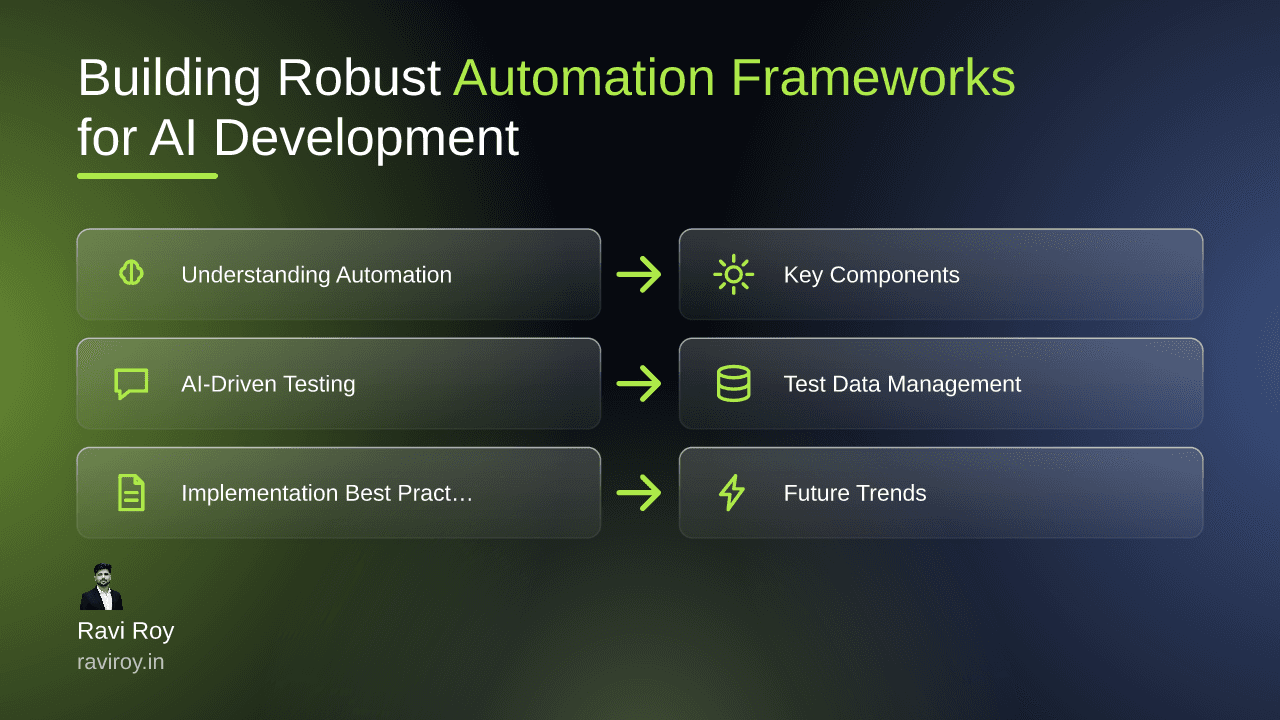
Building Robust Automation Frameworks for Successful AI Development
Imagine launching your AI project in half the time it once took while dramatically reducing the potential for errors. This isn’t just a dream; it’s the power of a well-built automation framework in AI development. Leveraging automation is essential for organizations aiming to enhance efficiency, minimize costs, and ensure the robust performance of AI models. In this guide, we’ll explore how to develop a strong automation framework tailored specifically for AI projects.
Understanding Automation in AI Development
Definition of Automation
Automation in the context of AI development encompasses the application of technology to perform tasks with minimal human intervention. This involves everything from coding to testing and deployment. By automating these processes, developers can streamline workflow and focus on innovation rather than mundane operations.
Benefits of Automation in AI
The benefits of automation in AI are manifold. Here are a few key advantages:
Error Reduction: Automating repetitive tasks leads to fewer manual errors, which are crucial in AI, where precision is paramount.
Accelerated Deployment: Automation accelerates the deployment process, allowing teams to bring AI products to market faster.
Cost Savings: With reduced manpower required for manual operations, companies can achieve significant cost savings in both development and maintenance phases. Automated testing and deployment can reduce resource allocation by up to 30% (link text).
Key Components of a Robust Automation Framework
Continuous Integration and Continuous Deployment (CI/CD)
At the heart of any robust automation framework in AI is the CI/CD pipeline. This process enables teams to integrate code changes continuously and deploy them reliably. By utilizing CI/CD, developers can detect issues early in the development cycle, allowing for rapid feedback and fixes.
Steps to Implement CI/CD in AI Projects:
Version Control: Use tools like Git to manage code changes.
Automated Testing: Integrate testing scripts that run automatically with each code change.
Deployment Automation: Create scripts that deploy code to production after passing tests.
Testing Automation Tools
Various tools can help automate testing in AI projects. Some popular ones include:
Selenium: Widely used for automating web applications but can be adapted for AI interfaces.
JUnit: A testing framework for Java that assists in writing and running tests.
TensorFlow Testing Framework: Designed to automate the testing of machine learning models while ensuring model integrity.
MLOps Integration
MLOps, or Machine Learning Operations, involves the practices and tools that streamline managing machine learning models in production. Integrating MLOps with your automation framework can lead to better collaboration between data scientists and operations teams.
Key Practices for MLOps:
Versioning of Models: Maintain versions of your models to track changes and facilitate rollbacks.
Performance Monitoring: Use monitoring tools to observe how models perform in real time and adjust as needed.
AI-Driven Testing and QA Transformation
Shift-Left Testing: What It Means
Shift-left testing is a crucial concept whereby testing processes are moved earlier in the development cycle. This strategy improves project timelines drastically. Implementing testing from the beginning can reduce overall rework time by up to 40% (link text).
Tools for AI-Driven Testing
Several tools support AI-driven testing methodologies by using machine learning to enhance testing accuracy and efficiency:
Test.ai: Automates UI testing using AI-driven capabilities to streamline testing processes.
Applitools: An AI-driven visual testing tool that checks for UI inconsistencies.
Integrating testing early not only catches issues sooner but also aligns better with agile methodologies, paving the way for smoother deployments.
Advanced Test Data Management Automation
Importance of Test Data Management
Effective test data management is vital for AI projects; the accuracy of models relies heavily on the quality of the data used for training. Poor data management can lead to inaccurate models and wasted resources.
Automating Test Data Generation
To ensure high-quality data, automation strategies should be implemented for test data generation. Here are some approaches:
Synthetic Data Generation: Generate synthetic datasets that mirror real-world scenarios while ensuring data privacy compliance.
Data Masking Techniques: Use data masking to protect sensitive information during testing.
Adhering to compliance considerations, such as GDPR or HIPAA, while managing test data is paramount.
Challenges in Building Automation Frameworks
Common Pitfalls
Despite the numerous benefits, implementing automation frameworks can present challenges. Common pitfalls include:
Lack of Buy-in from Teams: Resistance to change can stall automation initiatives.
Overcomplicated Processes: Rushing in with complex solutions can overwhelm teams.
Overcoming Resistance to Change
To manage team dynamics effectively:
Educate the Team: Offer training sessions to demystify automation tools and processes.
Showcase Success Stories: Present case studies that illustrate the benefits of automation in action.
For instance, a leading tech company improved its deployment speed by over 50% after adopting a robust automation framework.
Best Practices for Implementing Automation Frameworks
Start Small and Scale
Initiating automation in AI projects doesn't have to be an all-or-nothing approach. A step-by-step methodology can ease the transition:
Identify Repetitive Tasks: Start by automating tasks that consume time but add minimal value.
Pilot Programs: Implement pilot programs to refine automated processes before a full-fledged rollout.
Regularly Review and Refine Processes
Optimization should be ongoing. Regular audits can help identify areas for improvement:
Feedback Loops: Encourage team input to identify bottlenecks and pain points.
Benchmarking: Compare results against previous performance metrics to gauge success.
Future Trends in AI Automation Frameworks
The Rise of AI and Machine Learning Tools
Emerging trends point toward AI-driven testing becoming the norm in automation frameworks. Expect to see more tools that incorporate machine learning algorithms to enhance testing efficiency and accuracy.
Impact of Emerging Technologies
Technologies such as blockchain and edge computing will increasingly influence automation frameworks, providing new avenues for data security and processing capabilities.
Predictions show that MLOps will evolve significantly over the next few years, aiming to simplify the model lifecycle management and drive collaboration across teams.
Building a robust automation framework for AI development is not just a strategic advantage; it's becoming a necessity. By leveraging the outlined practices, tools, and methodologies, teams can enhance their efficiency, reduce costs, and improve the reliability of AI projects.
What challenges have you faced in building automation frameworks for AI? Share your experiences!
💬 Join the conversation — share your take in the comments and tell us what you’d add.