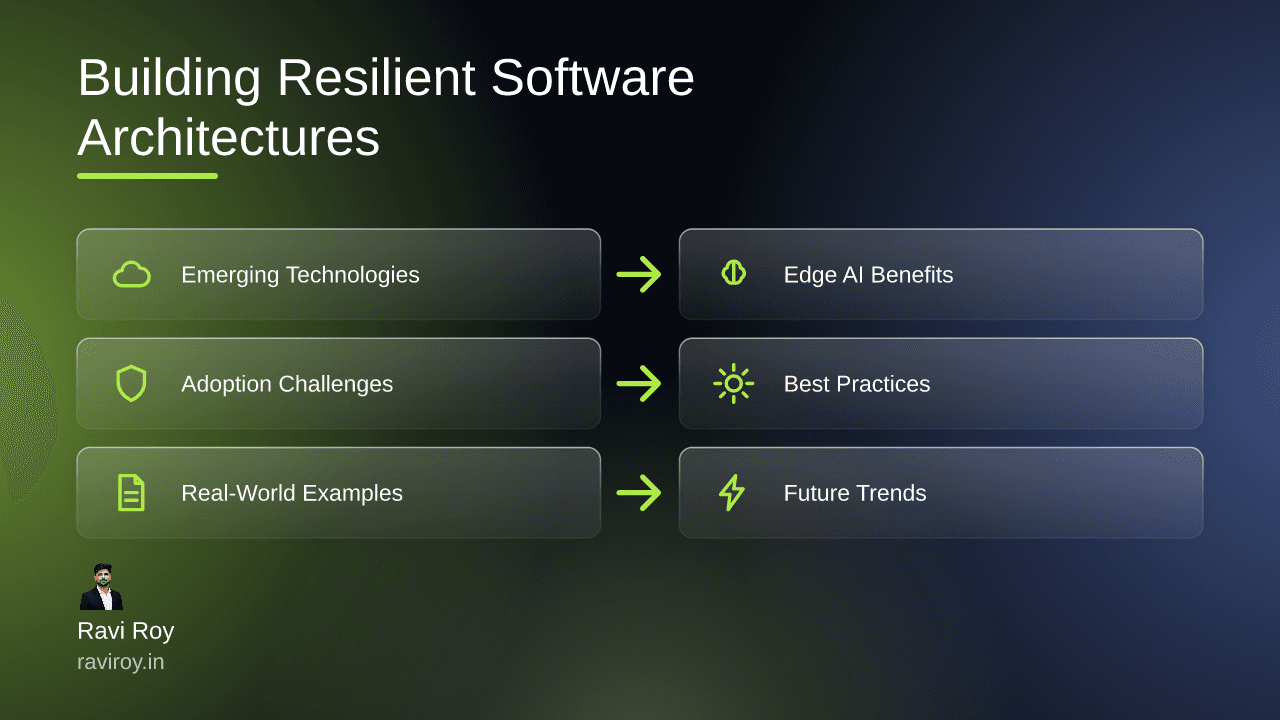
Building Resilient Software Architectures with Emerging Technologies
In a world where digital transformation is no longer optional, the need for resilient software architectures is more critical than ever. Leveraging emerging technologies offers a pathway to not just meet today’s demands but to anticipate future challenges.
Understanding Emerging Technologies in Software Architecture
Emerging technologies, such as Edge AI and the Internet of Things (IoT), are revolutionizing the landscape of software architectures. These technologies are designed to enhance system capabilities, enabling real-time processing and informed decision-making. The relevance of these technologies is underscored by their ability to integrate seamlessly into existing systems, paving the way for more intelligent and responsive software solutions.
Edge AI, in particular, allows for data processing closer to where it is generated—be it sensors on the factory floor or smart devices in healthcare settings. This approach minimizes latency, increases speed, and enhances the user experience by allowing immediate insights that drive proactive action.
Key Benefits of Integrating Edge AI into Software Architecture
Increased Data Processing Speed
Integrating Edge AI into your software architecture can dramatically improve data processing speed. By processing data locally, Edge AI reduces the time it takes to analyze information, enabling instantaneous decision-making. This advantage can be pivotal in applications requiring real-time analytics, such as fraud detection systems or autonomous vehicles.
Consider a smart manufacturing system that utilizes Edge AI for immediate data analysis collected from machinery. Such a system can immediately detect anomalies and trigger alerts, reducing downtime and enhancing productivity.
Improved Reliability and Scalability
Reliability is foundational in software architecture design, and Edge AI can enhance it significantly. By distributing processing loads across multiple edge devices, systems become less likely to fail due to a single point of failure. This not only fortifies the reliability of the architecture but also improves the overall user experience as services remain uninterrupted.
Scalability is another critical advantage of Edge AI. Unlike traditional cloud systems, which can struggle under varying network conditions, Edge solutions adapt better. As demands change, scalability can be achieved by simply adding more edge devices without overhauling the core architecture.
Challenges in Adopting Edge AI for Resilient Architectures
Data Security Concerns
While Edge AI offers numerous advantages, it also brings challenges, particularly concerning data security. The locality of data processing may expose sensitive information, creating vulnerabilities. For instance, if an edge device is compromised, attackers could gain access to crucial data and systems.
To mitigate these risks, employing strong encryption methods and robust access controls is essential. Regular security audits and compliance checks can help maintain integrity and confidentiality.
Interoperability Issues
Integrating Edge AI with existing systems may also introduce interoperability challenges. Legacy systems often lack compatibility with newer technologies, making seamless integration difficult. Custom APIs and middleware can address this, allowing for better communication between disparate systems and promoting a more cohesive architecture.
Best Practices for Building Resilient Software Architectures with Edge AI
Modular Design Principles
One of the best strategies for developing resilient software architectures is a modular design. By breaking the system into smaller, manageable components, flexibility and adaptability can be achieved. Each module can evolve independently, allowing for seamless updates and the incorporation of new features without disrupting the entire architecture.
Continuous Monitoring and Updates
Implementing a strategy for continuous monitoring of performance and health is crucial for long-term resilience. Automation tools can provide real-time analytics and alerts for system status, identifying potential issues before they escalate.
Here’s a checklist of key attributes for resilient architectures:
Modularity: Independent components
Redundancy: Backup systems in place
Real-time Monitoring: Alerts for anomalies
Security Measures: Robust data protection protocols
Adaptability: Easy integration of new technologies
Real-World Examples of Edge AI Enhancing Software Resilience
Case Study: Smart Manufacturing
In a recent implementation of Edge AI in smart manufacturing, predictive maintenance applications resulted in dramatic reductions in downtime. Machines equipped with sensors analyze their performance data at the edge, allowing for timely alerts on maintenance needs. This predictive capability leads to significant cost savings and operational efficiency improvements.
Case Study: Healthcare Systems
Another impactful application can be seen in healthcare systems, where Edge AI is utilized for real-time patient monitoring. Devices that track vital signs can analyze data on-site, sending alerts immediately if there are concerning changes. This capability improves patient outcomes and enhances the speed of intervention.
Future Trends in Software Architecture with Emerging Technologies
AI and Machine Learning Advancements
As artificial intelligence (AI) and machine learning (ML) continue to evolve, their impact on software architecture will only grow. These advancements promise even smarter systems capable of learning from data patterns and adapting autonomously. Expect software architectures to become increasingly self-healing, where systems can automatically detect and rectify issues.
Quantum Computing Impact
Another frontier is the advent of quantum computing, which has the potential to revolutionize how data is processed at unprecedented speeds. Industries such as finance, healthcare, and logistics stand to gain immensely, enabling highly sophisticated analytics and decision-making processes that were previously unattainable.
Conclusion
Emerging technologies like Edge AI are reshaping the framework of software architecture, fostering resilience and responsiveness in ways that were once inconceivable. By understanding these technologies, addressing their challenges, and adopting best practices, organizations can build systems that withstand the test of time.
What challenges have you faced when integrating Edge AI into your software architecture? Share your experiences!
💬 Join the conversation — share your take in the comments and tell us what you’d add.