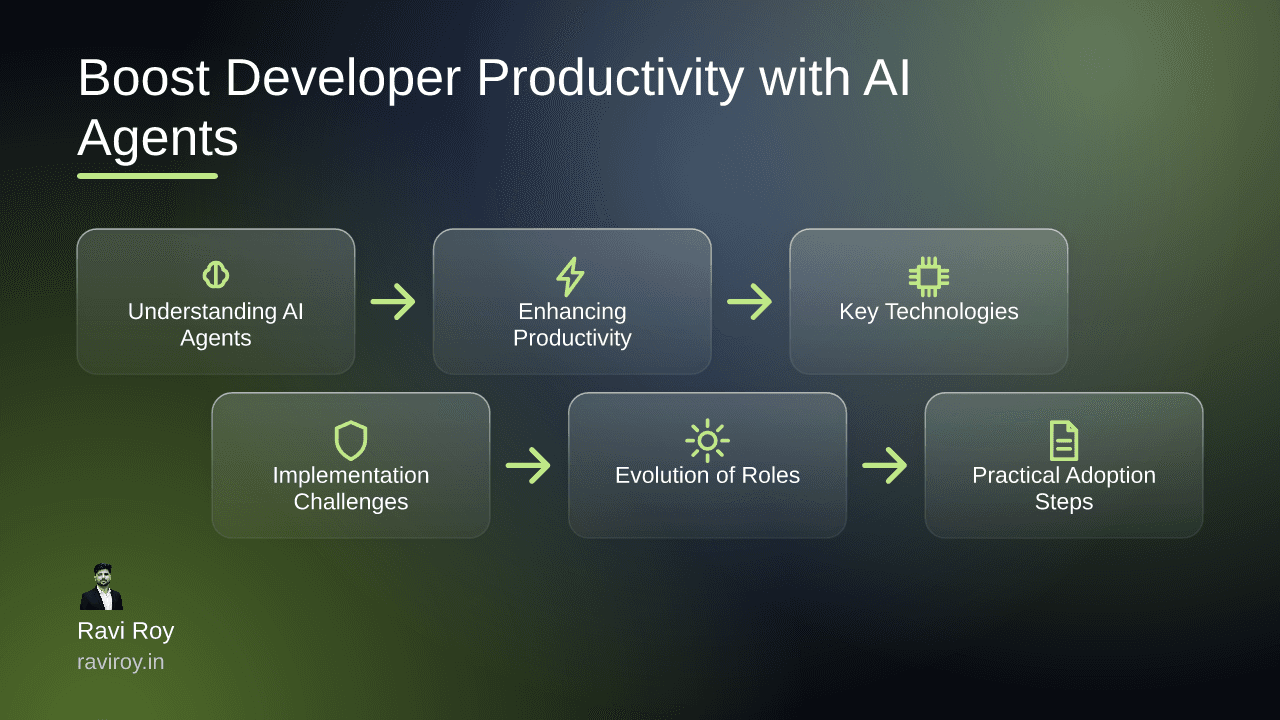
Boost Developer Productivity with AI Agents: A Comprehensive Guide
Imagine having a colleague who never tires, possesses encyclopedic knowledge, and can streamline complex tasks at lightning speed. This is the promise of AI agents in software development, tools designed to significantly enhance developer productivity by automating mundane tasks and improving workflows. As software teams embrace these innovative technologies, understanding the capabilities of AI agents becomes essential to maximizing their potential.
Understanding AI Agents in Software Development
What Are AI Agents?
AI agents are software programs equipped to perform tasks autonomously, leveraging machine learning and data analysis to support developers. Unlike traditional AI assistants, which require direct input for action, AI agents operate independently, making them crucial for enhancing developer workflows. They can perform a range of functionalities—from code generation to bug fixing—allowing developers to devote more time to high-level problem-solving and innovation.
The Role of AI Agents in Modern Development
In the fast-paced world of software development, AI agents serve as invaluable allies. They help ensure consistent coding standards, enhance code quality, and reduce the time spent on routine tasks. By automating these mundane responsibilities, AI agents free developers to concentrate on creative aspects of their work, ultimately leading to a more efficient and productive development environment.
How AI Agents Enhance Developer Productivity
Automating Repetitive Tasks
One of the standout features of AI agents is their ability to automate repetitive and time-consuming tasks. For example, tools like GitHub Copilot can generate code snippets based on comments and context provided by the developer. Imagine writing a few lines of a function, and the AI agent completes the entire code block, reducing not only the coding time but also potential syntax errors.
Example
# Example comment that GitHub Copilot might use to generate code
# Function to calculate the factorial of a number
def factorial(n):
And just like that, within seconds, the agent provides:
    if n == 0:
        return 1
    else:
        return n * factorial(n - 1)
This speeds up programming tasks and can include generating tests or fixing bugs, allowing the developer to focus on more innovative aspects of the project.
Improving Code Quality and Testing
AI agents also play a significant role in enhancing code quality. They can conduct automated code reviews, flagging potential issues and suggesting improvements. In a typical development cycle, integrating these agents into testing environments can lead to faster bug detection and resolution, resulting in more reliable software releases.
Research indicates that teams leveraging AI-powered tools report a decrease in bugs and improved code quality, leading to a quicker time to market (link text).
Facilitating Collaboration and Communication
Effective collaboration is essential in software development, and AI agents can bridge gaps among team members. For example, tools like Slack integrated with AI can summarize project discussions, track progress, and assign tasks based on team members’ strengths. Such capabilities help maintain project momentum, ensuring everyone is on the same page.
Key Technologies Behind AI Agents
Machine Learning and Natural Language Processing
The backbone of AI agents lies in machine learning (ML) and natural language processing (NLP). ML allows these agents to learn from large datasets, improving their performance over time. NLP enables AI to understand and process developer commands, turning natural language into actionable insights.
This combination empowers AI agents to assist with complex queries and provide context-sensitive recommendations, making them indispensable in the software development process.
Integration with Development Tools and Environments
Prominent tools like GitHub Copilot show how effectively AI agents can integrate with existing development environments. As they provide contextual code suggestions directly within IDEs, they enhance the overall development experience without interrupting the workflow. This seamless integration facilitates real-time feedback and support throughout the end-to-end software development lifecycle.
Challenges of Implementing AI Agents
Technical Challenges
Despite their advantages, implementing AI agents is not without obstacles. Developers often face technical challenges such as inadequate data for training models or compatibility issues with legacy systems. Organizations need to carefully assess their current infrastructure and data capabilities before fully adopting these technologies.
Reliability and Governance
The reliability of AI agents in a production environment is critical. Poorly governed AI can lead to unreliable outputs, which may jeopardize the overall project. Therefore, implementing stringent governance frameworks is crucial to ensure quality and performance standards are upheld.
Ethical Considerations
As with any rapidly advancing technology, ethical concerns regarding AI agents cannot be overlooked. Questions surrounding job displacement and algorithmic bias demand thoughtful discussions. Organizations must remain vigilant and proactive in addressing these concerns, ensuring AI acts as an enhancement rather than a replacement for human roles.
The Evolution of the Developer's Role with AI Agents
Shift in Responsibilities
The introduction of AI agents is fundamentally altering the responsibilities of developers. Automation takes care of repetitive coding tasks, freeing developers to engage more creatively and strategically in projects. This shift necessitates that developers adapt to new, higher-level responsibilities that focus on system design and architecture rather than mere implementation.
Collaboration with AI Agents
As developers work alongside AI agents, new skills become essential. Proficiency in managing AI tools, understanding their limitations, and critically evaluating their outputs will be vital moving forward. Embracing this collaboration will not only enhance individual productivity but will also allow teams to harness the full potential of AI in their workflows.
Practical Steps for Adopting AI Agents in Your Team
Initial Assessment and Planning
Before introducing AI agents, an initial assessment of your team's readiness is crucial. Understanding the unique challenges and dynamics within your team will shape the successful integration of AI tools. Identifying specific areas where AI can provide tangible improvements can significantly streamline the onboarding process.
Training and Integration
Training is key to realizing the benefits of AI agents. Providing workshops and resources to help team members familiarize themselves with these tools will facilitate a smoother integration. Ensure that employees understand the capabilities and limitations of AI agents to set realistic expectations and promote effective usage.
Continuous Monitoring and Adjustment
Once AI agents are in place, continuous monitoring of their performance and impact on productivity is essential. Regular evaluations will allow teams to make necessary adjustments, optimizing the way AI agents are leveraged. Engaging in iterative feedback loops ensures that both technology and workflows evolve effectively over time.
Conclusion and Future Outlook
AI agents are revolutionizing the software development landscape, offering myriad benefits that enhance productivity and innovation. As teams navigate the integration of these powerful tools, recognizing their transformative potential will guide developers to harness AI agents effectively. Embracing AI as a collaborative partner in development can unlock unprecedented efficiencies, ultimately leading to stronger and more creative solutions.
What specific experiences have you had with AI agents in your development process, and how have they affected your productivity?
💬 Join the conversation — share your take in the comments and tell us what you’d add.