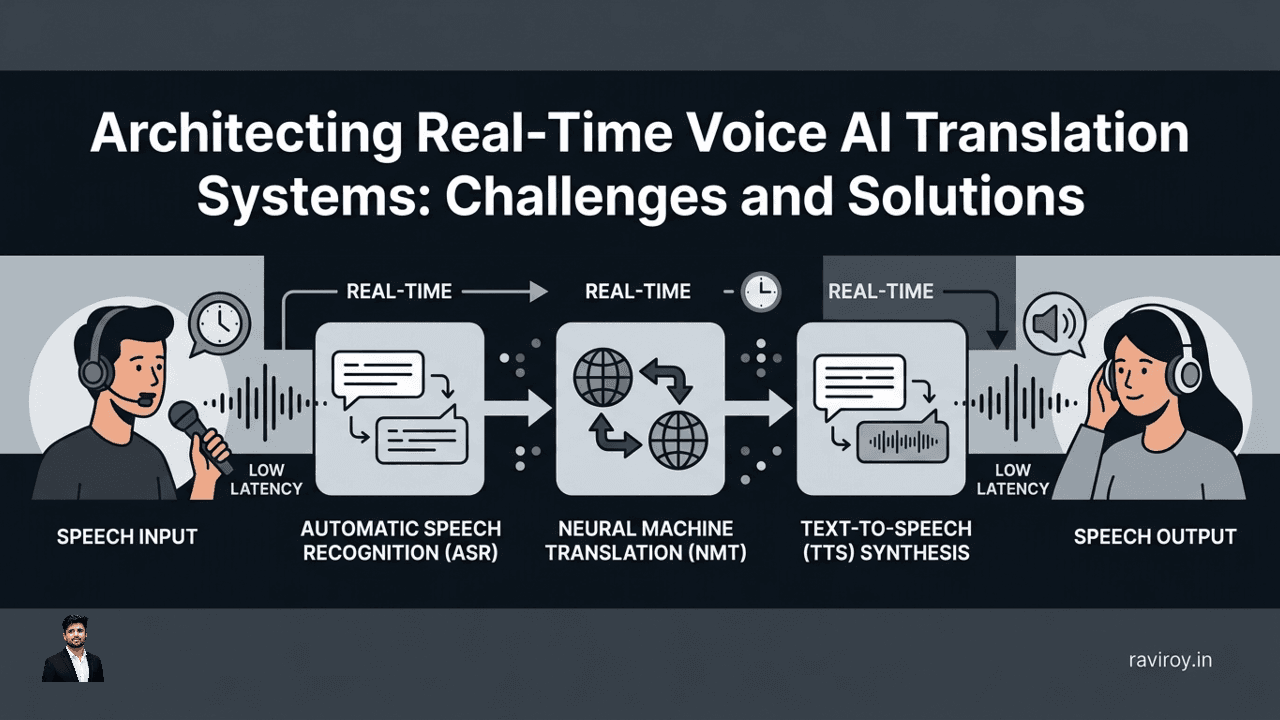
Imagine a world where language barriers simply melt away, where a conversation flows naturally between two people speaking different native tongues. This isn't a sci-fi fantasy; it's the promise of real-time voice AI translation systems. Building such a system, however, is a monumental engineering challenge, requiring a delicate balance of speed, accuracy, and naturalness.
These systems are complex, demanding innovation across multiple AI disciplines. From understanding spoken words to translating their meaning and then synthesizing new speech, every step must occur with breathtaking speed to facilitate a truly natural human interaction. This guide delves into the architectural decisions and engineering considerations crucial for designing robust, ultra-low-latency speech-to-speech translation systems.
The Core Challenge of Real-Time Voice AI Translation
The fundamental difficulty in real-time voice AI translation lies in a seemingly simple demand: translating speech as it is being uttered. Unlike text translation, which can process an entire sentence for full context before providing an output, speech translation often needs to begin translating before a speaker has finished their thought. This necessitates predictive capabilities and, crucially, a mechanism for rapid correction as more context becomes available.
Human conversation operates within an incredibly tight latency budget. Studies suggest that a round-trip delay exceeding 300 milliseconds can begin to disrupt natural turn-taking and make a conversation feel awkward or "laggy." For a voice AI translation system, this means the entire pipeline – from speech input, through recognition, translation, and synthesis, to output – must complete within a fraction of this budget. This extreme constraint dictates every architectural choice, from model selection to hardware deployment.
The impact of incomplete utterances and speaker pauses is profound. Early translation based on partial speech might be inaccurate, requiring the system to constantly revise and correct its output. Long pauses, while natural in human speech, can be interpreted as the end of an utterance, triggering premature translation that misses subsequent context. This can lead to fragmented, unnatural, or even incorrect translations, directly undermining the goal of seamless communication. The system must intelligently predict sentence boundaries, handle disfluencies, and adapt to the unpredictable rhythm of human dialogue while racing against the clock.
Foundational Architectures for Real-Time S2ST Systems
Architecting a real-time speech-to-speech translation (S2ST) system typically involves choosing between, or combining elements of, two primary approaches: cascade systems and end-to-end systems. Each has distinct advantages and disadvantages that impact latency, accuracy, and complexity.
Cascade Systems: The Modular Approach
The traditional and perhaps most intuitive approach is the cascade system, which breaks down the S2ST problem into a series of distinct, modular components. The standard pipeline is:
Voice Activity Detection (VAD): Identifies segments of audio that contain speech, filtering out silence or background noise.
Automatic Speech Recognition (ASR): Transcribes the spoken audio into text in the source language.
Machine Translation (MT): Translates the source language text into text in the target language.
Text-to-Speech (TTS): Synthesizes the target language text into spoken audio.
Advantages of Cascade Systems:
Modularity: Each component can be developed, optimized, and deployed independently. This allows teams to leverage mature, state-of-the-art models for each specific task (e.g., a highly accurate ASR model, a robust MT model).
Easier Debugging: When an error occurs, it's often simpler to pinpoint which specific component is responsible, as intermediate outputs (like source text or target text) are available for inspection.
Resource Management: Different components can be run on different hardware optimized for their specific tasks.
Disadvantages of Cascade Systems:
Compounding Errors: Errors made by an upstream component (e.g., ASR transcription errors) are propagated downstream and can be exacerbated by subsequent components (MT translating incorrect text, TTS speaking it).
Increased End-to-End Latency: Each stage introduces its own processing delay. While individual components can be fast, the sum of these delays can quickly exceed real-time requirements.
Challenges in Preserving Speaker Voice/Intonation: Information about the speaker's unique voice, emotional tone, and speaking style often gets lost after the ASR converts speech to text, making it difficult for the TTS to accurately recreate it.
End-to-End Systems: The Integrated Vision
End-to-end (E2E) systems attempt to bypass intermediate text representations entirely, directly mapping source speech to target speech. These models often leverage large neural networks trained to perform the entire S2ST task in one fell swoop.
Advantages of End-to-End Systems:
Potential for Lower Latency: By removing explicit intermediate steps and streamlining the data flow, E2E systems can theoretically achieve lower overall latency.
Better Voice Preservation: Since the system operates directly on speech signals, it has a greater opportunity to learn and preserve speaker-specific characteristics, such as voice timbre, intonation, and emotional cues, by using techniques like speaker embeddings.
Reduced Error Propagation: Errors are less likely to compound because the model learns to map directly from source audio features to target audio features, rather than passing through potentially lossy text representations.
Disadvantages of End-to-End Systems:
High Data Requirements: Training these complex models effectively demands vast amounts of paired speech-to-speech translation data, which can be scarce for many language pairs.
Complex Training: E2E models are notoriously difficult to train, requiring significant computational resources and intricate tuning.
Lack of Intermediate Textual Output: While beneficial for voice preservation, the absence of intermediate text makes debugging and understanding why a particular translation occurred much harder. This can also make it difficult to integrate with text-based tools or provide visual transcripts.
Hybrid Approaches
Recognizing the strengths and weaknesses of both pure cascade and end-to-end systems, many cutting-edge real-time voice AI translation systems adopt hybrid architectures. These approaches strategically combine elements to balance performance, latency, and debuggability.
Examples of hybrid architectures include:
Streaming ASR feeding an End-to-End MT/TTS Module: In this setup, a streaming ASR component continuously outputs partial text hypotheses. These hypotheses are then fed into an end-to-end speech-to-speech translation model that takes the (potentially partial) source text or speech features and directly generates target speech. This allows for early translation while leveraging the robustness of text-based MT models.
Common Speech Representation: Another approach involves translating source speech into a language-agnostic "intermediate speech representation" (like an acoustic embedding) and then synthesizing target speech from this representation. This maintains speech characteristics while allowing for language independence in the intermediate stage.
Hybrid models attempt to balance the strengths and weaknesses of both pure approaches by:
Leveraging the maturity and debuggability of modular components where appropriate (e.g., for initial ASR).
Exploiting the latency and voice preservation benefits of end-to-end models for the most critical S2ST parts.
Introducing control points where text can be extracted or injected for monitoring, debugging, or improvement.
Engineering for Ultra-Low Latency in Voice AI Pipelines
Achieving the sub-300ms latency target for real-time voice AI translation systems is not merely a feature; it's a fundamental requirement for natural interaction. This demands meticulous engineering across the entire pipeline.
Streaming ASR and Incremental Translation
The cornerstone of low-latency speech translation is streaming ASR. Unlike batch ASR, which waits for an entire audio clip, streaming ASR models process audio in small, continuous chunks, typically ranging from 20ms to 100ms. As each chunk arrives, the ASR generates partial hypotheses of the spoken words. These hypotheses are constantly refined and corrected as more audio context becomes available.
A critical trade-off exists between chunk size (latency) and ASR/MT accuracy (context). Smaller chunks mean lower latency but provide less context for the models, potentially leading to more errors or less natural translations. Larger chunks offer more context but increase latency. Engineers must find the optimal balance for their specific application.
To further reduce perceived latency, techniques like 'look-ahead' buffers and speculative decoding are employed.
Look-ahead buffers: These temporarily hold a small amount of incoming audio. While the current chunk is being processed, the system "looks ahead" into the buffer to gather a bit more context, potentially improving accuracy without significantly delaying the initial output.
Speculative decoding: The system generates a "speculative" translation based on the partial input. If subsequent audio confirms the prediction, the translation is emitted immediately. If not, the system quickly corrects and re-translates. This can give the perception of even lower latency by pre-empting the user's utterance.
Optimized Model Inference and Hardware Acceleration
Even the most ingeniously designed architecture can be bottlenecked by slow model inference. Optimizing models for speed without significant loss in accuracy is paramount:
Quantization: This technique reduces the precision of model weights and activations (e.g., from 32-bit floating-point to 8-bit integers, or int8). While it introduces a slight drop in accuracy, it dramatically reduces model size and speeds up inference, as int8 operations are much faster than float32.
Pruning: Irrelevant or less impactful connections (weights) in the neural network are removed, leading to a sparser, smaller model that requires fewer computations.
Knowledge Distillation: A smaller, "student" model is trained to mimic the behavior of a larger, more complex "teacher" model. The student model retains much of the teacher's performance but is significantly faster.
The choice of inference environment also heavily impacts real-time performance.
Cloud GPUs/TPUs: Offer immense computational power and scalability, ideal for handling peak loads or complex models. However, they introduce network latency.
Edge NPUs (Neural Processing Units)/CPUs: Provide lower latency and enhanced privacy by performing inference closer to (or directly on) the user's device. While less powerful than cloud GPUs, modern NPUs are highly optimized for AI workloads. For instance, a mobile NPU can perform real-time ASR with significantly lower power consumption and latency than a cloud-based GPU, crucial for on-device translation applications.
Network Optimization and Edge Processing
For components that must reside in the cloud, minimizing network round-trip times (RTT) is crucial. This involves:
Geographic Proximity: Deploying services closer to end-users.
Efficient Protocols: Using protocols like WebSockets for persistent, low-latency communication instead of traditional HTTP requests.
Content Delivery Networks (CDNs): Leveraging CDNs to cache and deliver static model assets or even run lightweight inference tasks closer to the edge.
Edge computing plays an increasingly vital role in distributed Voice AI systems. By pushing processing capabilities to edge servers or directly onto user devices, network latency can be drastically reduced or even eliminated. The benefits of on-device processing extend beyond guaranteed low latency to significant privacy advantages, as sensitive audio data never leaves the user's device. This is particularly critical for enterprise Voice AI deployments where data governance and security are paramount.
Ensuring Robustness and Naturalness in Live Translation
Achieving real-time speed is only half the battle. A truly effective real-time voice AI translation system must also be robust to real-world audio conditions and produce translations that sound natural and preserve the speaker's identity.
Overcoming Real-World Audio Challenges
Live conversations rarely happen in pristine, soundproof environments. Systems must contend with:
Noise Reduction: Techniques like spectral subtraction, Wiener filtering, and increasingly, deep learning-based denoising algorithms are crucial. These remove background noise without distorting the speaker's voice, which can significantly improve ASR accuracy. For instance, a deep learning model trained on noisy speech can learn to isolate and enhance the target voice, making it clearer for subsequent ASR processing.
Accent Robustness and Model Adaptation: Voice AI models trained on general datasets may struggle with diverse accents or unique speaking styles. Strategies include collecting diverse training data, using multi-accent models, and employing online adaptation techniques where models learn incrementally from a user's speech over time.
Far-Field Audio and Microphone Array Processing: When speakers are not close to a microphone (far-field), audio quality degrades. Microphone arrays with techniques like beamforming (to focus on a specific sound source) and dereverberation (to remove echoes) are essential for capturing clean speech in these environments, feeding better audio into the ASR.
Preserving Speaker Identity and Voice Tone
A critical aspect of naturalness is ensuring the translated voice maintains the original speaker's identity and emotional tone. Losing this connection can make the translated speech sound robotic or impersonal.
Speaker Embeddings: These numerical representations capture the unique characteristics of a speaker's voice. They can be extracted from the source speech and then provided to the target TTS model, guiding it to synthesize speech in the original speaker's style.
Zero-shot/Few-shot Voice Cloning: Advanced TTS models can "clone" a voice with very little (few-shot) or even no (zero-shot) prior training data for that specific voice, adapting to the timbre and prosody of the input speaker.
Ensuring Consistent Timbre/Prosody: Beyond just voice similarity, maintaining consistent intonation, rhythm, and emotional expression is vital. This requires tight integration between the ASR/MT and TTS components, often through shared representations or joint training objectives.
Ethical considerations are paramount here. While voice cloning offers immense potential for naturalness, it also raises concerns about misuse. Transparent communication with users and robust security measures are essential when handling and replicating vocal characteristics.
Handling Complex Conversational Dynamics
Real conversations are messy, involving more than just one speaker uttering complete sentences sequentially.
Overlapping Speech and Speaker Diarization: When multiple people speak simultaneously, it creates a challenge for ASR and translation. Speaker diarization is the process of identifying who spoke when. In real-time, this means segmenting audio by speaker, allowing individual ASR streams to process each speaker's utterance independently and preventing chaotic, mixed translations.
Code-Switching: Speakers often mix languages within a single utterance or conversation, especially in multilingual environments. Models need to be robust enough to detect and seamlessly translate these shifts, a complex task that requires language-agnostic feature extraction or multi-lingual models.
Turn-Taking and Barge-in Scenarios: Natural dialogue involves turn-taking. Systems must recognize when a speaker has finished their turn or when another speaker has "barged in." This often involves sophisticated VAD and ASR output analysis to manage interruptions gracefully, pausing or stopping the current translation to prioritize the new speaker without causing jarring interruptions.
Evaluating and Monitoring Real-Time Voice AI Performance
Building an S2ST system is an iterative process. Continuous evaluation and monitoring are essential to ensure it meets performance targets and delivers a high-quality user experience.
Key Metrics for Live S2ST
Unlike offline translation, real-time S2ST requires a specific set of metrics:
End-to-End Latency: The most critical metric. Measured from the precise start of a speaker's utterance in the source language to the start of the synthesized translated speech in the target language. This is what the user perceives.
ASR Word Error Rate (WER): Measures the accuracy of the speech-to-text component. While intermediate, high WER will cascade into poor translation.
Machine Translation (MT) Quality: Evaluated using metrics like BLEU (Bilingual Evaluation Understudy) or chrF (Character F-score). These compare the machine translation output to human reference translations.
Text-to-Speech (TTS) Mean Opinion Score (MOS): A subjective human rating of the naturalness, clarity, and overall quality of the synthesized speech.
Objective Metrics for Speaker Similarity and Prosody Transfer: More advanced metrics can quantify how well the system preserves the original speaker's voice characteristics and intonation, often using speaker embedding similarity scores.
Defining and measuring a "perceptible" latency threshold is crucial from a user experience perspective. What might be acceptable for a delayed message might be intolerable for a live conversation. This often involves user studies to establish the real-world threshold where latency begins to negatively impact conversational flow.
Observability and A/B Testing
Robust real-time voice AI translation systems demand robust observability.
Real-time Monitoring Dashboards: Essential for tracking critical operational metrics like end-to-end latency, ASR WER (estimated in real-time), MT quality (where applicable), server load, resource utilization (CPU, GPU, memory), and error rates. These dashboards provide immediate insights into system health and performance bottlenecks.
A/B Testing Strategies: For continuous improvement, it's vital to A/B test different model versions, architectural changes, or optimization techniques in a live environment. This involves routing a small percentage of traffic to a new version and comparing its performance against a baseline using the defined metrics. Careful rollout strategies are needed to minimize impact on user experience.
User Feedback Loops: Directly collecting user feedback is invaluable. This includes explicit ratings, bug reports, and implicit signals (e.g., how often users repeat themselves or abandon a session). This data helps identify qualitative issues not captured by objective metrics and guides future development.
The Future of Real-Time Voice AI: Beyond Basic Translation
The journey of real-time voice AI translation systems is far from over. The horizon promises even more sophisticated capabilities and challenges.
We're moving towards multi-speaker and long-form conversational translation, where systems must track multiple participants, maintain topic continuity over extended dialogue, and manage complex interjections. Imagine a real-time conference call translator that not only translates each speaker but correctly identifies who said what and maintains the conversational context seamlessly.
The growing importance of context-aware translation means leveraging not just the current utterance but also the prior dialogue history to inform translation decisions. This allows the system to resolve ambiguities, understand references, and produce more coherent and accurate translations, moving beyond sentence-by-sentence processing to truly conversational understanding.
Finally, privacy and data governance remain critical considerations, especially for enterprise Voice AI deployments. This includes further advancements in secure on-device processing to keep sensitive data local, and the adoption of federated learning techniques, where models are trained on decentralized data sources without centralizing raw user information, protecting privacy while improving model performance.
What specific, real-world latency targets are you aiming for in your Voice AI translation projects, and what's been your biggest challenge in hitting them?
💬 Join the conversation — share your take in the comments and tell us what you’d add.