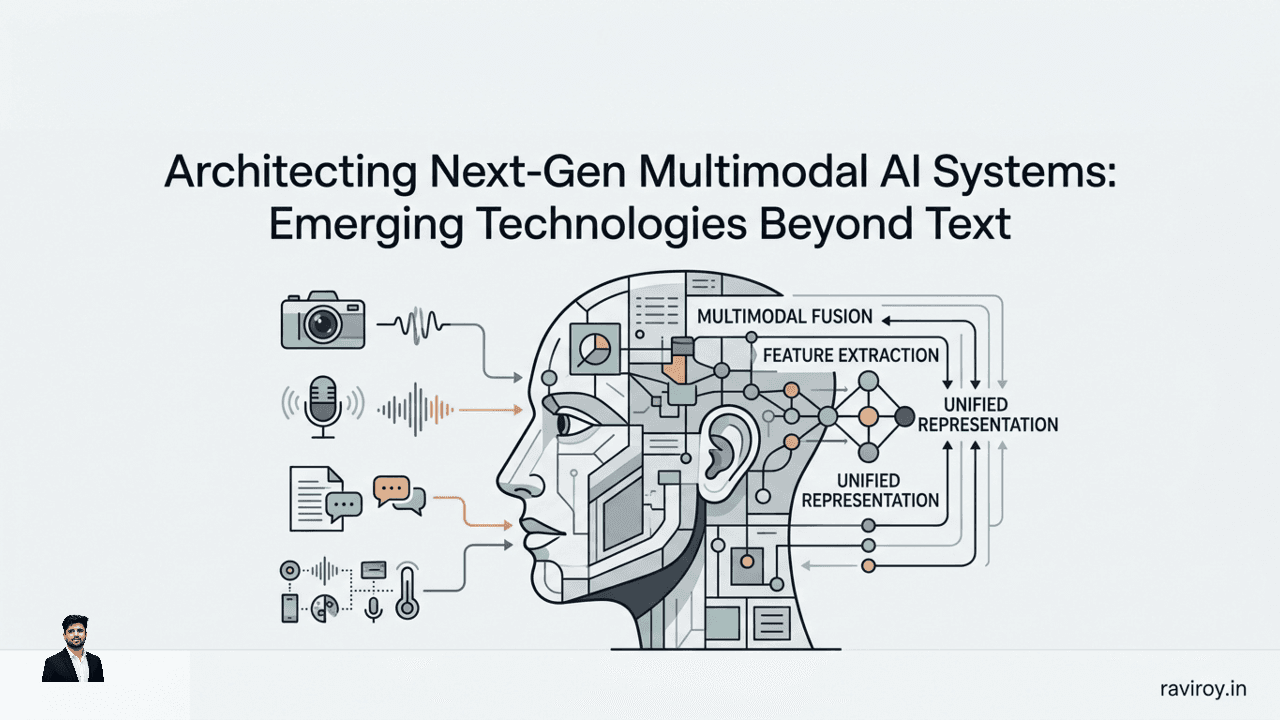
The future of artificial intelligence isn't just about what systems can understand, but how they understand. We're moving beyond AI that merely processes text or images in isolation, into a new frontier where machines perceive and interpret the world with human-like richness, integrating diverse streams of information. This paradigm shift demands a new approach to building robust, intelligent solutions, making the task of architecting next-gen multimodal AI systems a critical challenge and opportunity for technical leaders.
What is Multimodal AI and Why it's a Key Emerging Technology
At its core, multimodal AI is the ability of an artificial intelligence system to process, understand, and integrate information from multiple input types, or "modalities," simultaneously. Unlike traditional AI models, which often specialize in a single data format—such as large language models (LLMs) trained exclusively on text or computer vision systems focused solely on images—multimodal AI seeks to emulate the comprehensive way humans interact with the world. It’s a key emerging technology because it unlocks far more sophisticated interpretations and interactions than any single-modality system could achieve.
Defining Multimodality: Beyond Text and Voice
While text and voice are common modalities, the definition extends far beyond them. Multimodal AI integrates input from a diverse array of sources, including:
Vision: Images, videos, object recognition, facial expressions, scene understanding.
Language: Text, speech, sentiment analysis, natural language understanding (NLU) and generation (NLG).
Audio: Speech, environmental sounds, music, speaker identification, emotion detection from tone.
Haptic: Touch, force, vibration data, tactile feedback.
Sensor Streams: Temperature, pressure, GPS, lidar, radar, biometric data.
The evolution from single-modality to multimodal also affects output. While early generative AI often produced text, today’s advanced systems can generate images from text descriptions, synthesize speech from text, or even create videos from a combination of inputs, demonstrating a move towards truly integrated perception and generation.
The 'How': Core Principles of Multimodal Understanding
The general process for a multimodal AI system involves several key steps:
Individual Encoding: Each input modality (e.g., an image, a spoken sentence, sensor data) is first processed by a specialized encoder. These encoders transform raw data into a numerical representation, often called an embedding or feature vector, tailored to that specific modality. For images, this might involve convolutional neural networks (CNNs) or Vision Transformers; for text, it could be transformer-based models like BERT or GPT.
Shared Latent Space: A foundational concept in multimodal AI is the projection of these individual modality embeddings into a common, shared latent space. Imagine a conceptual "map" where representations of a "cat" from an image, the word "cat" from text, and the sound of a "meow" from audio are positioned close together. This alignment allows the system to understand the semantic relationships between different modalities.
Fusion: Once encoded and aligned, the different modal representations are combined or "fused." This fusion layer integrates the information, allowing the system to form a unified, richer context and understanding. For example, seeing a person with a "sad" facial expression (vision) while hearing a "low-pitched, slow" voice (audio) and reading text about a "difficult day" (language) would lead to a more robust conclusion about their emotional state than any single input alone.
So, can multimodal AI truly understand text, images, audio, and video together? Absolutely. By converting disparate data streams into a unified, semantically rich representation, these systems can grasp nuanced context, infer complex relationships, and make more informed decisions, just as humans do when processing the world around them.
The Enterprise Imperative: Why Multimodal AI Matters Now
The move towards multimodal AI isn't just an academic pursuit; it's an urgent business imperative. Enterprises are rapidly recognizing that their existing AI tools, often siloed and modality-specific, fall short of delivering truly intelligent and integrated solutions. The future of enterprise AI lies in systems that can process a holistic view of customer interactions, operational data, and environmental cues.
Shifting from Disconnected Silos to Integrated Intelligence
For years, enterprises have relied on a patchwork of AI solutions: optical character recognition (OCR) for documents, automated speech recognition (ASR) for calls, text-to-speech (TTS) for voice interfaces, and separate computer vision systems for image analysis. While effective in their narrow domains, these tools often operate in isolation, leading to:
Fragmented Insights: Incomplete understanding of complex scenarios because critical contextual data from other modalities is missed.
Manual Integration Overhead: Developers spending significant time stitching together outputs from different systems.
Suboptimal User Experiences: Chatbots that can't "see" what a user is pointing at, or voice assistants that don't consider the user's facial expression.
Multimodal AI resolves this by enabling unified workflows. Instead of separate models, a single multimodal system can ingest and correlate information from across channels, creating a richer, more contextual understanding. This integration is why multimodal AI is being positioned as a core capability in 2026-era AI products across diverse sectors.
Business Value and Transformative Use Cases
The business value of multimodal AI is immense, translating into richer insights, dramatically improved user experiences, and the automation of previously intractable complex tasks. Consider these high-impact enterprise applications:
Customer Service & Experience: Imagine a customer support agent (or AI assistant) not only analyzing the text of a chat transcript but also interpreting the sentiment from the customer's voice tone (audio), detecting frustration from their facial cues via video (vision), and even processing screenshots of their problem (vision). This comprehensive understanding allows for more empathetic, efficient, and personalized support, moving beyond simple chatbots to truly cross-modal interactions.
Quality Control & Manufacturing: In a factory setting, multimodal AI can monitor product quality by combining visual inspection (detecting surface defects in images/video) with acoustic anomaly detection (listening for unusual sounds in machinery or products during operation). This simultaneous analysis can identify flaws faster and more accurately than relying on a single modality.
Healthcare Diagnostics: Integrating medical imaging (X-rays, MRIs, CT scans) with patient electronic health records (text), sensor data (wearable biometrics), and even physician notes (text/speech) can lead to more accurate diagnoses, personalized treatment plans, and predictive analytics for disease progression.
Autonomous Systems (Robotics/Vehicles): Self-driving cars fuse lidar, radar, camera feeds, and GPS data to create a real-time, 360-degree understanding of their environment, enabling safe navigation and decision-making. Similarly, advanced robots combine vision, haptics, and sometimes even olfactory sensors to perform intricate tasks in unstructured environments.
Why is multimodal AI important for enterprise applications? Because real-world enterprise problems are inherently multimodal. Customers don't just type; they speak, gesture, and share visuals. Operations don't just produce logs; they generate sensor data, video streams, and audio cues. By embracing multimodal AI, businesses can unlock deeper insights, automate more complex processes, and deliver truly intelligent and seamless experiences across all touchpoints.
Architecting Multimodal Systems: Core Components & Design Patterns
Building robust multimodal AI systems requires careful architectural planning, focusing on how different data streams are processed, integrated, and understood. The core challenges lie in effectively encoding diverse data types, aligning their representations, and fusing them into a coherent understanding.
Encoder Design: Specialization vs. Generalization
The first step in any multimodal pipeline is converting raw data from each modality into a meaningful numerical representation (an embedding). Here, architects face a fundamental choice:
Multi-Encoder Architectures (Specialization): This is the most common approach, employing separate, specialized encoders for each distinct modality.
Image Encoder: A Convolutional Neural Network (CNN) like ResNet or a Vision Transformer (ViT) for images.
Text Encoder: A transformer-based model like BERT or RoBERTa for text.
Audio Encoder: A recurrent neural network (RNN), a CNN, or an Audio Transformer for audio spectrograms. The advantage is that each encoder can be highly optimized for its specific data type, leveraging years of research in individual domains. The complexity then shifts to effectively fusing these disparate representations.
Universal Encoder Architectures (Generalization): An emerging research area explores the possibility of a single, universal encoder capable of handling diverse inputs. Models like Google's Perceiver IO demonstrate this, using a self-attention mechanism over a latent array to process arbitrary modality inputs. While still in its early stages for broad enterprise adoption, the promise is a simplified architecture and potentially better generalization across new modalities. However, designing such an encoder that performs optimally across all modalities is a significant challenge.
Shared Embeddings and Cross-Modal Alignment
Regardless of the encoder choice, a crucial step is projecting the different modality embeddings into a common latent space. This common space is where cross-modal relationships are learned and where the system can understand that an image of a dog, the word "dog," and the sound of a "bark" are semantically related.
Importance: Without alignment, the system might treat "dog" in text and "dog" in an image as entirely separate concepts, missing the critical link.
Techniques:
Contrastive Learning: A popular method, exemplified by OpenAI's CLIP (Contrastive Language-Image Pre-training). CLIP learns to associate text descriptions with images by pushing semantically similar pairs closer in the embedding space and dissimilar pairs further apart. This is often achieved through a contrastive loss function that maximizes agreement between correct (image, text) pairs while minimizing it for incorrect pairs.
Cross-Modal Transformers: Transformer architectures can also be adapted to directly learn cross-modal alignments by allowing attention mechanisms to attend across different modality embeddings.
Once aligned, the embeddings share a common ground, making them suitable for subsequent fusion and unified processing.
The Fusion Layer: Integrating Information
The fusion layer is where the distinct signals from various modalities are combined to form a unified, coherent understanding. The choice of fusion strategy profoundly impacts the system's performance and complexity.
Early Fusion: This approach concatenates or combines the raw data or early-stage features from different modalities before significant processing.
Example: For a video (sequence of images + audio), you might concatenate visual features from each frame with corresponding audio features and then feed this combined stream into a single processing model.
Pros: Allows for fine-grained interaction between modalities from the earliest stages, potentially capturing subtle correlations.
Cons: Can lead to high-dimensional input spaces, making training computationally expensive and potentially sensitive to misalignments or noise in individual modalities.
Late Fusion: Here, each modality is processed independently by its own specialized model, and only the decisions or high-level representations from these individual models are combined at a later stage.
Example: One model classifies sentiment from text, another classifies emotion from facial expressions, and a third classifies tone from voice. The outputs (e.g., probabilities for different emotions) are then combined by a separate decision-making layer (e.g., a simple classifier or a weighted average).
Pros: Simpler architecture, allows leveraging pre-trained, high-performing single-modality models, easier to debug and understand individual modality contributions.
Cons: Misses opportunities for rich, early interactions between modalities; potential for information loss if individual decisions are made too early.
Hybrid Fusion: Many advanced multimodal systems employ hybrid strategies that combine elements of early and late fusion. This often involves initial modality-specific processing, followed by intermediate fusion layers that allow for controlled interaction between modalities, and finally a decision-level fusion.
Common Components: Attention mechanisms and transformer blocks are increasingly used in fusion layers. Cross-attention, in particular, allows a model to weigh the importance of elements from one modality (e.g., visual features) when processing another modality (e.g., text tokens), facilitating dynamic and contextual integration of information.
The architectural choice for the fusion layer depends heavily on the specific task, the nature of the modalities, and the computational resources available. The goal is always to maximize the synergistic benefits of combining information while managing complexity.
Building the Practical Stack: Data, Training, and Deployment
Architecting multimodal AI systems goes beyond theoretical designs; it requires a practical approach to data management, model training, and efficient deployment. Each stage presents unique challenges that differentiate multimodal development from single-modality pipelines.
Curating and Preprocessing Multimodal Datasets
Data is the lifeblood of any AI system, and for multimodal AI, the challenges are significantly amplified:
Collection and Synchronization: Gathering data across multiple modalities that are precisely aligned in time and context is complex. For instance, a video dataset for emotion recognition needs synchronized frames (vision) with corresponding audio segments (speech) and perhaps transcripts or labels (text) precisely mapping to specific time intervals. This often requires specialized recording setups and meticulous data capture protocols.
Annotation: Labeling multimodal datasets is labor-intensive and expensive. Not only do individual modalities need annotation (e.g., bounding boxes for objects in images, transcripts for audio), but the relationships between modalities often need to be explicitly labeled (e.g., which word in a transcript corresponds to which visual action).
Preprocessing: Each modality demands specific preprocessing steps:
Audio: Feature extraction (e.g., Mel-frequency cepstral coefficients (MFCCs), spectrograms), noise reduction, silence removal, normalization.
Images/Video: Resizing, normalization, data augmentation (rotation, cropping), frame sampling for video.
Text: Tokenization, stemming/lemmatization, stop-word removal, embedding generation (e.g., Word2Vec, GloVe, or transformer embeddings).
Sensor Data: Time-series alignment, interpolation for missing data, outlier detection, scaling.
Robust data pipelines are essential to handle the volume, variety, and velocity of multimodal data, ensuring consistency and quality across all streams.
Model Training and Optimization Considerations
Training multimodal models is resource-intensive and requires careful planning:
Infrastructure: Multimodal models often have significantly more parameters than their single-modality counterparts, demanding powerful computing resources. Specialized hardware like GPUs and TPUs is virtually indispensable for training and often for inference. Distributed training frameworks (e.g., PyTorch Distributed, TensorFlow Distributed) are crucial for scaling operations.
Transfer Learning & Fine-tuning: Training a complex multimodal model from scratch is rarely feasible due to data and compute constraints. Leveraging pre-trained single-modality encoders (e.g., a pre-trained image encoder from ImageNet, a language model like BERT) is a common strategy. These pre-trained components can then be fine-tuned on task-specific multimodal datasets, significantly reducing training time and improving performance, particularly for tasks with limited labeled data.
Optimization Challenges: Optimizing for multiple loss functions (one for each modality or a combined multimodal loss) can be tricky. Techniques like gradient clipping, learning rate schedules, and careful hyperparameter tuning are vital. The interplay between modalities can also introduce complex optimization landscapes.
Deployment, Latency, and Cost Tradeoffs
Bringing multimodal AI systems into production presents a new set of challenges:
Serving Models Efficiently: Multimodal models are often large and computationally heavy. Deploying them requires robust inference pipelines that can handle high throughput and manage the memory footprint. Model quantization, pruning, and knowledge distillation can reduce model size and accelerate inference.
Latency Challenges: For real-time applications (e.g., live customer service analysis, autonomous navigation), latency is critical. Processing multiple high-bandwidth streams (like video and audio) and integrating them in real-time is a significant hurdle. Strategies to mitigate latency include:
Edge Computing: Performing inference closer to the data source.
Optimized Architectures: Designing models specifically for efficiency.
Asynchronous Processing: Handling different modalities in parallel where possible, or prioritizing critical modalities.
Hardware Acceleration: Utilizing specialized inference accelerators.
Computational Costs: The complex nature of multimodal models translates directly into higher operational costs, both in terms of compute resources (GPUs/TPUs) and energy consumption. Architects must carefully evaluate the cost-benefit ratio of different model sizes and architectural choices against performance requirements.
What are the challenges of multimodal AI systems? Data synchronization, complex annotation, resource-intensive training, and high-latency, costly deployment are among the most significant. Overcoming these requires a holistic approach that considers the entire AI lifecycle.
Advanced Multimodal Strategies: Orchestration and Dynamic Routing
As multimodal AI systems become more sophisticated, static architectures often give way to more dynamic and adaptive designs. Advanced strategies focus on intelligently managing the flow of information, enhancing robustness, and improving interpretability.
Dynamic Modality Selection and Adaptive Processing
Not all modalities are equally important for every task, nor are they always available or necessary. Advanced multimodal systems can dynamically adapt their processing based on context, task requirements, or even the quality of available inputs:
Context-Aware Modality Prioritization: In a noisy environment, an AI assistant might prioritize visual cues (e.g., lip reading, gestures) over audio for speech recognition, or vice-versa in a dark room.
Task-Specific Modality Activation: For a simple query, only text and voice modalities might be needed. For a complex diagnostic task, the system might activate vision, sensor data, and language processing.
Adaptive Routing Mechanisms: Systems can be designed with routing mechanisms that direct different modal inputs through appropriate processing pipelines. This could involve "expert" sub-models for specific modalities that are only invoked when their input is deemed relevant or high-quality. For example, a "mixture of experts" architecture could have modal-specific experts that contribute to a final decision.
Conditional Processing: If a particular modality's input is ambiguous or low-confidence, the system might dynamically request additional information from another modality or engage in disambiguation.
This dynamism leads to more efficient resource utilization, improved performance in varied real-world conditions, and a more natural interaction experience.
Enhancing Robustness and Interpretability
Multimodal AI offers unique avenues for improving system robustness and tackling the perennial challenge of interpretability.
Redundant Information for Robustness: One of the inherent strengths of multimodal systems is the presence of redundant information across modalities. If one modality's input is corrupted or missing (e.g., blurry image, noisy audio), other modalities can compensate.
Example: If a word is unclear in speech, the accompanying facial expressions or body language might provide sufficient context for understanding. This cross-modal redundancy makes the system more resilient to noise, adversarial attacks, and missing data, leading to more reliable performance in unpredictable real-world environments.
Approaches to Interpretability: Interpretability in complex AI models remains a significant challenge, and it's compounded in multimodal systems due to the intertwined nature of information. However, multimodal approaches can also offer unique insights:
Cross-Modal Explanations: By correlating features across modalities, a system can explain its decision more comprehensively. For instance, if a medical AI system diagnoses a condition, it could highlight the specific regions in an MRI scan (vision) and specific terms in a patient's history (text) that contributed to its conclusion.
Attention Maps: Visualizing attention maps that show which parts of an image or segments of audio a model "focused" on when processing a piece of text can provide insight into the cross-modal reasoning process.
Gradient-based Saliency Maps: Similar to single-modality approaches, these can highlight input features across different modalities that were most influential in a prediction.
While full interpretability is an ongoing research area, multimodal systems provide richer diagnostic information that can lead to more transparent and trustworthy AI deployments.
Use Cases and Future Outlook for Multimodal AI
The transformative potential of multimodal AI is already evident across numerous industries, and its trajectory suggests it will soon become the default paradigm for intelligent systems.
Diverse Applications Across Industries
Multimodal AI is not confined to a single sector; its ability to process the world comprehensively makes it invaluable wherever rich, contextual understanding is required:
Smart Cities: Combining traffic camera feeds (vision) with acoustic sensors (audio) to detect unusual sounds (e.g., gunshots, breaking glass) and environmental sensors (temperature, pollution) to manage urban infrastructure, respond to emergencies, and optimize resource allocation.
Healthcare: As discussed, integrating medical imaging, patient records, biometric sensor data, and even genetic information for personalized medicine, remote patient monitoring, and predictive analytics.
Robotics and Automation: Robots leveraging vision, haptics (touch/force feedback), speech recognition, and environmental sensors to navigate complex environments, perform delicate manipulation tasks, and interact naturally with humans.
Retail and E-commerce: Analyzing customer behavior through in-store video (gaze tracking, dwell time), audio (conversations with sales associates), and online purchase history (text) to personalize recommendations and optimize store layouts.
Education: Adaptive learning platforms that use facial expression analysis (vision) to gauge student engagement, speech analysis (audio) to understand comprehension, and written responses (text) to tailor educational content dynamically.
The best use cases for multimodal AI are those where a single modality provides an incomplete or ambiguous picture, and where the integration of diverse information leads to a demonstrably richer, more accurate, or more efficient outcome. This includes sensor data, which bridges the gap between the digital and physical worlds, providing crucial context from environmental and physical interactions.
The Road Ahead: Challenges and Innovations
Despite its immense promise, the widespread adoption of multimodal AI still faces several challenges:
Data Scarcity and Quality: High-quality, synchronously annotated multimodal datasets remain expensive and difficult to acquire.
Computational Intensity: Training and deploying these complex models demand substantial computational resources and expertise.
Explainability and Interpretability: While progress is being made, fully understanding why a multimodal model makes a particular decision, especially when interactions across modalities are intricate, remains a research frontier.
Ethical Considerations: Bias in one modality can amplify bias in another when fused. Ensuring fairness, privacy, and responsible use of multimodal AI, especially concerning sensitive data like biometric information, is paramount.
Causal Inference: Moving beyond correlation to understanding causal relationships between multimodal inputs and outcomes is critical for robust decision-making, particularly in high-stakes applications.
Ongoing research is pushing the boundaries in areas like few-shot learning for multimodal tasks, developing more efficient training algorithms, and advancing cross-modal generation capabilities. The trend is clear: multimodal capabilities are rapidly becoming the default interface and API for advanced AI models. As these challenges are addressed, multimodal AI systems will become increasingly pervasive, redefining human-computer interaction and enabling a new generation of intelligent applications that perceive and understand the world as comprehensively as we do.
What's the most challenging multimodal integration you've encountered in your projects, and what architectural decisions helped overcome it?
💬 Join the conversation — share your take in the comments and tell us what you’d add.