A truly immersive conversational experience hinges on one critical factor: speed. Users expect interactions with Voice AI to feel as natural and responsive as talking to another human, and any noticeable delay shatters that illusion. This necessitates architecting sophisticated low-latency Voice AI pipelines designed from the ground up to minimize every millisecond of processing and communication time.
An "immersive user experience" in Voice AI means a conversation flows effortlessly, without awkward pauses or the feeling of waiting for a computer to "think." It's about achieving a nearly instantaneous back-and-forth, where the AI understands, processes, and responds with minimal lag. Even small latencies—anything over 300 milliseconds—can disrupt this delicate balance. Such delays don't just feel slow; they increase cognitive load, forcing users to consciously wait and deduce if the AI is still listening or processing, leading to unnatural conversational turns and a perception of a less intelligent or less capable system.
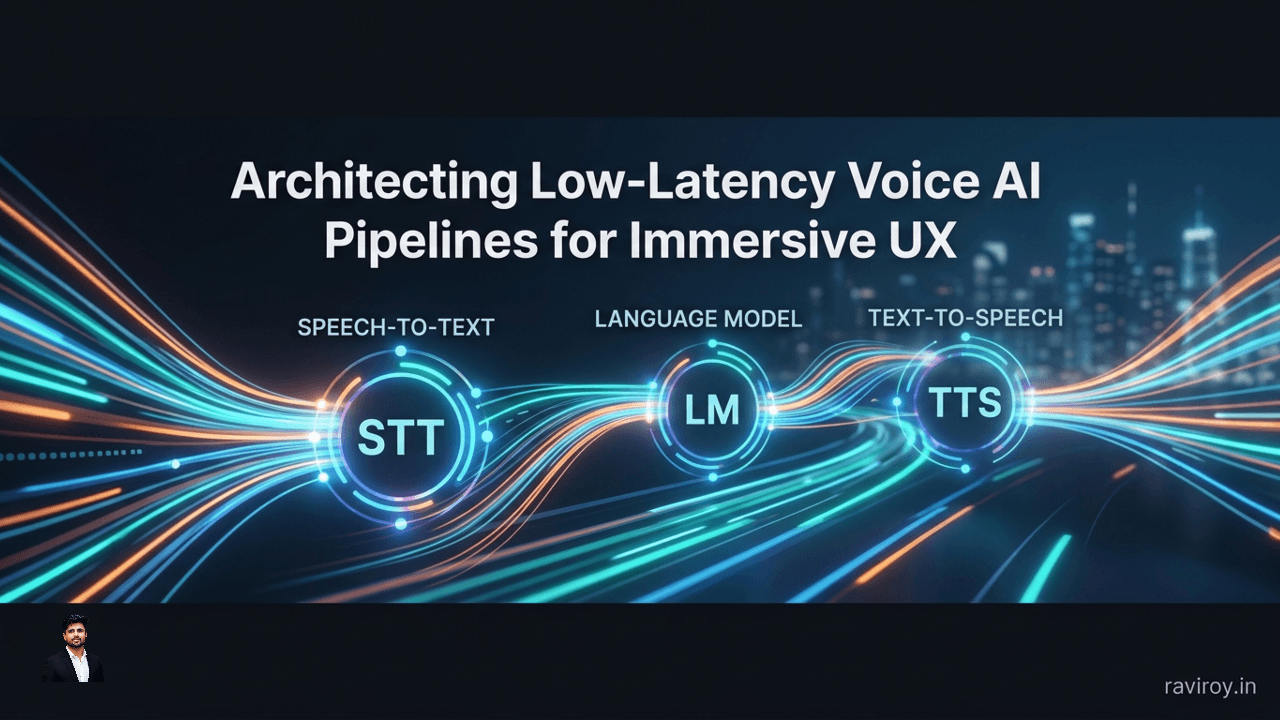
At its core, a modern Voice AI pipeline comprises several integrated components: Streaming Speech-to-Text (STT), a Large Language Model (LLM) for inference, and Streaming Text-to-Speech (TTS). The foundational principle for achieving the desired low latency and responsiveness across these stages is a streaming-native approach, where data flows continuously rather than in discrete, delayed blocks. This allows for parallel processing and overlapping operations, significantly reducing cumulative wait times.
Deconstructing Latency: Budgeting for Each Pipeline Stage
Achieving end-to-end low latency isn't about haphazard optimization; it requires a precise strategy known as latency budgeting. This involves setting strict performance targets for each component within the Voice AI pipeline. For instance, you might aim for 100-150ms for STT processing, 150-250ms for LLM inference (especially for Time-to-First-Token, or TTFT), and a tight 50-100ms for TTS audio generation. The sum of these budgets provides a clear picture of your maximum acceptable end-to-end latency, often targeting under 500ms for a truly real-time feel. This structured approach is critical because any delay in one stage directly impacts the overall user experience.
Common latency bottlenecks are prevalent across each stage:
Streaming Speech-to-Text (STT): Latency here often stems from the ASR (Automatic Speech Recognition) model's complexity, the size of the acoustic and language models, and the computational intensity of processes like beam search or neural network inference. While partial transcripts arrive quickly, the final, most accurate transcript might take longer as the model processes more audio context.
Large Language Model (LLM) Inference: This stage introduces two key latency metrics: Time-to-First-Token (TTFT) and Time-to-Last-Token (TTLT). TTFT is crucial for perceived responsiveness, as the user wants to hear the AI's response start quickly. TTLT dictates when the full response is available. Bottlenecks include model size, server capacity, batching strategies, and the efficiency of the inference engine.
Streaming Text-to-Speech (TTS): TTS latency is often tied to how quickly text chunks are received from the LLM, the complexity of the voice model, and the granularity of audio synthesis (e.g., synthesizing word-by-word, phrase-by-phrase, or full sentences).
Network Overhead: A frequently overlooked, yet significant, factor is the time spent transmitting data between services. Serialization, deserialization, and the physical distance between your user, STT, LLM, and TTS services add measurable latency. Advocating for service colocation—deploying services within the same data center region or even on the same hardware where possible—is paramount to minimize these network hops and their associated delays.
Consider a scenario where your STT service consistently delivers results in 200ms, exceeding its 150ms budget. This 50ms overshoot directly eats into the budget for the subsequent LLM and TTS stages. If, however, you optimize your STT to deliver within 100ms, you've now gained an extra 50ms that can be allocated to a more complex LLM or a higher-quality TTS voice, all while maintaining the overall latency target. This iterative optimization across the pipeline ensures that every component contributes positively to the perceived responsiveness.
Architectural Pillars for Real-time Voice AI
Achieving true real-time performance in Voice AI hinges on designing an architecture that inherently supports concurrent and continuous processing. Each stage must be engineered to deliver its output progressively, without waiting for an entire input segment to complete.
Streaming Speech-to-Text (STT)
Traditional STT systems process an entire audio clip before returning a transcript. Streaming STT, however, continuously processes audio as it arrives, generating incremental transcripts in real-time. As the user speaks, you receive partial results, which can be immediately fed into the next stage. This "think-ahead" capability dramatically reduces the perceived wait time.
For example, a streaming STT service might provide callbacks for partial transcripts:
def on_partial_transcript(transcript_chunk):
    # Send this chunk to the LLM for early processing
    print(f"Partial: {transcript_chunk}")

def on_final_transcript(final_transcript):
    # Final transcript for the user's turn
    print(f"Final: {final_transcript}")

# (Illustrative: Actual implementation would use WebSockets or gRPC streams)
stt_service.stream_audio(audio_data, on_partial_transcript, on_final_transcript)
This continuous flow ensures that the system is always working, rather than idling, waiting for a full audio segment to conclude.
Streaming LLM Inference
The challenge with LLMs is their generation process, which typically produces one token (a word or sub-word unit) at a time. Streaming LLM inference focuses on delivering these tokens as soon as they are generated, rather than waiting for the entire response to be complete. Techniques like speculative decoding and advanced parallel processing within the LLM's inference engine allow for faster Time-to-First-Token (TTFT), making the AI appear to respond instantly. As soon as the first few tokens are available, they can be streamed to the TTS engine.
Consider this example of an LLM client:
for token_chunk in llm_client.stream_generate(prompt):
    # Each token_chunk can be immediately sent to the TTS engine
    print(f"LLM Token: {token_chunk}")
    tts_engine.synthesize_chunk(token_chunk)
This token-by-token generation capability is vital because it allows the TTS to begin synthesizing audio before the LLM has finished formulating its complete response, creating a highly responsive dialogue.
Streaming Text-to-Speech (TTS)
Mirroring the STT and LLM, streaming TTS synthesizes audio chunks as soon as the corresponding text is available. As tokens or small text segments arrive from the LLM, the TTS engine converts them into audio. To maintain natural prosody and intonation (avoiding a robotic, choppy sound), TTS engines often leverage sentence-boundary buffering. This means the engine might wait for a natural break point (like a comma, period, or sentence end) before synthesizing an audio segment, ensuring that the synthesized speech sounds fluent and natural, even if generated in chunks.
The synergy between these streaming components is paramount. Parallel processing and asynchronous communication are the bedrock of minimizing cumulative delay. As the STT processes audio and sends partial transcripts, the LLM can begin its inference. Simultaneously, as the LLM generates tokens, the TTS can start synthesizing audio. This overlapping of operations, often orchestrated through message queues or event-driven architectures, ensures that the pipeline remains active and responsive, maximizing throughput and drastically reducing the end-to-end latency.
Optimizing User-Agent Interaction: Semantic Endpointing and Barge-in
Beyond optimizing the technical pipeline, the perceived responsiveness of a Voice AI system is heavily influenced by how intelligently it manages turn-taking. Two crucial concepts here are semantic endpointing and robust barge-in capabilities.
Semantic Endpointing
Traditional Voice Activity Detection (VAD) primarily relies on detecting silence to determine the end of a user's turn. While effective for basic scenarios, it can lead to frustrating delays if a user pauses mid-sentence or if there's ambient noise. Semantic endpointing takes this a step further by using linguistic cues and contextual understanding to intelligently detect when a user has finished speaking, even if they haven't explicitly paused.
This involves analyzing the partial transcripts from the streaming STT, along with prosodic features (pitch, rhythm, stress), to infer grammatical completeness or a complete thought. For example, if the user says "What's the weather like in New York?" and then pauses, a semantic endpointing system can recognize the completed question and signal the end of the turn, rather than waiting for an arbitrary period of silence. This significantly improves perceived responsiveness by enabling the AI to react more quickly and naturally.
Barge-in and Interruption Handling
One of the most human-like features in a conversational AI is the ability for a user to barge-in or interrupt the agent mid-speech. Without this, users are forced to wait for the agent to complete its entire utterance, which can be frustrating and unnatural in a fast-paced dialogue. Implementing robust barge-in allows users to speak over the agent without waiting for full turn completion, making the conversation feel much more fluid and controllable.
The challenges of implementing barge-in are significant:
Detecting User Speech: The system must continuously monitor for user speech even while the agent is talking. This requires advanced multi-channel audio processing and sophisticated VAD that can distinguish user speech from the agent's synthesized output.
Stopping Agent Output: Once a barge-in is detected, the agent's current TTS output must be immediately truncated.
Context Preservation and Recovery: This is perhaps the most complex aspect. When a user interrupts, the AI needs to:
Preserve the context of the agent's interrupted utterance.
Understand the user's interruption, which might be a correction, a new question, or a clarification.
Gracefully recover the conversation flow, either by addressing the interruption directly or by resuming the previous context seamlessly.
Strategies for graceful recovery might involve:
Re-prompting: If the interruption is ambiguous, the agent might ask for clarification ("Sorry, could you elaborate on that?").
Contextual Adjustment: If the interruption clearly corrects a previous statement, the agent updates its internal state and responds to the correction.
Discard and Restart: In some cases, if the interruption signals a complete change of topic, the agent might acknowledge the new topic and gracefully pivot.
# Illustrative logic for handling barge-in
if user_speech_detected_during_agent_output():
    agent_tts_engine.stop_synthesis()
    # Process user's new input
    user_input = stt_service.get_user_speech()
    new_response = llm_client.process_interruption(
        previous_agent_context=agent_state.current_utterance,
        user_interruption=user_input
    )
    tts_engine.synthesize_and_play(new_response)
There are inherent tradeoffs. Aggressive semantic endpointing and barge-in (e.g., reacting to very short pauses or slight vocalizations) can lead to speech truncation or false positive interruptions, where the system misinterprets background noise or a slight hesitation as a turn completion or interruption. Conversely, conservative settings might make the system feel sluggish. The key is to find a balance that maximizes perceived responsiveness without sacrificing accuracy or leading to frustrating misinterpretations.
Engineering for Robustness and Scalability in Production
Deploying low-latency Voice AI pipelines in production demands meticulous engineering for robustness and scalability. These systems must not only be fast but also reliable, highly available, and capable of handling fluctuating loads across diverse environments.
Service Colocation
A fundamental principle for minimizing latency in production is the colocation of media, inference, and synthesis services. Every millisecond added by network round trips accumulates rapidly. Deploying your STT, LLM inference, and TTS services within the same data center region, availability zone, or even on the same physical hardware (for edge deployments) drastically reduces network hops and the associated latency. This ensures that the high-bandwidth audio streams and rapid text exchanges occur over the lowest-latency connections possible.
For example, an optimal architecture might place a user's client near an edge node, which then connects to a proximate STT service, which in turn feeds into an LLM and TTS service located in the same regional cloud cluster.
graph TD
    A[User Client] --> B(Edge Server/Load Balancer)
    B --> C{STT Service}
    C --> D{LLM Inference}
    D --> E{TTS Service}
    E --> B
    B --> A
    subgraph Cloud Region 1
        C
        D
        E
    end
Multi-Region Deployment and High Availability
For critical Voice AI applications, a single region deployment is a single point of failure. Implementing multi-region deployment strategies ensures high availability and disaster recovery. This involves duplicating your entire Voice AI stack across multiple geographically distinct regions. Failover mechanisms automatically reroute traffic to a healthy region if one experiences an outage, providing uninterrupted service.
Furthermore, these systems must exhibit graceful degradation behavior under peak load. Rather than crashing or completely failing, the system should intelligently shed non-essential features, reduce model complexity, or even temporarily increase latency thresholds to remain operational. This might involve:
Dynamic model switching: Using smaller, faster LLMs during peak times.
Rate limiting: Applying intelligent throttling to prevent overload.
Prioritization: Ensuring critical user interactions are processed first.
Tuning for Different Communication Channels
Voice AI pipelines need to be adaptable to various communication channels, each with its own unique characteristics:
Web-based Applications: Often use WebSockets for bidirectional communication, typically leveraging modern audio codecs like Opus for efficient, low-latency streaming. Bandwidth can be high, but network stability varies.
Mobile Applications: Similar to web, but must contend with potentially unstable cellular networks, requiring robust error handling, jitter buffering, and adaptive bitrate streaming. Battery consumption is also a key consideration.
Telephony (PSTN/SIP): This environment often involves narrower bandwidth, legacy codecs (G.711, G.729), and different signaling protocols. Special gateways and media servers are required to bridge the Voice AI pipeline with traditional phone networks. Latency budgeting here is even more constrained due to fixed network overheads.
Each channel demands specific tuning of audio codecs, buffering strategies, and network protocols to optimize for latency and reliability within its constraints.
State Preservation Across Complex Turns
Managing conversational state is crucial, especially in scenarios involving interruptions and context switching. The system needs to remember:
The user's previous utterances.
The agent's recent responses.
Any extracted entities or intent.
User preferences or historical context.
The point of interruption and the interrupted utterance.
This state can be preserved in session stores (e.g., Redis), databases, or within the LLM's context window. Effective state management allows the AI to provide coherent, contextually aware responses, even after complex interactions or mid-sentence interruptions.
Measuring and Monitoring End-to-End Latency in Production
Deploying a low-latency Voice AI pipeline is only half the battle; continuously measuring and monitoring its performance in production is equally vital. Without robust observability, identifying and resolving performance regressions becomes a guessing game.
Key Latency Metrics
Beyond the overall end-to-end latency, it's essential to break down performance by stage:
Audio-to-STT Completion:
Time-to-First-Word (Ttfw): From audio start to the first transcribed word.
Time-to-Final-Transcript (Ttft): From audio start to the complete user utterance.
STT-to-LLM Response: Time from when the STT sends its final transcript to when the LLM generates its first output token (TTFT).
LLM-to-TTS Audio Generation: Time from when the LLM sends its first output token to when the TTS engine produces the first audio chunk.
Overall Turn-Taking Time (TTT): The crucial user-centric metric: from the moment the user stops speaking to the moment the agent begins its audible response. This aggregates all pipeline latencies and human perception.
Distributed Tracing and Correlation IDs
To precisely identify and diagnose latency bottlenecks, implement per-stage timestamping, distributed tracing, and correlation IDs. Every request flowing through your pipeline should have a unique correlation ID that propagates across STT, LLM, and TTS services. Each service logs timestamps at key operational points (e.g., request received, processing started, response sent).
Tools like Jaeger, Zipkin, or AWS X-Ray allow you to visualize these traces, showing the exact time spent in each service and on the network between them. This granular visibility is indispensable for pinpointing where latency budget overruns are occurring.
{
    "correlation_id": "conv-12345-abcde",
    "event": "stt_request_received",
    "timestamp": "2023-10-27T10:00:00.123Z",
    "stage": "STT"
},
{
    "correlation_id": "conv-12345-abcde",
    "event": "stt_final_transcript_sent",
    "timestamp": "2023-10-27T10:00:00.245Z",
    "stage": "STT"
},
{
    "correlation_id": "conv-12345-abcde",
    "event": "llm_request_received",
    "timestamp": "2023-10-27T10:00:00.250Z",
    "stage": "LLM"
}
// ... and so on for all stages
Concurrency Testing
While single-call benchmarks provide baseline performance, concurrency testing is far more critical for assessing production readiness. Simulating real-world user load—hundreds or thousands of concurrent conversations—reveals bottlenecks that wouldn't appear under light load. This includes thread contention, database connection pooling issues, CPU saturation, and memory leaks. Tools like Locust, JMeter, or custom load generators can simulate concurrent users interacting with your Voice AI, providing crucial insights into how your system performs under stress.
Real-time Monitoring and Alerting
Finally, implement real-time monitoring and alerting for per-stage Service Level Agreements (SLAs). Set thresholds for acceptable latency at each pipeline stage (e.g., STT latency must remain below 200ms for 99% of requests). When these thresholds are breached, trigger immediate alerts to your operations team. This proactive approach ensures that any performance regressions are detected and addressed swiftly, preventing a degradation in the immersive user experience. Dashboards built with Grafana, Prometheus, or cloud-native monitoring services should visualize these metrics, providing an immediate overview of pipeline health.
Architecting for low-latency Voice AI is an intricate balance of technical precision, thoughtful design, and continuous optimization. By embracing streaming-native architectures, carefully budgeting latency, and implementing robust monitoring, you can deliver truly immersive and natural conversational experiences that captivate users.
What specific challenges have you encountered when trying to implement barge-in capabilities in your low-latency Voice AI pipelines, and how did you address them?
💬 Join the conversation — share your take in the comments and tell us what you’d add.