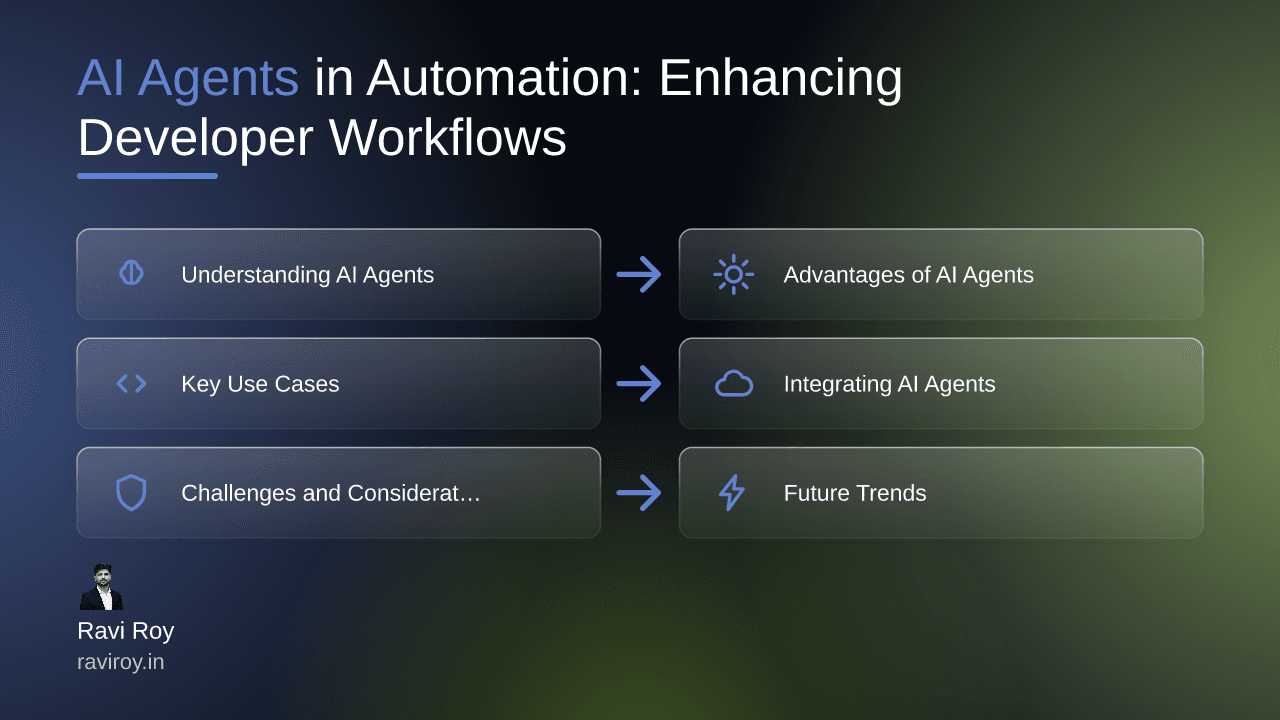
Understanding AI Agents
What Are AI Agents?
AI agents are specialized software programs designed to perform tasks autonomously by mimicking human decision-making capabilities. Their primary purpose in automation is to streamline processes, eliminate repetitive tasks, and enhance overall efficiency in various workflows. By leveraging machine learning and artificial intelligence, these agents can analyze data, recognize patterns, and execute tasks that traditionally require human intelligence.
The scope of AI agents is vast, impacting industries ranging from customer service to software development. In particular, in developer workflows, these agents alleviate the manual burden, allowing developers to focus on higher-level tasks.
Types of AI Agents
AI agents can be categorized into three primary types: reactive, proactive, and hybrid.
Reactive Agents: These agents respond to specific stimuli in their environment. They operate based on predefined rules, executing tasks when conditions are met. While effective for straightforward, routine assignments, they lack the ability to predict future needs.
Proactive Agents: In contrast, proactive agents anticipate future demands. They analyze past behavior to predict what actions are required next, enabling a more intelligent approach to task management. This forward-thinking capability allows them to prepare solutions before a problem arises.
Hybrid Agents: Combining elements of both reactive and proactive agents, hybrid models are the most versatile. They can adapt to immediate tasks while also planning for future needs, creating a balance between responsiveness and foresight.
The Advantages of Using AI Agents in Developer Workflows
Improved Efficiency
One of the most significant advantages of incorporating AI agents in developer workflows is the notable improvement in efficiency. By automating repetitive tasks such as code formatting, testing, and deployment, AI agents free up developers’ time, allowing them to concentrate on more complex and creative aspects of software development.
For instance, AI-powered code linters can automatically enforce coding standards and best practices. This not only speeds up the coding process but also reduces potential errors, saving teams from time-consuming debugging sessions. As a result, projects can progress faster, enabling teams to meet deadlines without sacrificing quality.
Enhanced Collaboration
AI agents also facilitate enhanced collaboration within development teams. By automating communication and documentation processes, teams can stay aligned and focused on their objectives. Tools integrated with AI capabilities can automatically update team members on project changes or tasks, ensuring that everyone is on the same page.
Additionally, these agents can analyze team dynamics and suggest optimal pairs or groups for specific projects. For example, platforms like GitHub leverage AI to highlight contributors based on code changes, making it easier for teams to collaborate efficiently.
Key Use Cases of AI Agents in Developer Workflows
Automated Code Reviews
One of the most practical use cases for AI agents in developer workflows is automated code reviews. Tools like SonarQube use AI algorithms to assess code quality, detecting vulnerabilities and suggesting improvements. By automatically scanning code for issues, these agents help maintain high standards and can significantly reduce the load on human reviewers.
For instance, an AI-powered review might highlight complex functions that are prone to error or style inconsistencies. This not only enhances code quality but also educates developers on best practices over time, creating a learning feedback loop.
Intelligent Bug Fixing
AI agents excel in identifying bugs and suggesting fixes quickly, far exceeding the traditional manual process. Tools such as DeepCode analyze code repositories and offer real-time recommendations on potential errors. By providing contextual advice based on patterns learned from vast datasets, these agents can assist developers in resolving issues more efficiently.
In a real-world scenario, imagine a developer struggling with an error related to an obscure API integration. An AI agent can quickly analyze the issue, reference documentation, and present potential fixes — drastically reducing the time to resolution.
Integrating AI Agents into Your Development Process
Choosing the Right AI Agent
Selecting the right AI agent for your development team is essential to maximizing its benefits. Factors to consider include the specific needs of your workflow, the complexity of tasks involved, and the compatibility of the AI tool with your existing technology stack.
For instance, if your team frequently engages in code reviews, opting for a tool focused on language syntax and structure would be advantageous. On the other hand, if the primary challenge lies in collaboration, a proactive agent that can facilitate communication might be more suitable.
Implementation Steps
Integrating AI agents into your development process doesn’t have to be overwhelming. Here’s a simplified step-by-step guide:
Identify Pain Points: Begin by analyzing your current workflow to pinpoint areas that consume excessive time or resources.
Research Options: Gather information on various AI agents that could address your specific pain points. Look into reviews and case studies for insight into effectiveness.
Run Pilot Tests: Before a full rollout, test a selected AI agent with a small team. This allows for evaluating performance without a complete commitment.
Gather Feedback: Collect feedback from team members on their experiences with the agent. This can help identify improvements or adjustments needed.
Gradual Integration: Once validated, gradually integrate the AI agent across the team, ensuring ongoing support and training.
Challenges and Considerations When Using AI Agents
Data Privacy and Security
Implementing AI agents raises important data privacy and security considerations. Given that these agents often require access to sensitive information to function optimally, it is crucial to ensure that your organization adheres to best practices for data protection.
For instance, ensure robust encryption methods are in place for any data processed by AI tools, and regularly audit your AI systems for compliance with regulations such as GDPR. Additionally, educating your team about safeguarding data when interacting with AI agents is essential.
Mitigating Bias in AI
Bias in AI models can lead to unintended consequences, particularly in decision-making processes. To address this challenge, it’s vital to actively work on strategies that promote fairness. This includes diversifying the data used to train AI systems and consistently monitoring outputs for bias.
Involving a diverse group of engineers and stakeholders during the deployment phase can also provide various perspectives, helping catch potential biases before they impact the development process.
Future Trends of AI Agents in Software Development
Predictions for AI in Development
As we propel into the future, AI agents are poised to dramatically reshape the landscape of software development. One prediction lies in the idea that these agents will become more sophisticated, capable of understanding context and delivering insights beyond mere code suggestions.
In the next decade, we might see AI agents serving as collaborative partners that not only suggest code improvements but also help architect entire systems based on project goals and constraints.
Evolving Roles of Developers
With the rise of AI agents, the role of developers will inevitably evolve. Rather than focusing solely on writing code, developers will transition into more strategic roles — overseeing AI agents, fine-tuning them, and ensuring that they align with project objectives.
Furthermore, as new AI tools emerge, developers will need to acquire skills that help them interpret AI outputs and integrate these insights into their workflows effectively.
How have AI agents impacted your own development process? Share your experiences and insights!
💬 Join the conversation — share your take in the comments and tell us what you’d add.