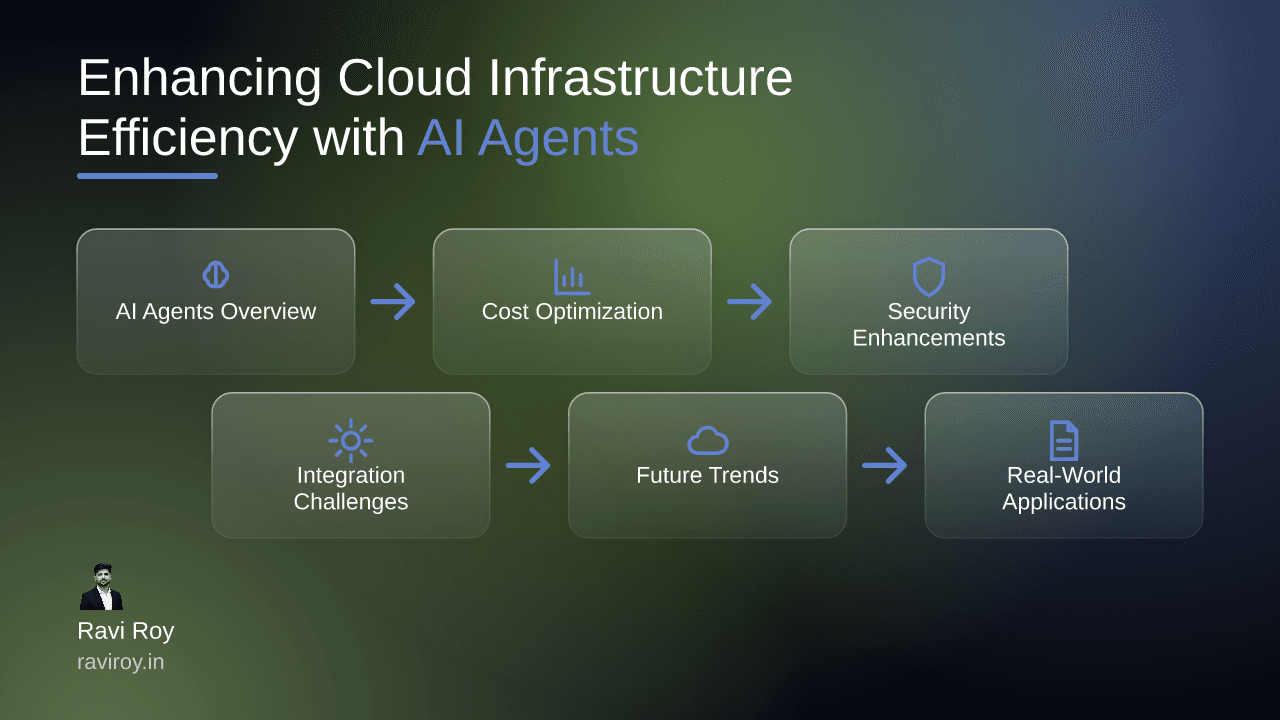
What Are AI Agents and Their Role in Cloud Infrastructure?
Defining AI Agents
Imagine a digital workforce that tirelessly automates tasks, reduces errors, and enhances efficiency. Enter AI agents—automated software designed to perform a variety of tasks through machine learning and artificial intelligence. These agents can range from simple chatbots to complex systems capable of making independent decisions based on data analysis. In cloud infrastructure, they're revolutionizing operational processes by automating routine tasks, improving efficiency, and allowing human operators to focus on higher-level strategic initiatives.
How AI Agents Function in the Cloud
AI agents work by harnessing vast amounts of data stored in the cloud, analyzing it to identify patterns, and then acting on that analysis. They rely on machine learning algorithms—often powered by neural networks—that allow them to learn from user interactions and adapt over time. The role of AI agents in automating tasks such as server provisioning, load balancing, and even data backups cannot be overstated. By taking over monotonous chores, they free up time for human staff to engage in more creative problem-solving, effectively transforming the workforce landscape.
Optimization of Cloud Infrastructure Through AI Agents
Cost Optimization Strategies
One of the most compelling advantages of employing AI agents in cloud operations is their ability to optimize costs. For instance, these agents can analyze usage patterns and suggest the most cost-effective configurations for cloud resources, adjusting them in real-time. Consider a cloud service provider that utilizes AI to monitor workload fluctuations. By automatically scaling resources up and down, such AI agents can significantly reduce wasted spending, translating to tangible savings in monthly bills.
For example, a large e-commerce platform experienced seasonal fluctuations. By integrating AI agents, they automated their scaling processes, ensuring they only paid for additional servers during peak times. This resulted in a 40% reduction in operational costs over a fiscal year.
Resource Allocation and Management
Efficient resource allocation becomes easier with the implementation of AI agents that can analyze both current and historical data. By integrating AI into cloud management systems, companies can ensure that resources are allocated based on real-time needs rather than historical guesswork. This leads to optimal utilization, thus avoiding over-provisioning or under-utilization of resources.
AI-driven resource management is exemplified through case studies highlighting companies that have effectively used AI agents to analyze trends in cloud consumption. These organizations can dynamically adjust their resources based on predictive analytics, which ultimately keeps costs low while maintaining performance.
The Role of AI Agents in Enhancing Cloud Security
Proactive Threat Detection
AI agents are increasingly being utilized to enhance cloud security through proactive threat detection. Leveraging machine learning, these agents can process millions of data points to identify unusual activity that may indicate a security breach. Instead of waiting for a human to recognize a threat, AI agents can spot anomalies in real-time and initiate containment measures even before an attack escalates.
For instance, an organization faced a security breach where an unrecognized login pattern was detected by an AI agent. This agent alerted the security team and helped to mitigate the breach before data could be compromised.
Anomaly Detection Mechanisms
Anomaly detection is a crucial part of maintaining security in cloud infrastructure. AI agents employ various algorithms, such as clustering and classification, to categorize normal and abnormal behavior. By training on historical data, these agents learn what "normal" looks like and can flag irregularities instantly. Such mechanisms not only bolster security but also provide valuable insights for future improvements in cloud architecture.
Real examples abound where effective anomaly detection has thwarted potential security incidents. Companies that adopted AI agents for this purpose reported an increase in threat mitigation efficiency by as much as 60%, underscoring the importance of machine learning in modern cyber defense strategies.
Challenges of Integrating AI Agents into Cloud Operations
Technical Constraints
While the benefits of AI agents are clear, integrating them into existing cloud operations presents significant challenges. Technical constraints often include compatibility issues with legacy systems and the high costs associated with implementing new technologies. Furthermore, many companies lack the necessary expertise to deploy and maintain such advanced systems.
For example, a retail company that attempted to integrate AI agents faced significant pushback from their existing IT infrastructure, which was unable to support the new technologies without substantial overhaul.
Cultural and Organizational Resistance
Beyond technical hurdles, cultural and organizational resistance often hampers the adoption of AI agents. Employees may be apprehensive about job displacement or may view AI as a threat rather than a tool for collaboration. Therefore, addressing these concerns is vital for a successful implementation.
Solutions such as comprehensive training programs can alleviate fears and encourage acceptance. Some organizations have successfully involved employees in the AI integration process, allowing them to see firsthand the benefits and new opportunities that AI agents create.
Future Trends: Agentic Cloud Operations and Frontier Agents
Emerging Trends in AI Agents
With AI technology continuously evolving, several emerging trends stand to reshape how AI agents function in cloud environments. For instance, the integration of natural language processing (NLP) in AI agents will further enhance their interactive capabilities, allowing them to communicate more intuitively with users. Meanwhile, advancements in deep learning are expanding the potential roles that AI agents can fulfill, from analytics to creative tasks.
Potential of Frontier Agents
Looking ahead, the concept of "frontier agents" is gaining traction. These agents will not only manage tasks but also take on more complex problem-solving roles that require long-term strategic thinking. Unlike current AI agents, frontier agents will be capable of performing extended decision-making processes in environments fraught with uncertainty.
The implications of frontier agents could be revolutionary as they might enable businesses to automate entire workflows from end to end, transforming cloud infrastructure management as we know it.
Real-World Applications of AI Agents in Cloud Environments
Case Studies of Successful Implementations
Real-world applications abound for AI agents, with numerous case studies showcasing their successful implementation. One notable example is a financial services firm that adopted AI agents for risk assessment. By analyzing vast amounts of transactional data, the agents provided real-time insights that enabled swift decision-making, significantly improving operational efficiency.
Small Business Use Cases
Small businesses, too, can leverage AI agents to enhance their cloud infrastructure. From managing customer relations to automating billing processes, AI agents offer solutions that are often cost-prohibitive for smaller organizations to manage manually. Feedback from small businesses indicates that those utilizing AI-driven cloud services have seen improvements in both operational efficiency and customer satisfaction.
In one instance, a small online retailer implemented AI agents to manage inventory and customer interactions, leading to a 30% increase in sales due to improved response times and better inventory management.
What has been your experience with AI agents in cloud infrastructure? Share specific examples or challenges you’ve encountered.
💬 Join the conversation — share your take in the comments and tell us what you’d add.