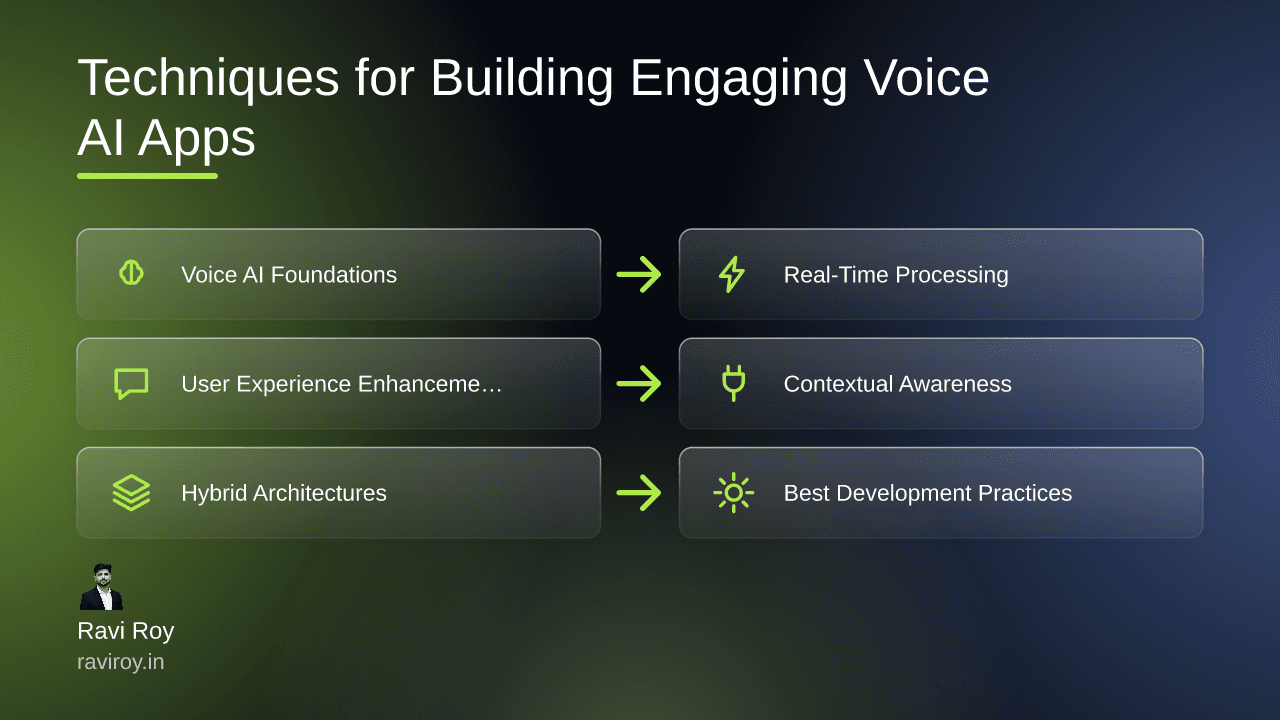
Understanding the Foundations of Voice AI
Creating compelling Voice AI applications begins with a robust understanding of the fundamental technologies involved. Mastering these core elements is essential for anyone looking to engage users effectively.
Key Technologies in Voice AI
Voice AI revolves around key technologies such as Automatic Speech Recognition (ASR) and Text-to-Speech (TTS).
Automatic Speech Recognition (ASR): This technology transforms spoken language into text. In practical terms, ASR interprets user commands or queries in real-time. Its effectiveness largely dictates the accuracy and responsiveness of the Voice AI application. For instance, enhancing the acoustic model used in ASR can significantly improve recognition rates, especially in noisy environments.
Text-to-Speech (TTS): TTS systems convert text into spoken language, making interactions feel more natural. Choosing a high-quality TTS engine is vital to ensure nuanced and emotionally resonant replies. Recently, advancements in neural synthesis have made TTS voices sound remarkably human, a must-have for creating engaging user experiences.
The Role of Large Language Models (LLMs)
Large Language Models (LLMs) are game-changers in voice applications. They provide improved contextual understanding and generation capabilities. Unlike traditional models, LLMs are trained on vast datasets, allowing them to generate sophisticated and contextually appropriate responses.
For instance, utilizing an LLM can enhance a Voice AI's ability to maintain context over multi-turn conversations. This contextual awareness can lead to a smoother user journey, as users no longer need to reintroduce topics in ongoing discussions. Companies implementing LLMs report increased user satisfaction due to the AI's capability to understand context deeply and generate relevant follow-up questions or statements.
Real-Time Processing and Latency Challenges
In the world of Voice AI, speed is everything. Real-time processing becomes a pivotal factor in ensuring a smooth user experience.
Achieving Sub-Second Latency
Real-time processing allows for immediate interaction, which is crucial for user engagement. Latency metrics directly impact how users perceive responsiveness. A response time exceeding a second can lead to frustration and disengagement.
Implementing technologies that facilitate sub-second latency often involves optimizing signal processing pathways and leveraging faster data transmission techniques. For example, a recent study showed that applications utilizing edge computing drastically cut down response times, allowing processing to occur closer to the user rather than relying solely on distant cloud servers.
Techniques for Reduced Latency
To tackle latency, several strategies can be implemented:
Edge Computing: This method shifts some processing tasks from the cloud to local devices. By processing data closer to the user, it minimizes delays.
Optimized Algorithms: Redesigning algorithms to reduce the complexity of processing tasks can lead to significant performance improvements. Techniques like model pruning and quantization offer viable solutions by reducing the computational load without sacrificing accuracy.
Enhancing User Experience with Emotional Intelligence
The heart of user engagement lies in emotional resonance. Voice AI applications equipped with emotional intelligence provide a deeper connection with users.
Sentiment Detection in Voice AI
Integrating sentiment detection into voice interactions enables the AI to gauge a user's emotional state. This capability can transform generic responses into tailored interactions. Key methodologies involve:
Natural Language Processing (NLP): Using NLP algorithms to assess the emotional tone of user inputs can allow the system to respond appropriately.
For example, if a user expresses frustration, the application might recognize this and respond with empathy, altering the course of the dialogue positively.
Personalizing Responses Based on Emotion
Once sentiment detection is in place, personalizing responses becomes feasible. This involves configuring your system to adjust its communication style based on identified emotions.
Practical implementation might include:
Dynamic Response Libraries: Create a set of responses tailored to various emotional states. For instance, a happy user might receive upbeat and encouraging responses, while a frustrated user is greeted with understanding and supportive language.
Feedback Mechanisms: Encourage users to provide feedback on the AI's emotional responses, allowing continuous improvement in understanding and engagement.
Contextual Awareness in Voice AI Applications
The capability of an AI to understand context significantly enhances its interactions with users.
Building Contextual Understanding
A Voice AI's ability to maintain context through conversations can radically improve user interactions. Contextual awareness allows the AI to remember past interactions, tailor its responses accordingly, and reduce frustration caused by repetitive questioning.
In practice, developers can implement context-tracking mechanisms that log user interactions and preferences, creating a more personalized experience over time. For example, if a user frequently asks about cooking, the AI can recommend new recipes based on previous interactions.
Examples of Context-aware Voice AI
Several companies have already successfully integrated contextual awareness into their Voice AI applications.
Amazon Alexa learns from past user behavior, suggesting routines and integrations based on previous commands.
Google Assistant utilizes context to enhance its search capabilities, ensuring that follow-up questions are relevant to the discourse.
These advancements indicate the efficacy of context-aware systems in driving user satisfaction and engagement.
Exploring Hybrid Architectures for Voice AI
Adopting hybrid architectures can be a game changer for Voice AI applications, optimally blending cloud-based and edge components.
Benefits of Hybrid Solutions
Hybrid solutions offer versatility by balancing the extensive capabilities of cloud computing with the immediate responsiveness of edge processing. This model can lead to improved performance in terms of speed, efficiency, and scalability.
For example, data processing tasks that require large datasets can be managed in the cloud, while everyday user interactions can be executed at the edge for low latency.
When to Use Hybrid Architectures
Hybrid architectures shine in scenarios requiring a combination of high processing power and real-time responsiveness. Applications that anticipate fluctuating demand or that require high availability can greatly benefit.
Customer Service Bots: These bots can handle massive scale during peak hours while reducing latency during casual conversations.
Smart Home Devices: Such devices benefit from real-time processing for immediate user interactions while maintaining the option to access more complex functions via cloud support.
Spatial Awareness and Multi-Speaker Environments
Creating a seamless experience in multi-speaker environments is a significant challenge for Voice AI applications. Spatial awareness becomes crucial for effective user interactions.
Implementing Spatial Awareness Features
Spatial recognition techniques allow a Voice AI application to differentiate between multiple speakers. This necessitates implementing robust audio processing algorithms capable of discerning location-based audio signals.
For instance, integrating beamforming technology can help isolate voices based on source direction, enhancing the system's ability to respond accurately to multiple users within the same vicinity.
Challenges in Multi-Speaker Interactions
Handling simultaneous user inputs presents unique challenges, particularly in accurately addressing multiple requests. Effective strategies involve establishing rules for priority responses or using a queuing system that allows users to speak one at a time.
By designing responses that clarify user intent, applications can reduce the noise created in multi-user environments, improving the overall user experience.
Best Practices for Developing Advanced Voice Agents
To create top-notch Voice AI applications, adhering to best practices is essential.
Designing User-Centric Voice Interfaces
User-centric design should place the user experience at its core. Key considerations include:
Intuitive Dialogue Flow: Ensuring that conversations feel natural and intuitive goes a long way in enhancing engagement.
Accessibility Features: Implementing features that cater to diverse user needs, such as voice modulation and language options, broadens user accessibility.
Iterative Testing and User Feedback
Continuous improvement through iterative testing is vital. Gathering user feedback through A/B testing and usability studies can shed light on how effectively your Voice AI meets expectations.
Establish user feedback channels specific to voice interactions, as they differ significantly from traditional interfaces. Incorporating user suggestions can lead to decisive adjustments, enhancing engagement levels considerably.
Conclusion
Advanced techniques in Voice AI are paving the way for applications that not only respond but also engage and understand users on a deeper level. By integrating cutting-edge technologies and adopting user-focused strategies, developers can significantly enhance user experiences in voice-driven applications.
What advanced techniques have you implemented in your Voice AI projects that improved user engagement?
💬 Join the conversation — share your take in the comments and tell us what you’d add.